Rescue Operations from Scam Centers in Southeast Asia
Source:Indian Express ↗
Why It Matters
The emergence of transnational scam centers in Southeast Asia represents a complex intersection of cybercrime and human trafficking. It underscores the challenges of policing organized crime across borders and highlights the essential role of Indian diplomatic missions in ensuring the safety of citizens overseas.
Summary
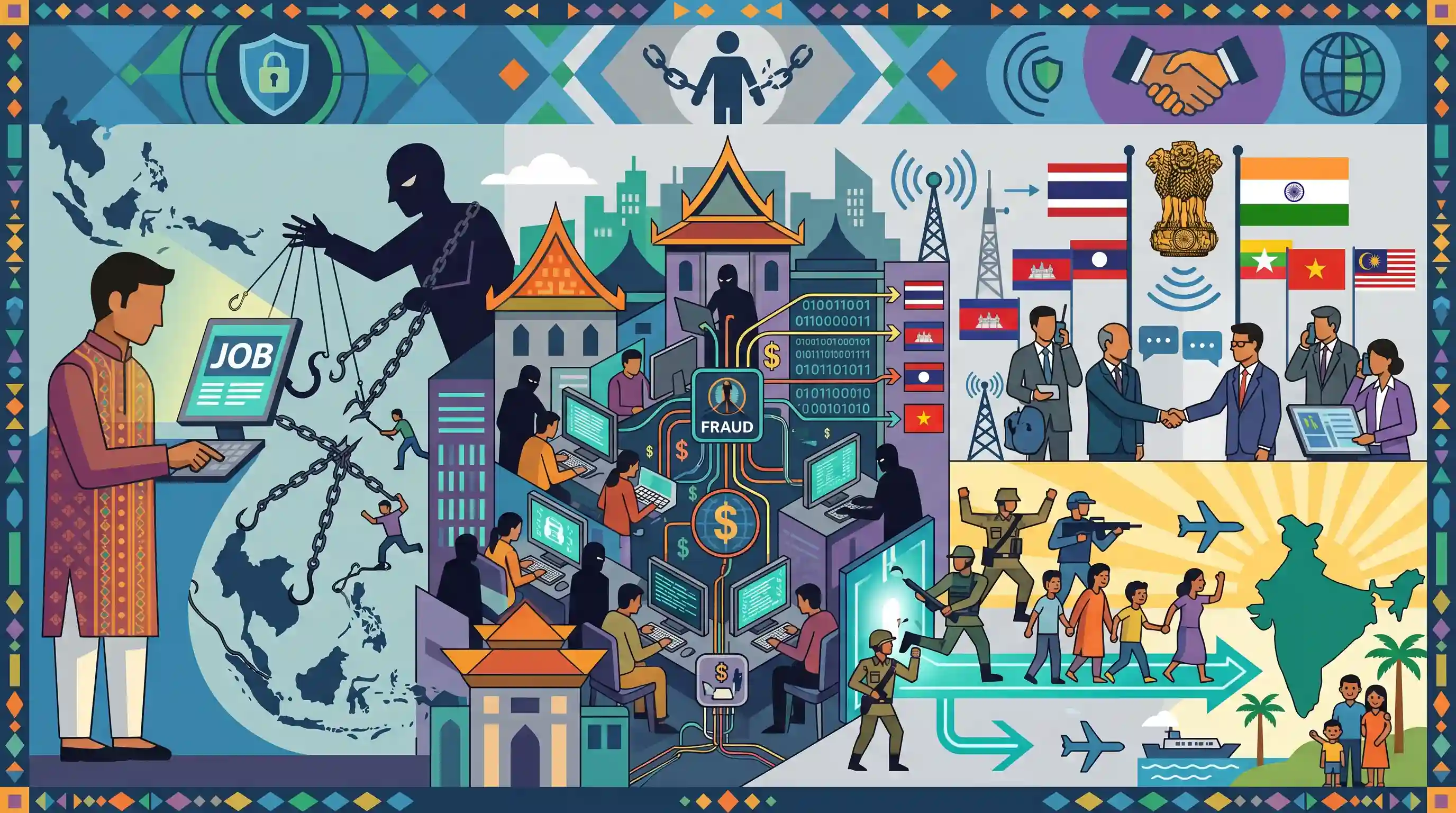
According to government data, 2,471 Indians have been rescued from fraudulent scam centers across Southeast Asian countries between 2022 and 2025. These centers, often operating as transnational organized crime networks, lure individuals with fake job offers and force them into carrying out cyber fraud activities. The Ministry of External Affairs (MEA) and Indian missions have actively coordinated with host governments in the region to facilitate these rescue operations and repatriate the victims. This highlights the growing security threat of international cybercrime syndicates and human trafficking, as well as the critical importance of diplomatic intervention to protect Indian citizens abroad.
Key Points
- Rescue Operations: The Indian government successfully facilitated the rescue and repatriation of 2,471 citizens trapped in fraudulent scam centres in Southeast Asia between 2022 and 2025.
- Modus Operandi: Transnational organized crime syndicates use fake job offers to traffic individuals abroad, subsequently forcing them to execute cyber scams and financial fraud under duress.
- Diplomatic Intervention: The Ministry of External Affairs (MEA) and Indian missions play a critical role in coordinating with host governments to secure the release of trapped citizens.
- Regional Hotspots: These illegal cyber fraud operations are predominantly based in Southeast Asian nations, exploiting regional law enforcement gaps.
Important Terms
Ministry of External Affairs (MEA)

The central government body responsible for India's foreign policy, diplomatic representation, and the welfare of Indian citizens and the diaspora living overseas.
UPSC context
GS Paper 2 (International Relations); tests knowledge of India’s diplomatic machinery and global citizen protection.
Transnational Organized Crime (TOC)
Coordinated criminal activities that operate across national borders, involving networks engaged in human trafficking, drug smuggling, or cyber fraud to generate illicit profits.
UPSC context
GS Paper 3 (Internal Security); examines linkages between organized crime and international security challenges.
Human Trafficking
The recruitment, transportation, or receipt of persons through force or deception for exploitation, such as forced labor, modern-day slavery, or sexual services.
UPSC context
GS Paper 2 (Social Justice) and GS Paper 3 (Security); critical human rights and security issue.
Cyber Fraud
Deceptive acts conducted via the internet or digital communication to illegally obtain money, assets, or sensitive information from victims.
UPSC context
GS Paper 3 (Security/Cybersecurity); covers evolving digital threats and the role of technology in crime.
Repatriation
The process of returning a person—voluntarily or through government intervention—to their country of origin or citizenship, often involving diplomatic coordination.
UPSC context
GS Paper 2 (Consular Services); relates to India’s responsibility towards its citizens in distress abroad.
Indian Cyber Crime Coordination Centre (I4C)
A specialized unit under the Ministry of Home Affairs (MHA) that provides a framework for law enforcement agencies to coordinate the fight against cybercrime.
UPSC context
GS Paper 3 (Security/Cybersecurity); essential for understanding institutional responses to modern digital threats.
Prelims Trap
The Indian Cyber Crime Coordination Centre (I4C) operates under the Ministry of External Affairs.
I4C operates under the Ministry of Home Affairs (MHA). While the MEA handles diplomatic rescues, cyber-tracking and internal coordination are strictly MHA domains.
Static Concepts Connected
What is the UN Convention against Transnational Organized Crime (UNTOC)?
- UNTOC Mandate: Adopted in 2000, it is the primary global instrument fighting transnational organized crime, binding states to criminalize severe transnational offenses.
- Palermo Protocols: Supplemented by three protocols addressing human trafficking, migrant smuggling, and illicit firearms. India ratified UNTOC and these protocols in 2011.
How does the Indian Cyber Crime Coordination Centre (I4C) function?
- MHA Nodal Body: Established under the Ministry of Home Affairs (MHA) to coordinate a comprehensive response to cybercrime, including operating the National Cybercrime Reporting Portal.
- Financial Fraud Tracking: Manages the Citizen Financial Cyber Fraud Reporting system, helping freeze defrauded funds and track complex financial trails like 'pig butchering' scams.
Cross-Topic Patterns
Golden Triangle: Drugs to Cybercrime
The infamous Golden Triangle (Myanmar, Laos, Thailand) is pivoting from drug trafficking to fortified cyber-scam compounds, exploiting unstable border enclaves like Myawaddy to trap regional IT workers.
Emigration Act & Unregistered Agents
Rampant trafficking of IT professionals highlights the limitations of policing unregistered recruitment agents under the Emigration Act 1983, accelerating the need for a modernized Emigration Bill to protect job seekers.

Expect a 2026 GS-3 question linking transnational organized crime to cyber-slavery, or a prelims geography question on SE Asian scam hubs.
Linked PYQs · 4
Linked PYQs · 4
- 2022MainsGS3
Discuss the types of organised crimes. Describe the linkages between terrorists and organised crime that exist at the national and transnational levels.
- 2020MainsGS3
Discuss different types of cyber crimes and measures required to be taken to fight the menace.
- 2017MainsGS2
Indian diaspora has an important role to play in South-East Asian countries' economy and society. Appraise the role of Indian diaspora in South-East Asia in this context.
- 2019PrelimsGS1
Consider the following statements: 1. The United Nations Convention against Corruption (UNCAC) has a 'Protocol against the Smuggling of Migrants by Land, Sea and Air'. 2. The UNCAC is the ever-first legally binding global anti-corruption instrument. 3. A highlight of the United Nations Convention against Transnational Organized Crime (UNTOC) is the inclusion of a specific chapter aimed at returning assets to their rightful owners from whom they had been taken illicitly. 4. The United Nations Office on Drugs and Crime (UNODC) is mandated by its member States to assist in the implementation of both UNCAC and UNTOC. Which of the statements given above are correct?
