Airport Transit Visa Exemption for Indians in France
Source:Indian Express ↗
Why It Matters
The easing of transit visa regulations reflects India's growing diplomatic clout and the strengthening of strategic partnerships with major European powers. It has direct relevance to GS Paper II topics regarding bilateral agreements involving India's interests and policies affecting the Indian diaspora.
Summary
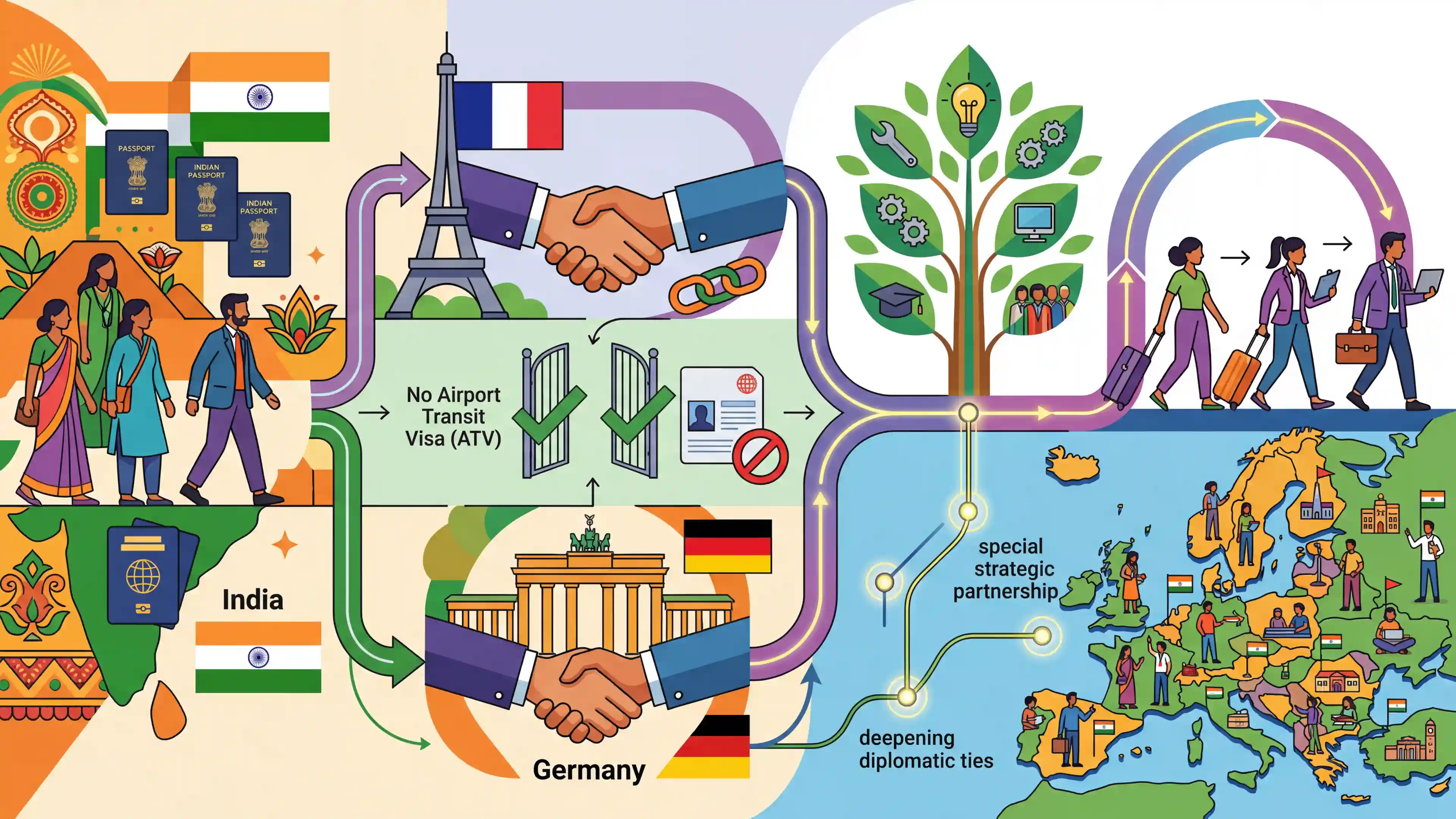
Indian nationals holding ordinary passports are now exempt from requiring Airport Transit Visas (ATV) for layover flights passing through France and Germany. The French exemption, effective April 10, 2026, follows a similar decision by Germany earlier in the year. The move signals deepening diplomatic ties and aligns with the recently elevated "special global strategic partnership" between India and France. It underscores both nations' commitments to expanding skills and talent mobility as articulated in the India-France Migration and Mobility Partnership Agreement and the Young Professional Scheme.
Key Points
- Indian nationals holding ordinary passports no longer require an Airport Transit Visa (ATV) for layovers in France or Germany.
- The French visa exemption took effect on April 10, 2026, following a similar exemption announced by Germany in January 2026.
- The decision reflects the strengthening of diplomatic ties, particularly the "special global strategic partnership" affirmed during President Macron's visit to India in February 2026.
- This move aligns with broader efforts to enhance talent and skills mobility between India and France under the Migration and Mobility Partnership Agreement and the Young Professional Scheme.
Important Terms
Special Global Strategic Partnership (India-France)

A diplomatic status granted to India-France relations in 2026, transitioning from a "buyer-seller" model to deep co-development in defense, technology, and space while ensuring regional stability.
UPSC context
GS-II: Bilateral agreements. Tests knowledge of diplomatic evolution and strategic alignment with key Western partners.
Horizon 2047 Roadmap
A 25-year bilateral roadmap adopted in 2023 to guide India-France cooperation in security, technology, and sustainable development leading up to the centenary of India’s independence.
UPSC context
GS-II: International relations. Tests understanding of long-term strategic visions and sectoral cooperation goals.
Migration and Mobility Partnership Agreement (MMPA)
A bilateral framework designed to facilitate the legal movement of students, researchers, and professionals while strengthening cooperation against irregular migration and human trafficking.
UPSC context
GS-II: Indian Diaspora. Tests knowledge of legal frameworks governing talent mobility and diplomatic efforts to ease travel.
Young Professional Scheme (YPS)
A reciprocal program under the MMPA allowing professionals aged 18-35 to work in the host country for up to 24 months to enhance their career prospects.
UPSC context
GS-II: Effect of policies on India’s interests. Tests specific programs targeting the youth and workforce mobility.
Airport Transit Visa (ATV)
A visa allowing travelers to wait in an airport's international zone during layovers without entering the country; recently waived for Indians by France and Germany.
UPSC context
GS-II: Diaspora/Mobility. Tests practical diplomatic outcomes and their impact on the ease of international travel for Indians.
Strategic Autonomy
A shared diplomatic principle of India and France prioritizing independent decision-making and a multipolar world order, resisting the dominance of any single global power bloc.
UPSC context
GS-II: Foreign Policy. Tests foundational concepts guiding India’s external relations and its alignment with middle powers.
Prelims Trap
Indian ordinary passport holders now enjoy visa-free entry to France and Germany.
The exemption is strictly for Airport Transit Visas (ATV) during layovers. It does not grant visa-free entry into the Schengen area.
Static Concepts Connected
What is the historical significance of the India-France Strategic Partnership?
- First Western ally: France was the first Western nation to establish a Strategic Partnership with India, initiating it in 1998.
- Post-Pokhran support: Unlike other Western powers (like the US), France did not condemn or impose sanctions on India following the 1998 Pokhran-II nuclear tests.
- Core pillars: The partnership historically rests on three core pillars: defence, space, and civil nuclear cooperation, now expanding to AI and mobility.
What are the three main types of passports issued by India?
- Ordinary Passport: Dark blue cover (Type P for 'Personal'), issued to ordinary citizens for standard travel, such as tourism or business.
- Official Passport: White cover (Type S for 'Service'), issued to individuals representing the Indian government on official business.
- Diplomatic Passport: Maroon cover (Type D for 'Diplomatic'), issued to Indian diplomats, top-ranking government officials, and diplomatic couriers.
Cross-Topic Patterns
MMPAs and the Demographic Dividend
India's push for Mobility and Migration Partnership Agreements across Europe (France, UK, Germany, Italy) directly ties its diplomatic capital to its demographic dividend strategy and overseas remittance inflows.
Proliferation of Young Professional Schemes
UPSC often tests nuanced differences in bilateral schemes. Aspirants must distinguish the India-France Young Professional Scheme under its MMPA from the highly publicized India-UK YPS (which involves a ballot system).

Expect a Prelims matching question on India's recent Migration & Mobility Agreements (MMPA) or Young Professional Schemes by country.
Linked PYQs · 3
Linked PYQs · 3
- 2023MainsGS2
Indian diaspora has scaled new heights in the West. Describe its economic and political benefits for India.
- 2020MainsGS2
Indian diaspora has a decisive role to play in the politics and economy of America and European Countries'. Comment with examples.
- 2023MainsGS2
‘The expansion and strengthening of NATO and a stronger US-Europe strategic partnership works well for India.’ What is your opinion about this statement ? Give reasons and examples to support your answer.
