Precious metals ETF investments threaten current account deficit
Source:Indian Express ↗
Why It Matters
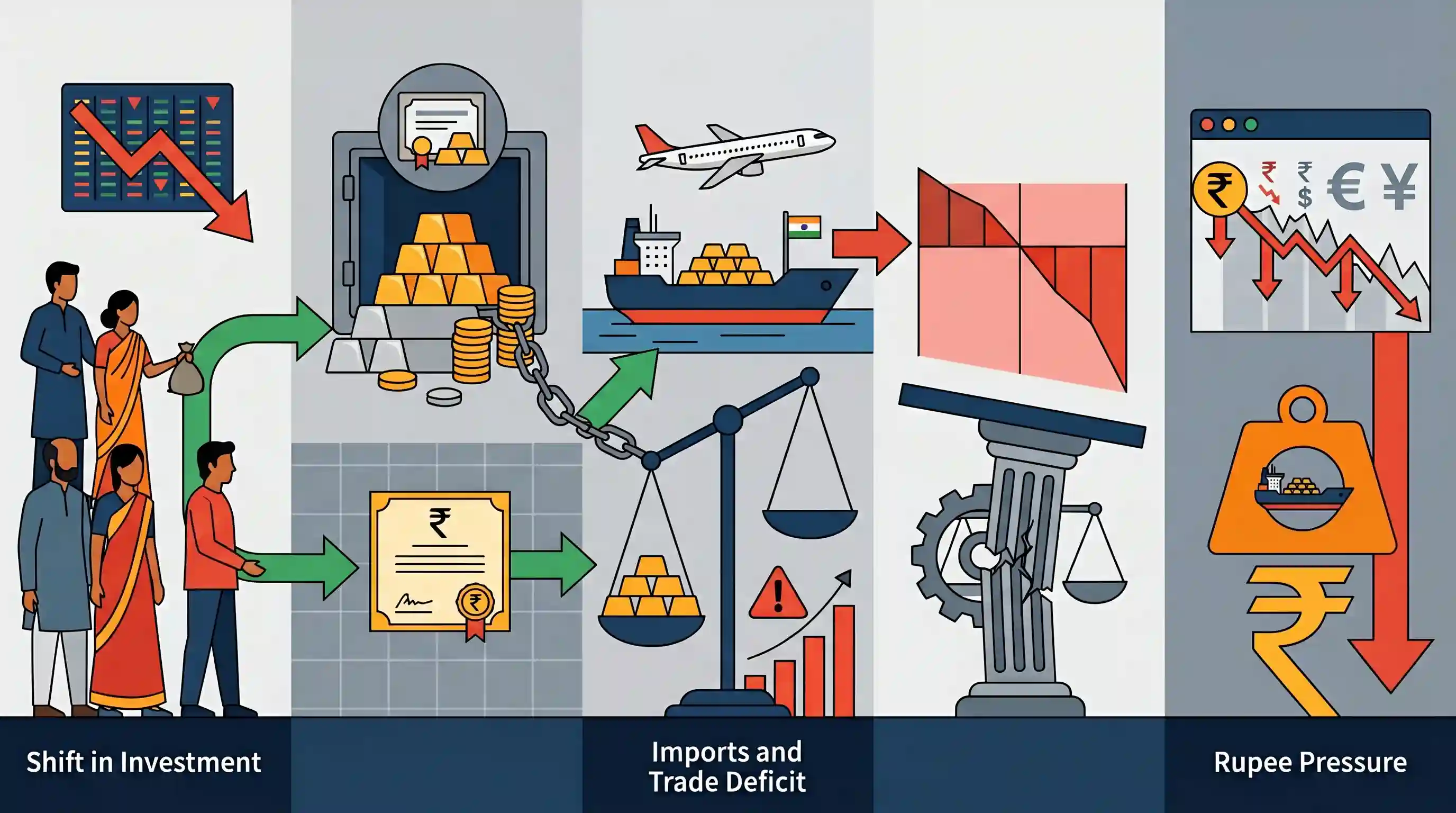
It highlights a critical paradox in the Indian economy: while the financialization of savings (via ETFs) is generally positive, investments in physically-backed commodity ETFs act as indirect imports, worsening the trade deficit and neutralizing the macro benefits of shifting away from physical assets.
Summary
Indian households are increasingly investing billions into Gold and Silver Exchange-Traded Funds (ETFs), pivoting away from traditional equities. While ETFs represent a form of financialization of savings, these specific instruments are backed by physical precious metals, necessitating massive imports. This surging demand has triggered a $35 billion trade deficit warning, straining India's macroeconomic stability by widening the Current Account Deficit (CAD). Unlike Sovereign Gold Bonds (SGBs) which do not require physical gold backing and thus save foreign exchange, the craze for physically-backed Gold/Silver ETFs inadvertently acts as physical gold imports, putting downward pressure on the external value of the Rupee.
Key Points
- Indian investors are heavily investing in Gold and Silver Exchange-Traded Funds (ETFs), moving capital away from equities.
- Although ETFs are financial instruments, Gold and Silver ETFs require 100% physical backing, meaning increased domestic demand directly forces massive imports of physical metals.
- This investment trend has triggered a $35 billion trade deficit warning, exerting pressure on India's Current Account Deficit (CAD) and macroeconomic stability.
- Unlike Sovereign Gold Bonds (SGBs), which are purely financial and save foreign exchange, the craze for physically-backed ETFs negates the macroeconomic benefits of financializing household savings.
Important Terms
Current Account Deficit (CAD)

The net difference between a country's total imports and exports of goods, services, and transfers. A wide CAD indicates the nation is a net borrower from the rest of the world.
UPSC context
GS Paper 3: Indian Economy. Vital for understanding Balance of Payments (BoP) stability and the Rupee's external value.
Sovereign Gold Bond (SGB) Scheme
Government securities denominated in grams of gold, issued by the RBI as a substitute for physical gold. They offer price appreciation plus a fixed annual interest (typically 2.5%).
UPSC context
GS Paper 3: Investment Models. Tests knowledge of non-physical gold investment tools and their impact on reducing imports.
Financialization of Savings
A structural shift where household savings move from physical assets (like gold and real estate) into financial instruments such as equities, mutual funds, and insurance.
UPSC context
GS Paper 3: Indian Economy & Growth. Highlighted in Economic Survey 2024-25 as a key trend for capital market deepening.
Exchange-Traded Funds (ETFs)
Marketable securities that track an index or commodity but trade like stocks on an exchange. 'Physical' gold/silver ETFs are backed by actual vaulted bullion, unlike synthetic versions.
UPSC context
GS Paper 3: Capital Markets. Important for distinguishing between traditional mutual funds and exchange-traded investment vehicles.
Gold Monetization Scheme (GMS)
A government initiative allowing individuals and institutions to deposit idle gold in banks to earn interest, aiming to reduce the country's reliance on gold imports.
UPSC context
GS Paper 3: Mobilization of Resources. Tests strategies for unlocking domestic idle assets to improve macroeconomic stability.
Prelims Trap
"Gold ETFs reduce physical gold imports because they are purely financial instruments."
Gold ETFs require 100% physical backing. Thus, high domestic demand for these ETFs directly forces fund houses to import physical metals, widening the CAD.
Static Concepts Connected
How do Sovereign Gold Bonds (SGBs) differ from Gold ETFs?
- Physical Backing: ETFs require 100% physical gold warehousing by fund houses, while SGBs are pure government-issued financial promises.
- Interest Payout: SGBs offer a fixed annual interest rate on the initial investment, whereas ETFs rely solely on the capital appreciation of gold prices.
- Macro Impact: ETFs increase physical imports and widen the CAD; SGBs mobilize household savings without draining foreign exchange.
How does physical Gold demand impact India's Balance of Payments?
- Trade Deficit: Gold is consistently one of India's largest merchandise imports, directly widening the trade deficit component of the Current Account.
- Currency Pressure: Massive gold imports require dollar payouts, draining forex reserves and putting depreciative pressure on the external value of the Rupee.
Cross-Topic Patterns
Financialization vs Capital Formation
A macroeconomic paradox: financializing savings into commodity ETFs leaks capital abroad via imports, unlike equities or corporate bonds which channel funds into domestic gross fixed capital formation (GFCF).
Gold imports and Imported Inflation
Rising CAD driven by gold imports depreciates the Rupee, which in turn escalates the cost of essential, price-inelastic imports like crude oil, directly feeding into imported inflation.

Expect a 2026 multi-statement question contrasting the BoP and capital formation impacts of Gold ETFs versus Sovereign Gold Bonds.
Linked PYQs · 4
Linked PYQs · 4
- 2015MainsGS3
Craze for gold in Indians has led to a surge in import of gold in recent years and put pressure on balance of payments and external value of rupee. In view of this, examine the merits of the Gold Monetization Scheme.
- 2016PrelimsGS1
What is/are the purpose/purposes of Government's 'Sovereign Gold Bond Scheme' and 'Gold Monetization Scheme'? 1. To bring the idle gold lying with Indian households into the economy 2. To promote FDI in the gold and jewellery sector 3. To reduce India's dependence on gold imports Select the correct answer using the code given below.
- 2024PrelimsGS1
Consider the following: 1. Exchange-Traded Funds (ETF) 2. Motor vehicles 3. Currency swap Which of the above is/are considered financial instruments?
- 2020PrelimsGS1
With reference to the international trade of India at present, which of the following statements is/are correct? 1. India's merchandise exports are less than its merchandise imports. 2. India's imports of iron and steel, chemicals, fertilisers and machinery have decreased in recent years. 3. India's exports of services are more than its imports of services. 4. India suffers from an overall trade/current account deficit. Select the correct answer using the code given below:
