Pakistan Rejects India Claims on Counter Terror Operations
Source:The Hindu ↗
Why It Matters
The diplomatic friction over counter-terrorism operations, the abeyance of the Indus Waters Treaty, and nuclear rhetoric underscore the volatile state of India-Pakistan relations. This is highly relevant for GS Paper 2 (Neighborhood Relations and International Treaties) and GS Paper 3 (Internal Security and Border Management), as it highlights the interplay between cross-border terrorism, water diplomacy, and strategic deterrence.
Summary
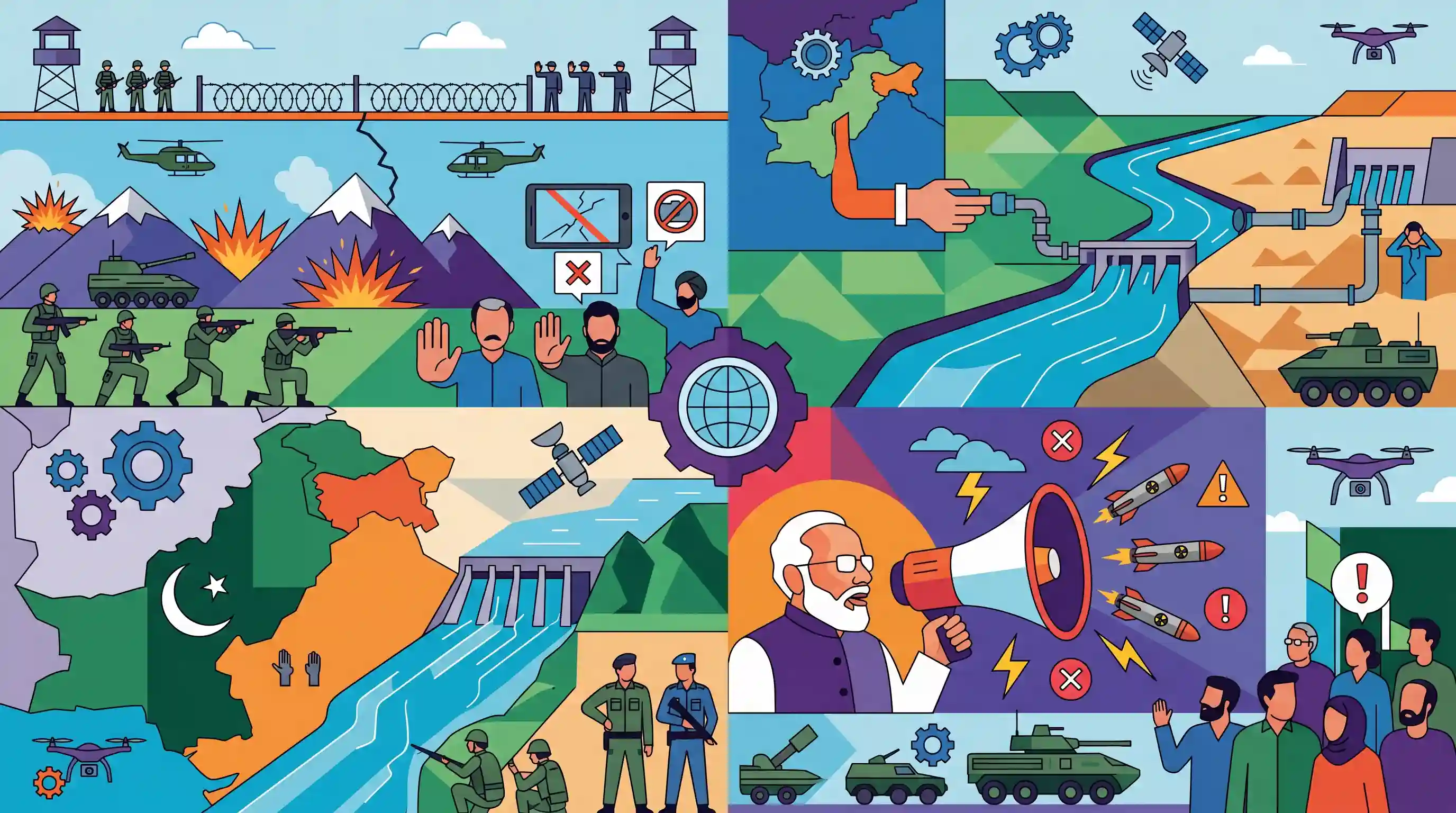
Pakistan has strongly refuted India's claims surrounding 'Operation Sindoor' and the neutralization of militants involved in the Pahalgam terror attack, describing the statements as 'fabrications' meant to justify Indian aggression. The Pakistani Foreign Office also condemned India's recent decision to place the Indus Waters Treaty in abeyance, framing it as a violation of international agreements and a threat to regional cooperation. Furthermore, Pakistan criticized the rhetoric of Indian leadership regarding 'nuclear blackmail,' viewing it as part of a strategy to secure regional dominance and escalate bilateral tensions.
Key Points
- Pakistan's Foreign Office rejected Indian claims regarding "Operation Sindoor," which India stated neutralized three Pakistani militants linked to the April 22 Pahalgam terror attack.
- Islamabad accused India of making fabrications to justify aggression and glorify conflict, referencing a previous cross-border escalation in May 2025 where it claimed to have successfully targeted Indian military assets.
- Pakistan criticized India’s decision to hold the Indus Waters Treaty in abeyance, interpreting it as a disregard for international treaties and a hindrance to regional cooperation.
- The Pakistani statement condemned what it termed a false narrative of "nuclear blackmail" from India's leadership, suggesting it is a pretext for asserting regional dominance.
Important Terms
Indus Waters Treaty

A 1960 World Bank-mediated water-sharing agreement allocating the Indus system's eastern rivers to India and western rivers primarily to Pakistan.
UPSC context
GS Paper II: International Relations and water diplomacy; crucial for India-Pakistan bilateral ties and regional stability.
Operation Sindoor
A 2025 Indian military response involving precision strikes on terrorist infrastructure in Pakistan-controlled territories following the Pahalgam terror attack.
UPSC context
GS Paper III: Security challenges and management in border areas; tests knowledge of India's 'zero-tolerance' counter-terrorism doctrine.
Nuclear Blackmail
The strategic use of nuclear threats by a state to deter conventional military retaliation or coerce an adversary.
UPSC context
GS Paper II: International relations and strategic affairs; concerns nuclear doctrine and regional security paradigms in South Asia.
Abeyance (Diplomatic Context)
The diplomatic status of a treaty or agreement being temporarily suspended or held in a state of inactivity rather than being permanently abrogated.
UPSC context
GS Paper II: Bilateral agreements and International Law; explores legal mechanisms for managing treaties during conflict.
Pahalgam Terror Attack
The April 2025 terrorist strike in Jammu and Kashmir that killed 26 civilians, triggering India’s military and diplomatic escalation.
UPSC context
GS Paper III: Internal security and the role of external state/non-state actors in cross-border terrorism.
Prelims Trap
"The World Bank acts as the official guarantor of the Indus Waters Treaty and can enforce binding penalties."
The World Bank is not a guarantor of the IWT. It is only a signatory for specific procedural roles (e.g., appointing a Neutral Expert) and cannot enforce compliance or penalize nations.
Static Concepts Connected
How are rivers allocated and disputes resolved under the Indus Waters Treaty (1960)?
- River Allocation: India has unrestricted use of Eastern rivers (Ravi, Beas, Sutlej). Western rivers (Indus, Jhelum, Chenab) are allocated primarily to Pakistan.
- India's Rights: India is permitted limited agricultural use and non-consumptive run-of-the-river (RoR) hydroelectric projects on the Western rivers.
- Dispute Mechanism: A three-tier process: Permanent Indus Commission (questions), Neutral Expert appointed by the World Bank (technical differences), and a Court of Arbitration (legal disputes).
What is the doctrine of 'rebus sic stantibus' in international law?
- Definition: Under Article 62 of the Vienna Convention on the Law of Treaties (VCLT), a state can suspend/withdraw from a treaty due to a "fundamental change of circumstances."
- Application to IWT: India cited this doctrine to place the IWT in "abeyance," arguing that Pakistan's persistent state-sponsored terrorism fundamentally altered the peaceful premise required to sustain the treaty.
Cross-Topic Patterns
Hydro-diplomacy as Counter-Terrorism
Suspending the IWT merges traditional water-sharing geography with internal security doctrines, shifting India's response to cross-border terror from purely kinetic actions to strategic resource denial.
Nuclear Doctrine vs. Proxy War
Pakistan's reliance on tactical nuclear weapons to deter India's conventional superiority creates a low-threshold nuclear umbrella, heavily relied upon to shield and embolden its state-sponsored proxy warfare in Kashmir.

Expect a multi-statement Prelims question linking VCLT's 'rebus sic stantibus', IWT's 3-tier dispute mechanism, and Western river rights.
Linked PYQs · 4
Linked PYQs · 4
- 2015MainsGS2
Terrorist activities and mutual distrust have clouded India-Pakistan relations. To what extent the use of soft power like sports and cultural exchanges could help generate goodwill between the two countries? Discuss with suitable examples.
- 2016MainsGS2
Increasing cross-border terrorist attacks in India and growing interference in the internal affairs of several member-states by Pakistan are not conducive for the future of SAARC (South Asian Association for Regional Cooperation)." Explain with suitable examples.
- 2012MainsGS2
The situation today is far different to that prevalent fifty years back when the Indus Water Treaty was signed." Highlight the complexity of the current challenges on both sides of the border in this regard. Do you think that a review of the Treaty is in India's best interests?
- 2025MainsGS3
Terrorism is a global scourge. How has it manifested in India? Elaborate with contemporary examples. What are the counter measures adopted by the State? Explain.
