Institutional Autonomy and State Priorities in Space Research
Source:The Hindu ↗
આ શા માટે મહત્વનું છે
The structural and administrative challenges facing ISRO are critical for UPSC Mains GS3 (Awareness in the fields of Space) and GS2 (Statutory, regulatory and various quasi-judicial bodies/Governance). It highlights the tension between commercialization, state control, and foundational R&D.
સારાંશ
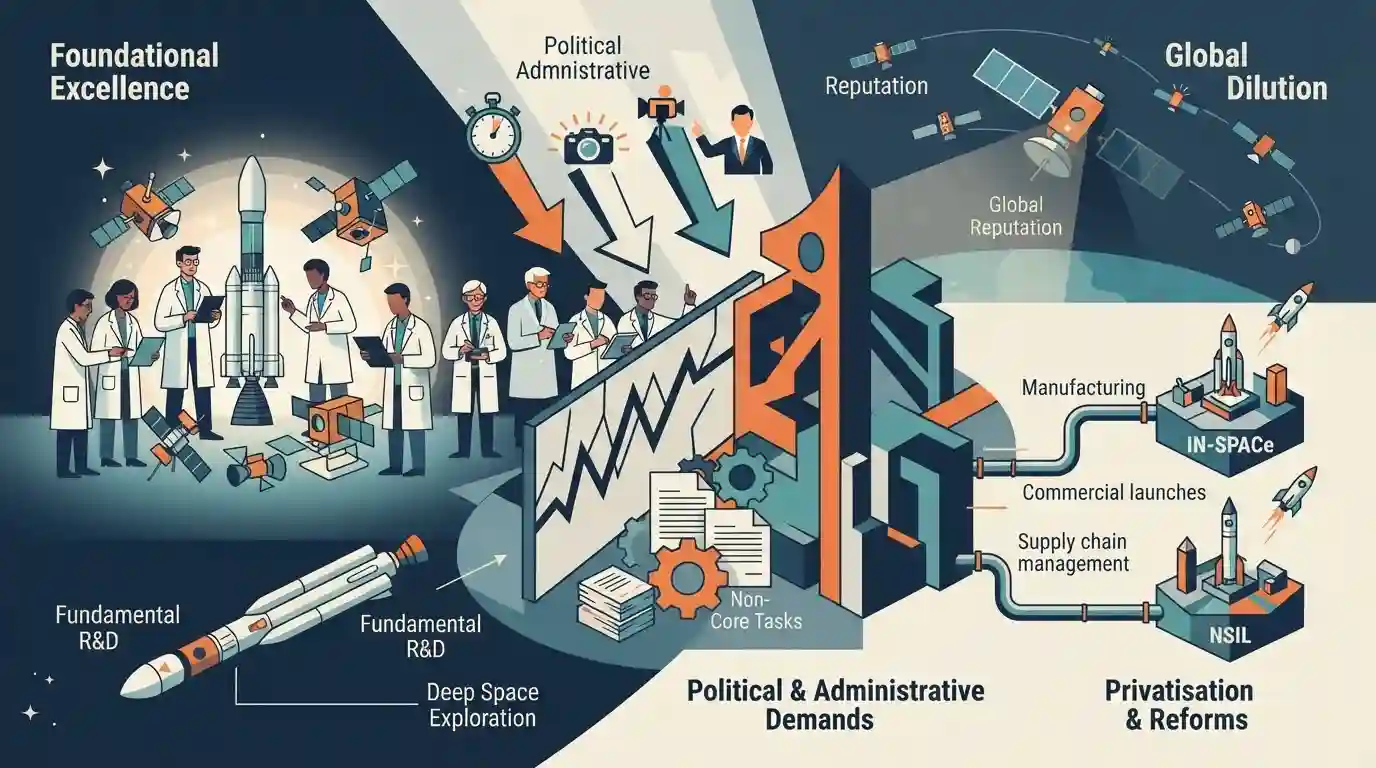
The article critically evaluates the institutional trajectory of the Indian Space Research Organisation (ISRO), arguing that state interference and shifting priorities are eroding its foundational excellence in space science. It highlights that while recent space sector reforms and the creation of entities like IN-SPACe and NSIL were meant to privatize routine operations, ISRO continues to bear the brunt of non-core administrative and political expectations. This diversion of focus away from fundamental R&D toward short-term, high-visibility milestones risks diluting ISRO's hard-won global reputation and hindering India's long-term capabilities in deep space exploration.
મુખ્ય મુદ્દા
- Shift in Priorities: ISRO's foundational focus on advanced space research and deep space exploration is being increasingly diluted by state demands for high-profile, politically motivated missions and routine commercial launches.
- Incomplete Institutional Offloading: Despite the creation of NSIL and IN-SPACe to handle commercialization and private sector integration, ISRO remains bogged down by administrative and operational tasks rather than focusing purely on R&D.
- Institutional Attrition: Bureaucratic constraints, inadequate focus on foundational science, and a lack of operational autonomy risk causing a drain of scientific talent and eroding the agency's global reputation.
- Need for Autonomy: To preserve its hard-won excellence, ISRO requires structural independence and a renewed mandate centered on fundamental scientific innovation rather than state-directed administrative goals.
મહત્વપૂર્ણ શબ્દો
Indian Space Policy 2023

A comprehensive policy framework approved in 2023 to reform India's space sector by defining the roles of ISRO, NSIL, and IN-SPACe, enabling full participation of private entities.
UPSC context
GS Paper III (Science & Technology); tests reforms, technology governance, and expanding India's share in the global space economy.
Indian Space Research Organisation (ISRO)
India's premier space agency under the Department of Space, responsible for advanced R&D, space exploration, and executing planetary and human spaceflight missions.
UPSC context
GS Paper III (Science & Technology); tests technological achievements, scientific autonomy, and deep space exploration programmes.
NewSpace India Limited (NSIL)
A wholly-owned public sector undertaking under the Department of Space that acts as ISRO's commercial arm, facilitating technology transfers and commercial satellite launches.
UPSC context
GS Paper III (Technology/Economy); tests space commercialisation, demand-driven satellite manufacturing, and public-private industry collaboration.
Indian National Space Promotion and Authorisation Centre (IN-SPACe)
An autonomous, single-window agency under the Department of Space created to promote, authorise, and regulate space activities of private and non-governmental entities in India.
UPSC context
GS Paper III (Technology/Governance); tests regulatory frameworks, private sector integration, and ease of doing business in space.
Department of Space (DoS)
The primary administrative department under the Prime Minister's Office that executes India's space program and oversees ISRO, NSIL, and IN-SPACe.
UPSC context
GS Paper II & III (Governance/Technology); tests administrative structures, policy execution, and governance of high-technology sectors.
પ્રિલિમ્સ ટ્રેપ
The Indian Space Policy 2023 mandates ISRO to handle the commercial execution and licensing of all private sector space missions.
The policy actually offloads commercial operations entirely to NewSpace India Limited (NSIL), freeing ISRO to focus exclusively on advanced R&D and deep-space science.
સંલગ્ન સ્થિર ખ્યાલો
How is the division of labor structured between ISRO, NSIL, and IN-SPACe?
- ISRO's R&D Focus: Dedicated to advanced research, deep-space exploration, and transferring newly developed technologies to industry.
- NSIL's Commercial Role: Commercializes space technologies, handles satellite launches, and manages technology transfers on commercial principles.
- IN-SPACe's Regulatory Role: Acts as an autonomous, single-window clearance body to promote and authorize private sector space activities.
What are the specific FDI limits permitted in India's space sector under 2024 reforms?
- Satellite Operations (74%): Allowed up to 74% under the automatic route for satellite manufacturing, operations, and data products.
- Launch Vehicles (49%): Allowed up to 49% under the automatic route for launch systems, spaceports, and creation of subsystems.
- Component Manufacturing (100%): Allowed up to 100% under the automatic route for manufacturing satellite components, subsystems, and ground segments.
આંતર-વિષય પેટર્ન
Defence Corporatisation vs Space Reforms
The shift of routine operations from ISRO to NSIL mirrors the corporatisation of the Ordnance Factory Board, highlighting a broader state strategy to segregate core R&D from commercial manufacturing.
Autonomy in Science vs Bureaucratic Inertia
Links the erosion of ISRO's scientific autonomy with similar administrative bottlenecks observed in DRDO and CSIR, showing systemic challenges in India's public R&D governance.

2026 GS-3 may test whether the tripartite division (ISRO-NSIL-IN-SPACe) has successfully relieved ISRO of non-core commercial burdens.
સંલગ્ન PYQ · 2
સંલગ્ન PYQ · 2
- 2016MainsGS3
Discuss India's achievements in the field of Space Science and Technology. How the application of this technology has helped India in its socio-economic development?
- 2026PrelimsGS1
Consider the following statements with regard to involvement of private entities in India's space programme : 1. The Indian National Space Promotion and Authorisation Centre (IN-SPACe) is an autonomous agency formed to facilitate participation of private entities. 2. Agnikul Cosmos launched the world's first flight using 3D-printed rocket engine. 3. Skyroot Aerospace has developed liquid fuel for GSLV. Which of the statements given above is/are correct ?
