Indian Standard Time Rules and Metrology Infrastructure Governance
Source:Indian Express ↗
हे का महत्त्वाचे आहे
Understanding time standards, metrology, and precise timing infrastructure is crucial for national security, critical infrastructure resilience, and science-technology governance in India.
सारांश
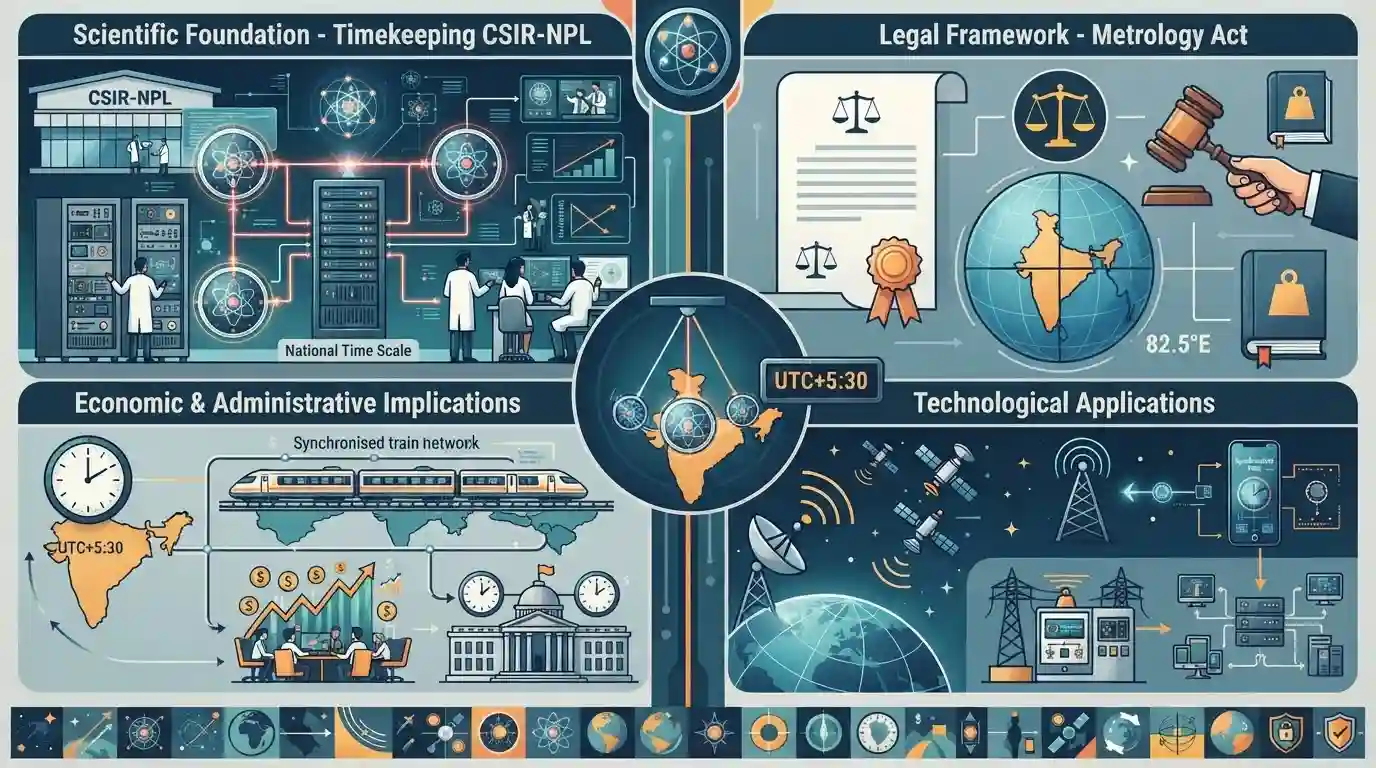
The article discusses the framework, significance, and regulatory updates surrounding the Indian Standard Time (IST) Rules 2026. It highlights the role of CSIR-NPL in maintaining precise time standards via atomic clocks, the legal basis under the Legal Metrology Act, and the broader economic, administrative, and technological implications of maintaining a uniform time zone across India.
मुख्य मुद्दे
- The Indian Standard Time (IST) is regulated under the Legal Metrology Act and recently updated framework via the Indian Standard Time Rules, 2026.
- IST is officially maintained by the Council of Scientific and Industrial Research - National Physical Laboratory (CSIR-NPL) using atomic clocks synchronized with UTC.
- Ensuring a single, precise time standard is vital for critical infrastructure, national security, synchronized telecommunications, financial networks, and transportation systems across India.
- Discussions around a single time zone versus multiple time zones for India often address administrative efficiency, energy conservation, and regional socio-economic challenges, especially for the country's eastern parts.
महत्त्वाच्या संज्ञा
Indian Standard Time Rules 2026

Notified under the Legal Metrology Act, these rules make Indian Standard Time the sole mandatory reference for administrative, legal, and commercial purposes across India, requiring systems to align over a 180-day transition window.
UPSC context
UPSC GS Paper III (Science & Technology - Policy & Infrastructure), testing governance of national digital infrastructure, timing frameworks, and compliance standards.
Legal Metrology Act
The statutory framework governing standards of weights and measures in India, under which Section 52 empowers the central government to notify official standard time regulations.
UPSC context
UPSC GS Paper II/III (Governance & Statutory Frameworks), testing legal provisions for standardisation, consumer protection, and administrative rule-making.
Council of Scientific and Industrial Research - National Physical Laboratory (CSIR-NPL)
The premier national measurement standards laboratory in India that maintains UTC(NPLI), the country's official atomic time scale, ensuring high-precision timekeeping and traceability.
UPSC context
UPSC GS Paper III (Science and Technology - Indigenous Research), evaluating institutional roles in national scientific metrology and technology development.
Ministry of Consumer Affairs, Food and Public Distribution
The nodal Union ministry responsible for consumer affairs, standard enforcement, and issuing statutory regulations under the Legal Metrology framework.
UPSC context
UPSC GS Paper II (Governance and Government Ministries), testing administrative machinery responsible for consumer welfare and metrological oversight.
पूर्वपरीक्षा सापळा
The Indian Standard Time Rules, 2026 decentralize time management by permitting two official time zones for eastern and western regions.
India has historically considered a second time zone (like BSI), but the 2026 rules officially reaffirm and mandate a single unified IST under the Legal Metrology Act.
संबंधित स्थिर संकल्पना
How is Indian Standard Time (IST) calculated, maintained, and legally backed in India?
- Standard Meridian: Reference Meridian, Measured along the 82°30' E longitude passing through Mirzapur, Uttar Pradesh, offset at UTC +5:30.
- Nodal Agency: Nodal Agency, Maintained by CSIR-National Physical Laboratory (CSIR-NPL), New Delhi, using atomic clocks and hydrogen masers.
- Legal Framework: Legal Framework, Governed under the provisions of the Legal Metrology Act, 2009 and the updated 2026 rules.
आंतर-विषय नमुने
NavIC + Critical Infrastructure Timing Security
Integration of NavIC for time synchronization connects space-based indigenous tech directly with critical infrastructure protection under internal security.
Legal Metrology + National Standards Governance
The legal mandate under the Legal Metrology Act links scientific time-keeping to consumer rights, commerce regulation, and federal enforcement.

Expect a statement-based question combining CSIR-NPL's atomic clock role, NavIC integration, and the Legal Metrology Act mandates.
संबंधित PYQ · 2
संबंधित PYQ · 2
- 2015MainsGS3
What do you understand by 'Standard Positioning Systems' and 'Precision Positioning Systems' in the GPS era? Discuss the advantages India perceives from its ambitious IRNSS programme employing just seven satellites.
- 2025PrelimsGS1
Consider the following countries : I. United Kingdom II. Denmark III. New Zealand IV. Australia V. Brazil How many of the above countries have more than four time zones?
