ISRO Chief Emphasizes International Cooperation in Space Roadmap
Source:The Hindu ↗
Why It Matters
This article provides essential updates on India's space roadmap (Bharatiya Antariksha Station, Gaganyaan) and highlights the strategic importance of international cooperation, particularly India-US space ties, which is highly relevant for GS3 Science & Technology and GS2 International Relations.
Summary
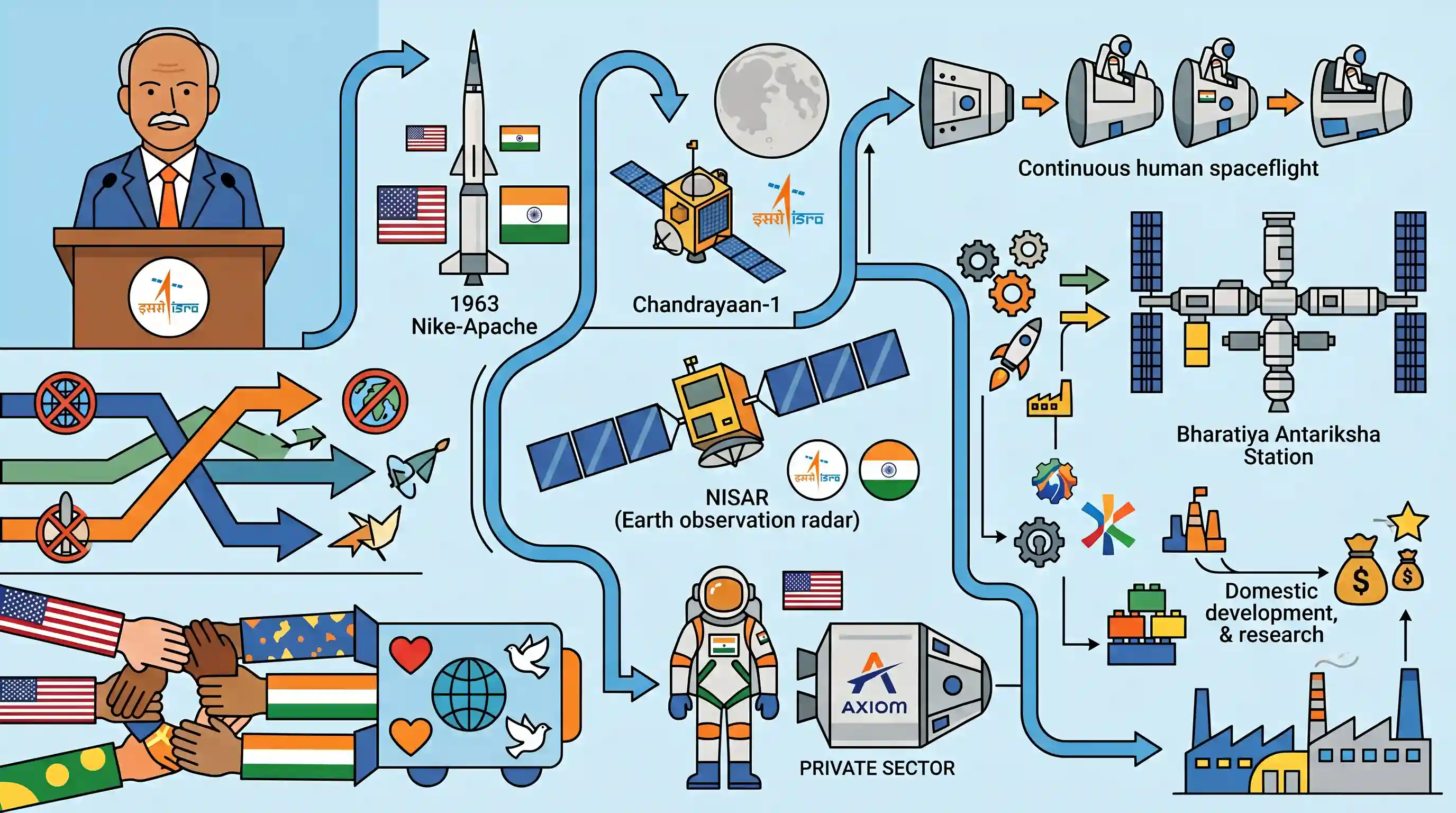
Speaking at the U.S.-India Space Business Forum in Bengaluru, ISRO Chairman V. Narayanan emphasized that India's space programme is built on international collaboration and human-centric benefits, rather than global competition. He highlighted a rich history of space diplomacy with the U.S., spanning from the 1963 launch of the Nike-Apache sounding rocket to modern collaborative milestones like the Chandrayaan-1 mission, the upcoming NISAR satellite, and the inclusion of an Indian astronaut in the Axiom mission. He also detailed India's future space roadmap, including a continuous human spaceflight programme and the operationalization of the Bharatiya Antariksha Station by 2035, aided by ongoing reforms to spur private sector participation.
Key Points
- ISRO Chairman V. Narayanan stated that India's space programme focuses on international cooperation and global benefits rather than competition.
- Historical space collaborations include the first US-supplied Nike-Apache rocket launch in 1963 and the joint US-India Chandrayaan-1 mission that discovered water on the Moon.
- Ongoing collaborations with the US feature the joint NASA-ISRO Synthetic Aperture Radar (NISAR) project and Indian astronaut Shubhanshu Shukla's involvement in the private Axiom mission.
- India aims to build the five-module Bharatiya Antariksha Station by 2035, with the first module scheduled for launch by 2028.
- Recent space sector reforms are actively encouraging private sector participation in Indian space research.
Important Terms
NISAR mission

A joint Earth-observation mission by NASA and ISRO using dual-frequency Synthetic Aperture Radar (SAR) to monitor global land and ice surface changes and natural disasters.
UPSC context
GS Paper 3 (S&T); crucial for understanding bilateral cooperation and Earth observation technology.
Bharatiya Antariksha Station (BAS)
India's planned modular space station, envisioned for full operation by 2035, intended to support long-duration human presence and microgravity research in Low Earth Orbit.
UPSC context
GS Paper 3 (S&T); represents India’s long-term vision for self-reliance in space exploration and strategic autonomy.
Gaganyaan mission
ISRO's mission to demonstrate human spaceflight capability by sending a three-member crew to a 400 km orbit for a three-day mission and ensuring their safe return.
UPSC context
GS Paper 3 (S&T); foundational for testing indigenous human-centric space travel and life support systems.
India-USA Civil Space Joint Working Group (CSJWG)
The primary bilateral mechanism between NASA and ISRO for coordinating policy, Earth science, and planetary exploration, strengthening the Indo-U.S. strategic and commercial space partnership.
UPSC context
GS Paper 2 (IR); vital for analyzing institutional frameworks in bilateral space diplomacy.
Axiom mission
A commercial spaceflight mission (Axiom-4) that will include an Indian astronaut visiting the International Space Station, marking a significant milestone in international human spaceflight collaboration.
UPSC context
GS Paper 3 (S&T); important for current affairs regarding human spaceflight training and international partnerships.
U.S.-India Space Business Forum
A bilateral platform involving government and private stakeholders aimed at fostering commercial ties, private sector participation, and joint investments in the Indian and American space economies.
UPSC context
GS Paper 3 (Economy/S&T); relevant for understanding space sector reforms and private industry integration.
Prelims Trap
"India's Bharatiya Antariksha Station (BAS) will be fully assembled in Geostationary Orbit (GEO) by 2028."
BAS will be deployed in Low Earth Orbit (LEO), not GEO. Additionally, only the first module launches in 2028; full operational capacity is targeted for 2035.
Static Concepts Connected
Why are space stations like ISS and the proposed BAS placed in Low Earth Orbit?
- Cost Efficiency: Closer proximity to Earth drastically reduces the fuel, cost, and complexity required for regular cargo resupply and crew rotation missions.
- Radiation Shielding: LEO keeps the station below the inner Van Allen belt, significantly shielding astronauts from lethal levels of cosmic and solar radiation.
How does Synthetic Aperture Radar (SAR) used in NISAR differ from optical sensors?
- Active Sensing: SAR emits its own microwave signals rather than relying on reflected sunlight, enabling continuous day-and-night earth observation.
- Cloud Penetration: Unlike optical sensors, SAR's longer wavelengths can easily penetrate dense cloud cover, fog, and forest canopies for all-weather imaging.
Cross-Topic Patterns
Quad Space Working Group & Earth Observation
Bilateral initiatives like NISAR bolster the broader Quad Space Working Group's goals, sharing critical earth observation and climate data to enhance disaster management capabilities across the Indo-Pacific region.
Indian Space Policy 2023 & LEO Commercialization
Partnering with private firm Axiom reflects a key shift in the 2023 Space Policy: outsourcing routine LEO activities to commercial entities via IN-SPACe, freeing ISRO for advanced deep-space R&D.

Expect a multi-statement Prelims 2026 question blending NISAR's dual-frequency SAR capabilities with the timelines of India's BAS project.
Linked PYQs · 2
Linked PYQs · 2
- 2016MainsGS3
Discuss India's achievements in the field of Space Science and Technology. How the application of this technology has helped India in its socio-economic development?
- 2025PrelimsGS1
Consider the following space missions : I. Axiom-4 II. SpaDeX III. Gaganyaan How many of the space missions given above encourage and support micro-gravity research?
