Indian Equity Markets Plunge Amid Global Trade War and Recession Fears
Source:The Hindu ↗
Why It Matters
The article illustrates the immediate and severe impact of global protectionist policies (like U.S. tariffs) on India's macroeconomic stability and financial markets. It is highly relevant for understanding the interconnectedness of global economies and the challenges India faces amid retreating multilateralism.
Summary
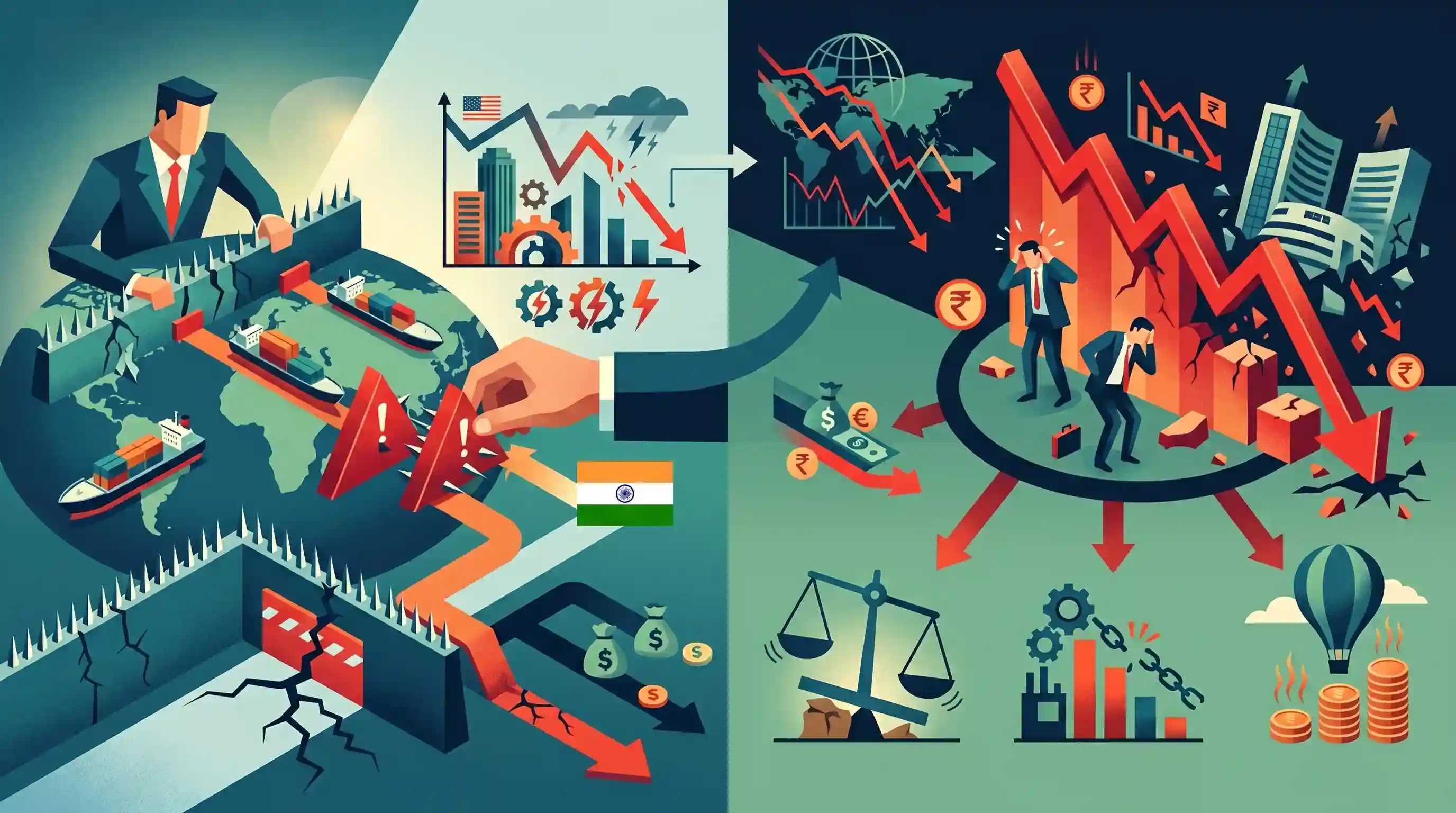
Indian stock markets experienced a severe crash, with the Sensex and Nifty 50 falling over 5%, mirroring a global market rout. The sell-off was triggered by fears of a U.S. recession and a looming global trade war following U.S. President Donald Trump's announcement of sweeping tariffs, which included a 26% reciprocal tariff on India. The U.S. Federal Reserve also warned about the potential negative impacts of these protectionist measures on economic growth and inflation.
Key Points
- Indian stock indices (Sensex and Nifty 50) plunged over 5% amid a broader Asian and global market sell-off.
- The crash was triggered by U.S. President Donald Trump's announcement of sweeping tariffs, including a 26% 'discounted reciprocal tariff' aimed at India.
- These protectionist measures have sparked fears of a global trade war and a potential U.S. economic recession.
- The Nasdaq index entered a bear market, and global commodity and oil prices plummeted as the Federal Reserve warned of impacts on inflation and growth.
Important Terms
Reciprocal Tariff

A trade policy where a country imposes import duties on another nation at the same rate that the other nation levies on its goods.
UPSC context
GS Paper 2: Effects of policies of developed countries on India's interests; tests understanding of bilateral trade dynamics and protectionism.
Protectionism
The practice of shielding domestic industries from foreign competition by imposing restrictions like tariffs, quotas, and subsidies on imported goods.
UPSC context
GS Paper 3: Effects of liberalization on the economy; tests knowledge of trade barriers and their impact on globalized supply chains.
Foreign Portfolio Investment (FPI)
Investment by non-residents in Indian financial assets like stocks and bonds, characterized by passive ownership without direct management control.
UPSC context
GS Paper 3: Indian Economy and mobilization of resources; tests understanding of capital flows and market volatility.
Federal Reserve
The central banking system of the United States, responsible for conducting monetary policy, regulating banks, and maintaining global financial stability.
UPSC context
GS Paper 3: Economy; tests understanding of how global monetary policies (like Fed rate hikes) impact Indian markets and rupee value.
Bombay Stock Exchange (BSE)
Asia's oldest stock exchange, established in 1875; its benchmark index, the Sensex, tracks the performance of 30 large, well-established companies.
UPSC context
GS Paper 3: Economy; tests knowledge of capital market infrastructure and indicators of domestic economic health.
Trade War
A conflict where nations retaliate against each other by raising import duties or creating other trade barriers, often disrupting global supply chains.
UPSC context
GS Paper 2: International Relations; tests ability to analyze geopolitical tensions and their subsequent economic fallout on emerging markets.
Prelims Trap
Reciprocal tariffs are a recognized trade remedy mechanism under WTO rules.
Reciprocal tariffs are unilateral and violate the WTO's Most-Favored-Nation (MFN) principle. Legitimate WTO trade remedies are strictly defined as Anti-dumping, Countervailing, and Safeguard duties.
Static Concepts Connected
What are the three legitimate trade remedy measures under the WTO?
- Anti-dumping Duty: Levied on goods imported at a price lower than their normal market value in the exporting country.
- Countervailing Duty: Imposed to neutralize the negative effects of subsidies provided by the exporting country's government.
- Safeguard Measures: Temporary restrictions applied to protect a specific domestic industry from a sudden, unforeseen surge in imports.
How does a US recession impact Indian markets via the contagion effect?
- Flight to Safety: Foreign Portfolio Investors (FPIs) pull capital from emerging markets to invest in safe-haven assets like US Treasuries or gold.
- Currency Depreciation: Sudden capital outflows weaken the Rupee against the Dollar, increasing the cost of dollar-denominated imports.
- Imported Inflation: A weaker Rupee makes imported raw materials and crude oil costlier, complicating the RBI's inflation-targeting mandate.
Cross-Topic Patterns
Protectionism vs. PLI schemes
As the US raises tariff walls, India's export-oriented PLI schemes face headwinds, potentially forcing a strategic pivot towards domestic consumption or free-trade agreements with non-US markets.
Capital flight and forex intervention
Sudden FPI sell-offs test the RBI's willingness to deploy its forex reserves to prevent excessive rupee volatility, tightly linking global trade shocks to domestic monetary management.

Expect a multi-statement question linking US reciprocal tariffs to WTO's MFN principle and RBI's forex intervention managing FPI flight.
Linked PYQs · 3
Linked PYQs · 3
- 2025MainsGS3
What are the challenges before the Indian economy when the world is moving away from free trade and multilateralism to protectionism and bilateralism? How can these challenges be met?
- 2018MainsGS3
How would the recent phenomena of protectionism and currency manipulations in world trade affect macroeconomic stability of India?
- 2024PrelimsGS1
Consider the following statements : 1. In India, Non-Banking Financial Companies can access the Liquidity Adjustment Facility window of the Reserve Bank of India. 2. In India, Foreign Institutional Investors can hold the Government Securities (G-Secs). 3. In India, Stock Exchanges can offer separate trading platforms for debts. Which of the statements given above is/are correct?
