Plant Molecular Alarm System and Stress Gateway Discovery
Source:The Hindu ↗
ఇది ఎందుకు ముఖ్యం
Understanding plant defense mechanisms at the molecular level is essential for developing resilient crops capable of withstanding biotic and abiotic stresses, directly impacting agricultural productivity and farmer livelihoods.
సారాంశం
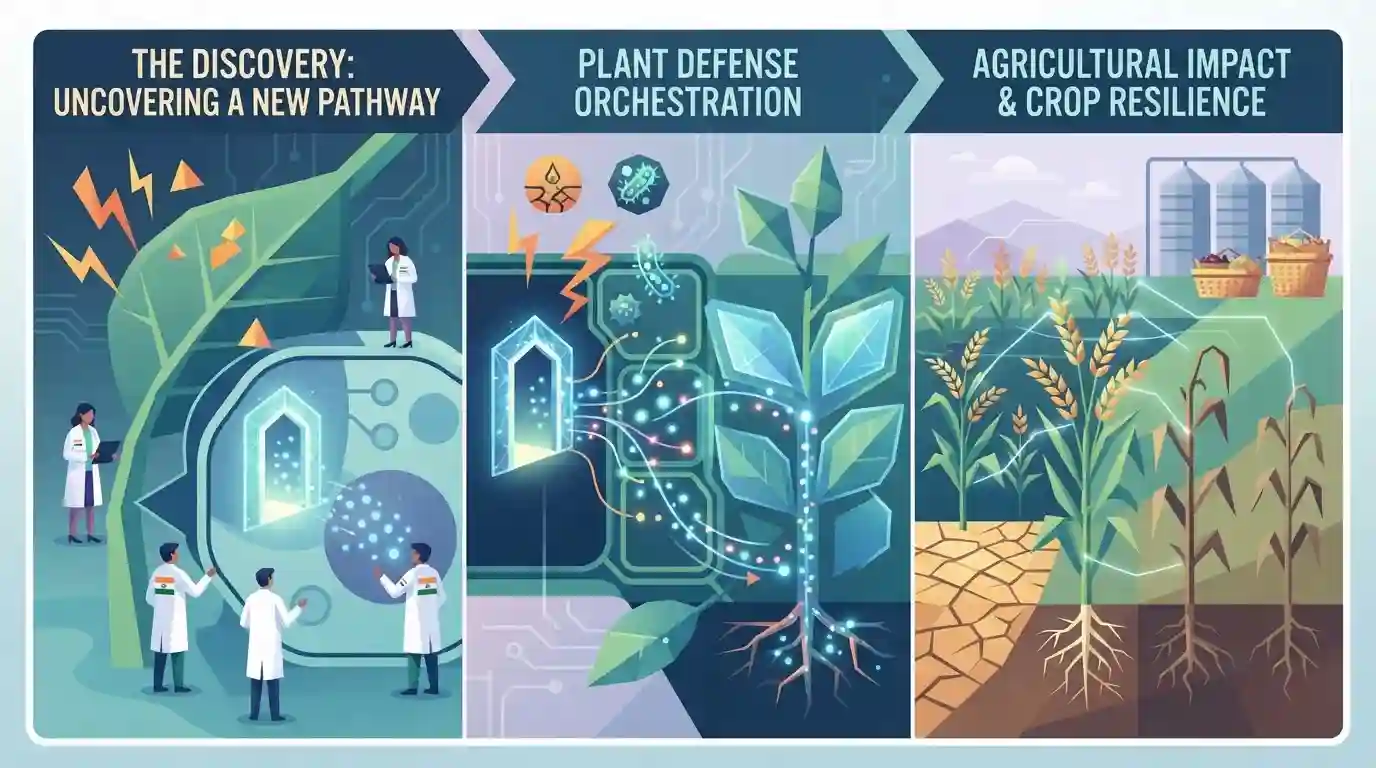
Indian researchers have uncovered a new pathway or gateway in the plant alarm system, shedding light on how plants orchestrate defense responses against stress and external threats. This fundamental discovery in plant science has implications for agricultural biotechnology, crop resilience, and food security.
ముఖ్య అంశాలు
- Indian scientists have discovered a novel gateway in the plant alarm system, providing deeper insights into how plants detect and respond to environmental stress or pathogen attacks.
- The finding enhances understanding of plant molecular biology, signal transduction, and defense mechanisms.
- Such discoveries in applied plant biology and biotechnology hold significant potential for developing climate-resilient and disease-resistant crop varieties to support sustainable agriculture and farmers.
ముఖ్యమైన పదాలు
CYCLIC NUCLEOTIDE GATED CHANNEL13 (CNGC13)

A key calcium-permeable channel protein in plants that propagates systemic calcium signals from damaged leaves to undamaged parts, triggering defense hormones like jasmonates against herbivores.
UPSC context
UPSC Prelims/Mains (S&T - Biotechnology, Crop Science): Tests understanding of plant genetic mechanisms, stress resilience, and agricultural innovations.
National Institute of Plant Genome Research (NIPGR)
A premier Indian research institution under the Department of Biotechnology that studies plant genomics, structural biology, and functional mechanisms for crop improvement.
UPSC context
UPSC Prelims/Mains (S&T / Agriculture): Tests awareness of premier Indian S&T institutions and their contributions to agricultural biotechnology.
Crop Resilience
The ability of crops to withstand biotic stresses like insect attacks and abiotic pressures, vital for sustaining agricultural productivity and food security.
UPSC context
UPSC Mains GS Paper III (Agriculture): Tests understanding of measures to enhance farm productivity and climate-smart agriculture.
ప్రిలిమ్స్ ఉచ్చు
Plant defense signaling against insect attacks is exclusively mediated by slow-moving chemical hormones transmitted through the vascular system.
Aspirants might assume alarm signals travel exclusively via chemical hormones like jasmonic acid, overlooking that rapid electrical and calcium wave signaling precedes hormone production.
అనుసంధానమైన స్థిర భావనలు
What are the primary signaling pathways and molecules involved in systemic plant defense responses?
- Calcium Signalling: Calcium waves act as rapid, long-distance electrical and chemical signals traveling through the plant vascular system within seconds of wounding or herbivory.
- Defense Hormones: Jasmonic acid and salicylic acid are key defense hormones activated downstream of initial stress perception to trigger targeted plant immunity.
- Ion Channels: Cyclic Nucleotide-Gated Channels (CNGCs) function as crucial plasma membrane ion channels mediating calcium influx during stress responses.
అంతర-అంశ నమూనాలు
Crop Resilience and Chemical-Free Farming
Plant molecular defense pathways like CNGC13 connect directly to national missions on climate-resilient agriculture and reducing chemical pesticide loads under sustainable farming frameworks.
Biotechnology R&D and Agri-Tech Commercialisation
Fundamental biotechnology discoveries frequently anchor India's bio-economy initiatives, linking basic plant physiology research with commercial agricultural biotech applications.

Expect statement-based MCQs on plant calcium signaling pathways, specifically linking protein channels like CNGC13 to systemic defense.
అనుసంధాన PYQలు · 2
అనుసంధాన PYQలు · 2
- 2021PrelimsGS1
Bollgard I and Bollgard II technologies are mentioned in the context of
- 2021MainsGS3
What are the research and developmental achievements in applied biotechnology? How will these achievements help to uplift the poorer sections of the society?
