Ozone Layer Over North Bay of Bengal: Unusual Thickness Detected
Source:tbsnews ↗
Why It Matters
Understanding the dynamics of the ozone layer is crucial for climate science and Geography. The use of Indian satellites (INSAT-3DR) for environmental monitoring highlights the intersection of atmospheric geography and space technology, both core components of the WBCS Science and Geography syllabi.
Summary
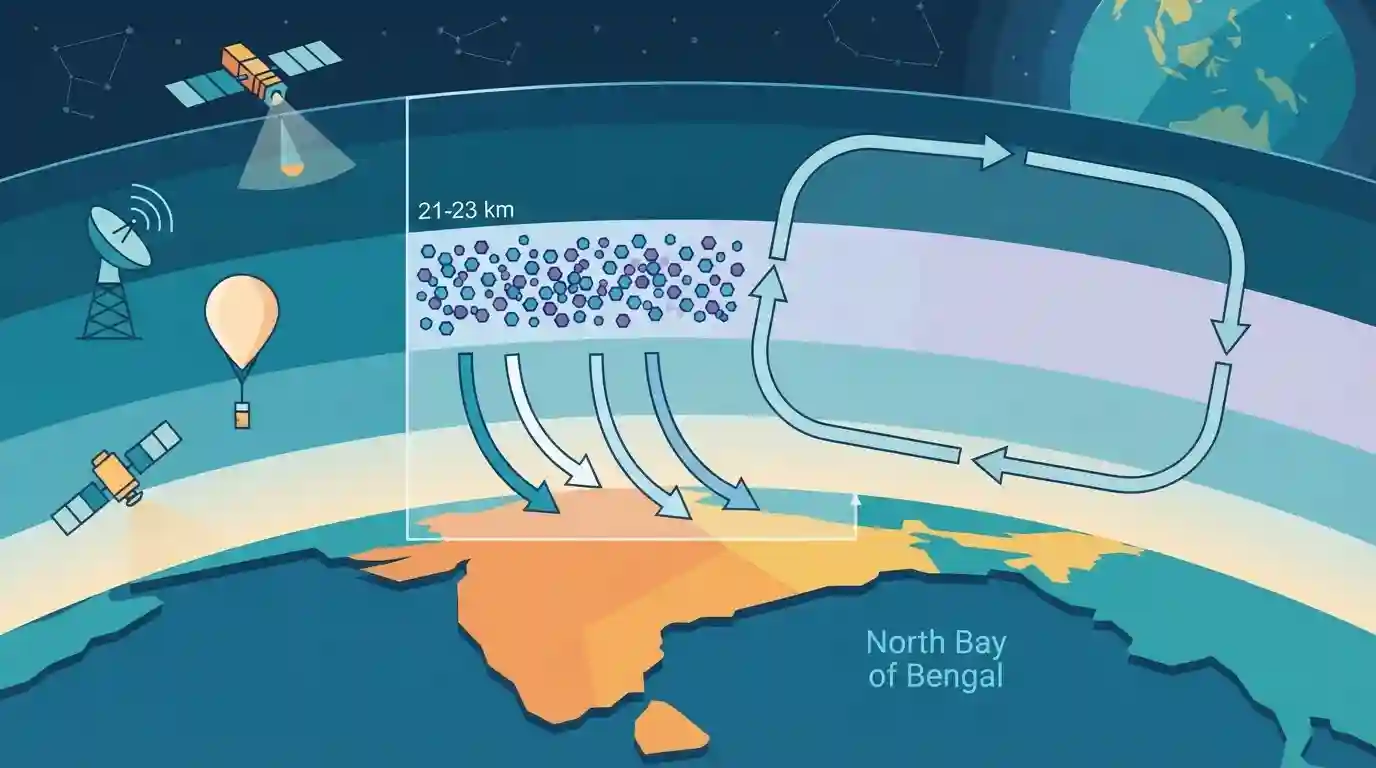
Indian scientists have detected an abnormally thick ozone layer at an unexpectedly low altitude of 21-23 km over the North Bay of Bengal. Utilizing data from atmospheric radars, weather balloons, and earth observation satellites like INSAT-3DR, researchers determined that the ozone enhancement was caused by atmospheric wind transport and downward air movement rather than photochemical reactions. The findings offer new insights into the wintertime redistribution of stratospheric ozone over the Indian subcontinent.
Key Points
- An unusually thick ozone layer was discovered at an unexpected altitude of 21-23 km over the North Bay of Bengal, lower than the typical 25-30 km range.
- The discovery was made by Indian scientists, including researchers from the Aryabhatta Research Institute of Observational Sciences (ARIES).
- Data was collected using weather balloons, atmospheric radars, the Aura Microwave Limb Sounder (MLS), and INSAT-3DR satellites.
- The enhanced ozone levels were observed day and night, indicating the anomaly was not primarily driven by sunlight-dependent photochemical processes.
- Scientists concluded the anomaly resulted from the horizontal transport of ozone-rich air followed by downward movement and compression in the lower stratosphere.
Important Terms
Aryabhatta Research Institute of Observational Sciences (ARIES)

An autonomous scientific research institute under India's Department of Science and Technology, specializing in observational astronomy, astrophysics, and atmospheric sciences, located at Nainital, Uttarakhand.
UPSC context
GS Paper III (Science & Technology); tests awareness of premier Indian research institutes, their infrastructure, and scientific contributions.
INSAT-3DR
An advanced Indian meteorological satellite launched by ISRO, equipped with a multi-spectral imager and atmospheric sounder, used for weather forecasting, search-and-rescue, and atmospheric observation.
UPSC context
GS Paper III (S&T - Space); tests understanding of India's space missions, meteorological satellite programs, and earth observation capabilities.
Stratosphere-Troposphere (ST) Radar
A high-frequency radar system used to measure wind speed, direction, turbulence, and vertical air movement in the lower atmosphere, crucial for analyzing stratospheric-tropospheric dynamics.
UPSC context
GS Paper III (Science & Technology); tests familiarity with indigenous atmospheric monitoring tools, meteorological radars, and weather observation technology.
NetRAD-ASMA Campaign
A coordinated, nationwide atmospheric observation campaign in India designed to investigate atmospheric circulation and dynamical transport processes associated with the Asian Summer Monsoon Anticyclone (ASMA).
UPSC context
GS Paper I (Geography - Climatology) & Paper III; tests knowledge of national climate research initiatives and atmospheric transport systems.
Ministry of Science and Technology
The nodal Indian administrative body responsible for formulating and implementing science, technology, and innovation policies, supervising autonomous institutes, and funding scientific research.
UPSC context
GS Paper II (Governance) & Paper III; tests awareness of government ministries, policy frameworks, and scientific departments in India.
American Geophysical Union (AGU)
A prominent international non-profit scientific association established to promote discovery in Earth and space science for the benefit of humanity through publishing and conferences.
UPSC context
GS Paper III (Science & Technology); tests familiarity with globally renowned scientific organizations and international collaborations in earth sciences.
Prelims Trap
Any significant lower-altitude ozone enrichment over India is a result of anthropogenic photochemical smog in the troposphere.
This anomaly occurred in the lower stratosphere (21-23 km), not the troposphere, and was active day and night, proving it was driven by dynamic transport rather than photochemistry.
Static Concepts Connected
What are the structural and chemical characteristics of the Ozone Layer?
- Stratospheric Shield: Occurs naturally in the stratosphere (typically 20-30 km) where it absorbs harmful solar UV-B and UV-C radiation.
- Chapman Cycle: A continuous natural cycle of ozone creation and destruction driven by solar ultraviolet radiation.
- Tropospheric Ozone: Formed near the surface via photochemical reactions of NOx and VOCs; acts as a toxic greenhouse gas.
What is INSAT-3DR and its atmospheric utility?
- Geostationary Orbit: An Indian geostationary meteorological satellite launched to ensure continuity of weather monitoring services.
- Payload Capabilities: Equipped with a 19-channel Sounder and a 6-channel Imager to profile atmospheric temperature, humidity, and ozone.
- Primary Mission: Aids in real-time tracking of cyclones, atmospheric vertical profiles, and search-and-rescue signals.
Cross-Topic Patterns
Stratosphere-Troposphere Exchange (STE)
How stratospheric air intrusions alter tropospheric chemistry and circulation over the Indian subcontinent, impacting winter monsoon dynamics and air quality assessments.
Satellite Sounding & Marine Meteorology
Using geostationary sounders (like INSAT-3DR) to track atmospheric profiles, linking stratospheric ozone anomalies with wintertime cyclogenesis in the Bay of Bengal.

Expect questions pairing stratospheric dynamics (dynamic transport vs Chapman cycle) with INSAT-3DR's atmospheric sounding capabilities.
Linked PYQs · 3
Linked PYQs · 3
- 2015WBCS_PRELIMSGS1
In which layer of the atmosphere does ozone act as a UV radiation shield ?
- 2017WBCS_PRELIMSGS1
The International Day for the Preservation of the Ozone Layer is observed on
- 2015WBCS_PRELIMSGS1
Satellites provide information about
