Space Situational Awareness and Orbital Tracking Capabilities
Source:Indian Express ↗
Why It Matters
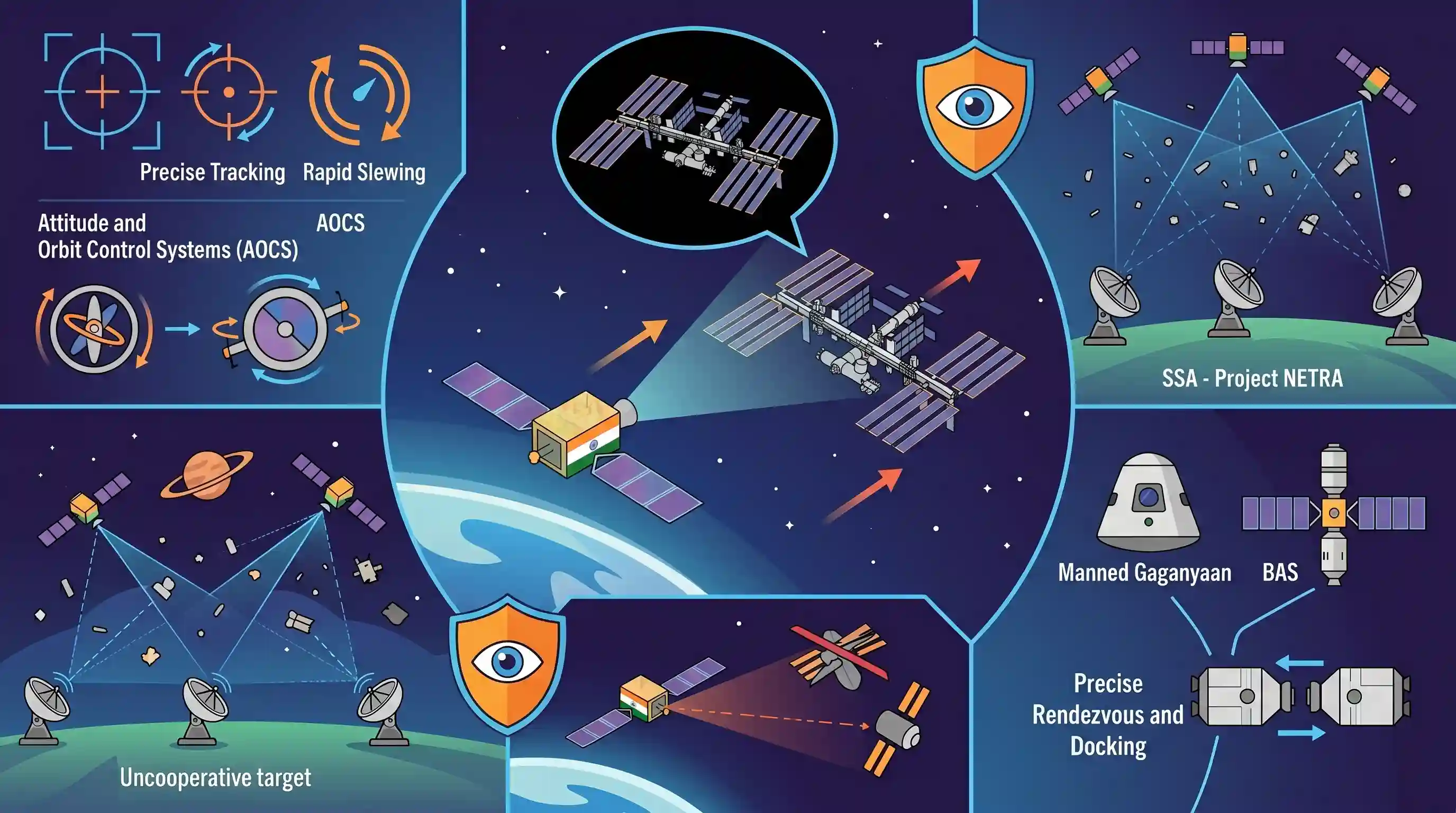
Tracking and imaging an object in Low Earth Orbit highlights India's technological leap in Space Situational Awareness (SSA) and satellite agility. This is a vital stepping stone for upcoming human spaceflight missions, space station assembly, and safeguarding orbital assets against debris and hostile actions.
Summary
An Indian satellite's recent successful capture of high-resolution images of the International Space Station (ISS) is being hailed as a major technical milestone. Capturing a clear image of another fast-moving object in Low Earth Orbit (LEO) requires extremely precise tracking, rapid slewing, and highly advanced Attitude and Orbit Control Systems (AOCS) to compensate for massive relative velocities. This achievement showcases India's growing prowess in Space Situational Awareness (SSA), an essential capability for monitoring space debris, avoiding collisions, and protecting space assets under initiatives like Project NETRA. Furthermore, the demonstrated precision tracking holds dual-use strategic value for observing uncooperative space targets and lays the crucial technical groundwork for complex rendezvous and docking maneuvers needed for upcoming missions like Gaganyaan and the Bharatiya Antariksha Station (BAS).
Key Points
- An Indian satellite's successful imaging of the International Space Station (ISS) demonstrates exceptional platform agility and pinpoint accuracy in Low Earth Orbit.
- The achievement proves the maturity of India's Attitude and Orbit Control Systems (AOCS), which are required to track objects moving at extreme relative velocities.
- This milestone significantly bolsters India's Space Situational Awareness (SSA) capabilities, essential for space traffic management, debris tracking, and collision avoidance (Project NETRA).
- The ability to image an uncooperative, fast-moving space asset has strong dual-use implications, providing strategic advantages in monitoring adversary satellites.
- Precision orbital tracking and targeting are foundational capabilities required for future rendezvous and docking operations for the Gaganyaan mission and the Bharatiya Antariksha Station.
Important Terms
Space Situational Awareness (SSA)

The comprehensive knowledge and tracking of all objects in Earth's orbit, including satellites and debris. It aims to predict and prevent collisions to ensure the safety and sustainability of space operations.
UPSC context
GS Paper III: Science & Tech/Security. Critical for space traffic management and protecting sovereign space assets from debris and hostile actions.
Project NETRA
ISRO's indigenous network of radars and telescopes designed to monitor space debris and provide early warnings. It forms the backbone of India's independent capability to track and protect its orbital assets.
UPSC context
GS Paper III: Science & Tech/Security. Tests knowledge of strategic space initiatives for asset protection and self-reliance in orbital surveillance.
Gaganyaan
India's first human spaceflight mission, aiming to send a crew to Low Earth Orbit (LEO). It demonstrates indigenous capabilities in developing human-rated launch vehicles, life support systems, and safe re-entry technologies.
UPSC context
GS Paper III: Science & Tech. A landmark mission testing India's technological depth in manned space exploration and mission safety.
Bharatiya Antariksha Station (BAS)
India's planned modular space station, expected to be operational by 2035. It will serve as an independent laboratory in Low Earth Orbit for microgravity research, space medicine, and deep-space mission preparation.
UPSC context
GS Paper III: Science & Tech. Represents the future of India's permanent presence in space and strategic autonomy in global space research.
Attitude and Orbit Control Systems (AOCS)
A critical satellite subsystem that maintains orientation (attitude) and positioning (orbit). It is essential for precise sensor pointing, solar power optimization, and executing complex maneuvers like rendezvous and docking.
UPSC context
GS Paper III: Science & Tech. Tests understanding of the technical precision required for advanced satellite operations and proximity maneuvers in space.
Prelims Trap
"Project NETRA is an early-warning airborne radar system developed for monitoring border airspace."
UPSC exploits the overlapping 'NETRA' name. DRDO's NETRA is an Airborne Early Warning (AEW&C) aircraft, whereas ISRO's Project NETRA is a Space Situational Awareness system for tracking orbital debris.
Static Concepts Connected
What is ISRO's Project NETRA and its core objective?
- Space surveillance: An early warning system in space to detect, track, and catalogue orbital debris and hazards.
- Infrastructure: Utilizes a network of indigenous radars, optical telescopes, and control centers to protect Indian space assets.
- Collision avoidance: Essential for issuing early warnings to execute Collision Avoidance Manoeuvres (CAMs) for operational satellites.
What is the Bharatiya Antariksha Station (BAS)?
- Modular architecture: India's proposed modular space station planned for a Low Earth Orbit (LEO) of approximately 400-450 km altitude.
- Phased timeline: The first module is targeted for launch by 2028, with full operational status expected by 2035.
- Orbital assembly: It requires advanced rendezvous and docking capabilities, tested by current precision-tracking technologies, to assemble modules in orbit.
Cross-Topic Patterns
Dual-use SSA & Space Weaponization
The precision tracking required for capturing ISS images directly correlates with non-kinetic anti-satellite (ASAT) capabilities and close-proximity orbital espionage, blurring civilian and military space boundaries.
Kessler Syndrome & Strategic Autonomy
As LEO becomes highly congested, indigenous SSA under Project NETRA reduces India's reliance on US Space Command data, strengthening strategic autonomy in orbital traffic management.

Expect a multi-statement question contrasting DRDO's NETRA aircraft with ISRO's Project NETRA, alongside BAS and Gaganyaan timelines.
Linked PYQs · 3
Linked PYQs · 3
- 2016MainsGS3
Discuss India's achievements in the field of Space Science and Technology. How the application of this technology has helped India in its socio-economic development?
- 2017MainsGS3
India has achieved remarkable successes in unmanned space missions including the Chandrayaan and Mars Orbitter Mission, but has not ventured into manned space missions. What are the main obstacles to launching a manned space mission, both in terms of technology and logistics? Examine critically.
- 2023MainsGS3
What is the main task of India's third moon mission which could not be achieved in its earlier mission? List the countries that have achieved this task. Introduce the subsystems in the spacecraft launched and explain the role of the Virtual Launch Control Centre' at the Vikram Sarabhai Space Centre which contributed to the successful launch from Sriharikota.
