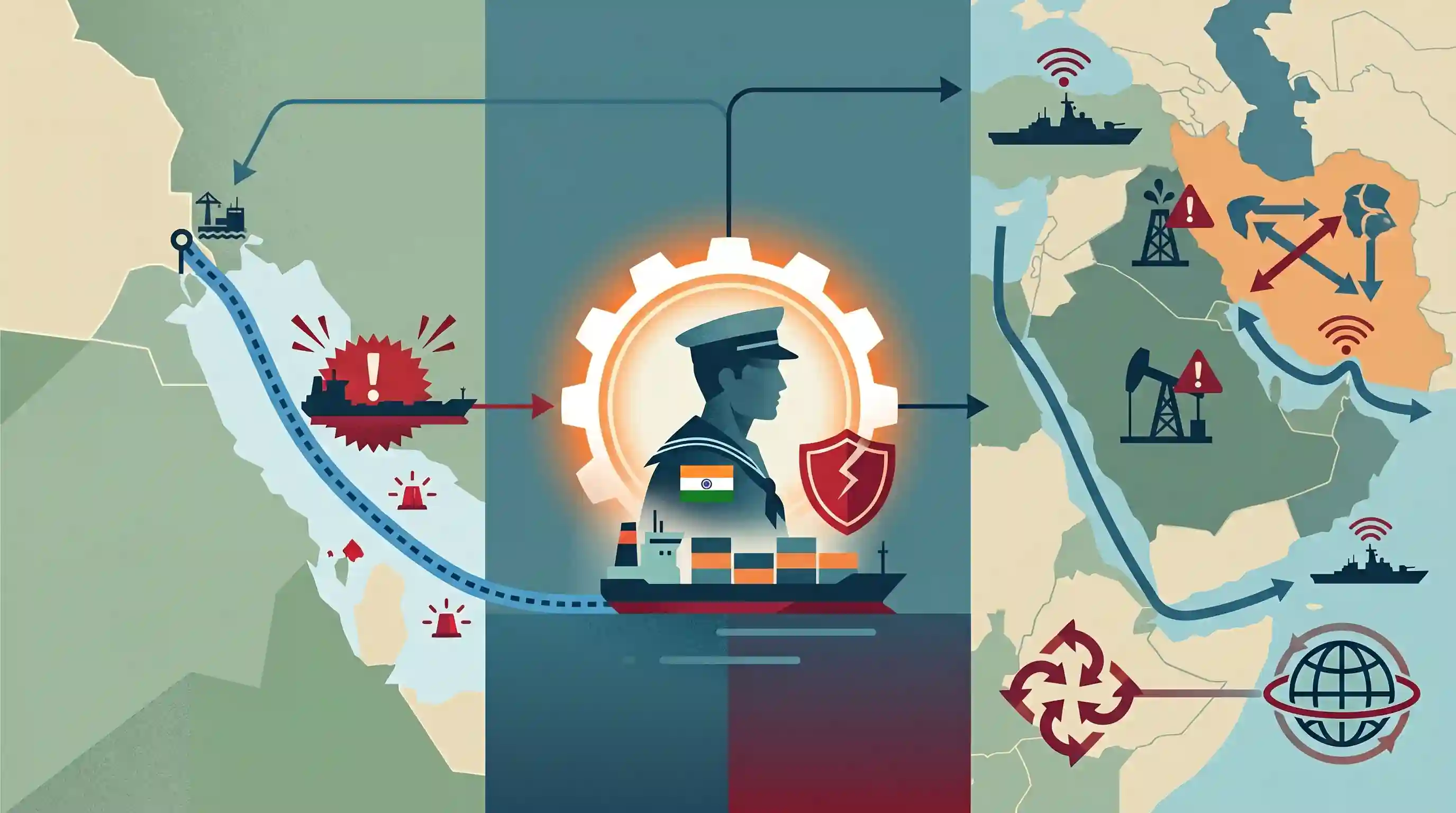
Tanker Attack Near Basra and Maritime Security Risks
Source:Indian Express ↗
Why It Matters
The Persian Gulf is a vital artery for global energy trade. Attacks on merchant ships disrupt global supply chains and heighten energy security risks. For India, it also poses a direct threat to the safety of its citizens, as Indians make up a significant percentage of the global seafaring workforce.
Summary
An Indian sailor was killed in an attack on the merchant tanker "Safesea Vishnu" near the port city of Basra, Iraq. The incident exposes the continuous maritime security risks faced by commercial shipping in the Persian Gulf and broader Middle East region. Furthermore, it brings to light the critical issue of ensuring the safety of Indian seafarers and diaspora working in high-risk, geopolitically sensitive zones.
Key Points
- An Indian sailor was killed during an attack on the merchant tanker 'Safesea Vishnu' near Basra, Iraq.
- The incident highlights severe vulnerabilities in maritime security for merchant vessels navigating through the geopolitically volatile Persian Gulf region.
- It underscores the persistent threats to critical Sea Lines of Communication (SLOCs) that are essential for global trade and energy security.
- The event draws attention to the safety and welfare concerns of Indian overseas workers, particularly the vast number of Indian nationals employed in the global seafaring industry.
Important Terms
Maritime Security

The protection of maritime interests, trade, and personnel from threats such as piracy, sabotage, and regional geopolitical conflicts.
UPSC context
GS Paper 3 (Security); vital for safeguarding India's Blue Economy and energy imports passing through volatile regions.
Sea Lines of Communication (SLOCs)
Principal maritime routes between ports used for trade and logistics; crucial for global energy stability and economic prosperity.
UPSC context
GS Paper 2 & 3; critical for energy security as most Indian crude oil imports transit via these lanes.
Strait of Hormuz
A strategic maritime 'choke point' between the Persian Gulf and Gulf of Oman through which approximately one-fifth of global oil passes.
UPSC context
GS Paper 1 (Geography) & 2 (IR); essential for India’s energy security and regional stability.
Indian Diaspora
India's overseas community, including over 300,000 seafarers (forming ~13-15% of global maritime workforce) often impacted by regional conflicts.
UPSC context
GS Paper 2 (IR); tests the state's capacity to protect citizens abroad in high-risk zones.
Safesea Vishnu
A US-owned, Marshall Islands-flagged oil tanker attacked near Basra in March 2026, resulting in the death of an Indian sailor.
UPSC context
GS Paper 2 (IR); a case study on maritime risks and the vulnerability of Indian seafarers in conflict zones.
Directorate General of Shipping (DGS)
The primary Indian government agency responsible for maritime administration, seafarer welfare, and safety of life at sea.
UPSC context
GS Paper 2 (Governance); coordinating agency for seafarer distress, emergency response, and repatriation.
Net Security Provider
India's strategic role in maintaining regional stability and freedom of navigation within the Indian Ocean and surrounding maritime corridors.
UPSC context
GS Paper 2 (IR); India’s regional ambition to ensure stability and safety across the Indian Ocean Region.
Prelims Trap
"Operation Sankalp is a multilateral coalition to protect commercial shipping in the Persian Gulf."
Operation Sankalp is an independent Indian Navy mission, often confused with US-led multilateral task forces like Operation Prosperity Guardian in the Red Sea.
Static Concepts Connected
What is the Shatt al-Arab and its strategic geographic significance?
- River Formation: It is a vital waterway formed by the confluence of the Tigris and Euphrates rivers at the town of al-Qurnah in southern Iraq.
- Border & Outlet: It forms the southern boundary between Iraq and Iran before emptying into the geopolitically critical Persian Gulf, housing the major port of Basra.
What are the parameters of the Indian Navy's Operation Sankalp?
- Core Mandate: Launched in 2019 to ensure the safe passage and provide reassurance to Indian-flagged merchant vessels transiting the Persian Gulf and Gulf of Oman.
- Naval Deployment: Involves the continuous deployment of stealth frigates, destroyers, and maritime patrol aircraft to monitor and protect Indian maritime interests in high-risk zones.
Cross-Topic Patterns
Energy Security & Maritime Chokepoints
Attacks near Basra and the Strait of Hormuz directly threaten India's macroeconomy, as over two-thirds of Indian crude imports transit these critical Sea Lines of Communication (SLOCs).
Diaspora Welfare via IMO Frameworks
Protecting the 10% of the global seafaring workforce that is Indian requires India to actively leverage the International Maritime Organization's Legal Committee against drone threats and piracy.

Map questions pairing Middle East ports (Basra) and strategic waterways (Shatt al-Arab, Strait of Hormuz) are highly probable in 2026.
Linked PYQs · 5
Linked PYQs · 5
- 2025MainsGS3
Why is maritime security vital to protect India's sea trade? Discuss maritime and coastal security challenges and the way forward.
- 2022MainsGS3
What are the maritime security challenges in India ? Discuss the organisational, technical and procedural initiatives taken to improve the maritime security.
- 2020MainsGS2
Indian diaspora has a decisive role to play in the politics and economy of America and European Countries'. Comment with examples.
- 2019PrelimsGS1
Consider the following pairs: Sea Bordering country 1. Adriatic Sea : Albania 2. Black Sea : Croatia 3. Caspian Sea : Kazakhstan 4. Mediterranean Sea : Morocco 5. Red Sea : Syria Which of the pairs given above are correctly matched?
- 2022PrelimsGS1
The term "Levant" often heard in the news roughly corresponds to which of the following regions?
