Indian Rupee Depreciation and RBI Exchange Rate Intervention
Source:The Hindu ↗
Why It Matters
The depreciation of the rupee impacts India's import bill (especially for crude oil), inflation, and current account deficit. For UPSC aspirants, it serves as a live case study of the complex interplay between domestic monetary policy, foreign portfolio flows, global bond yields, and international trade protectionism.
Summary
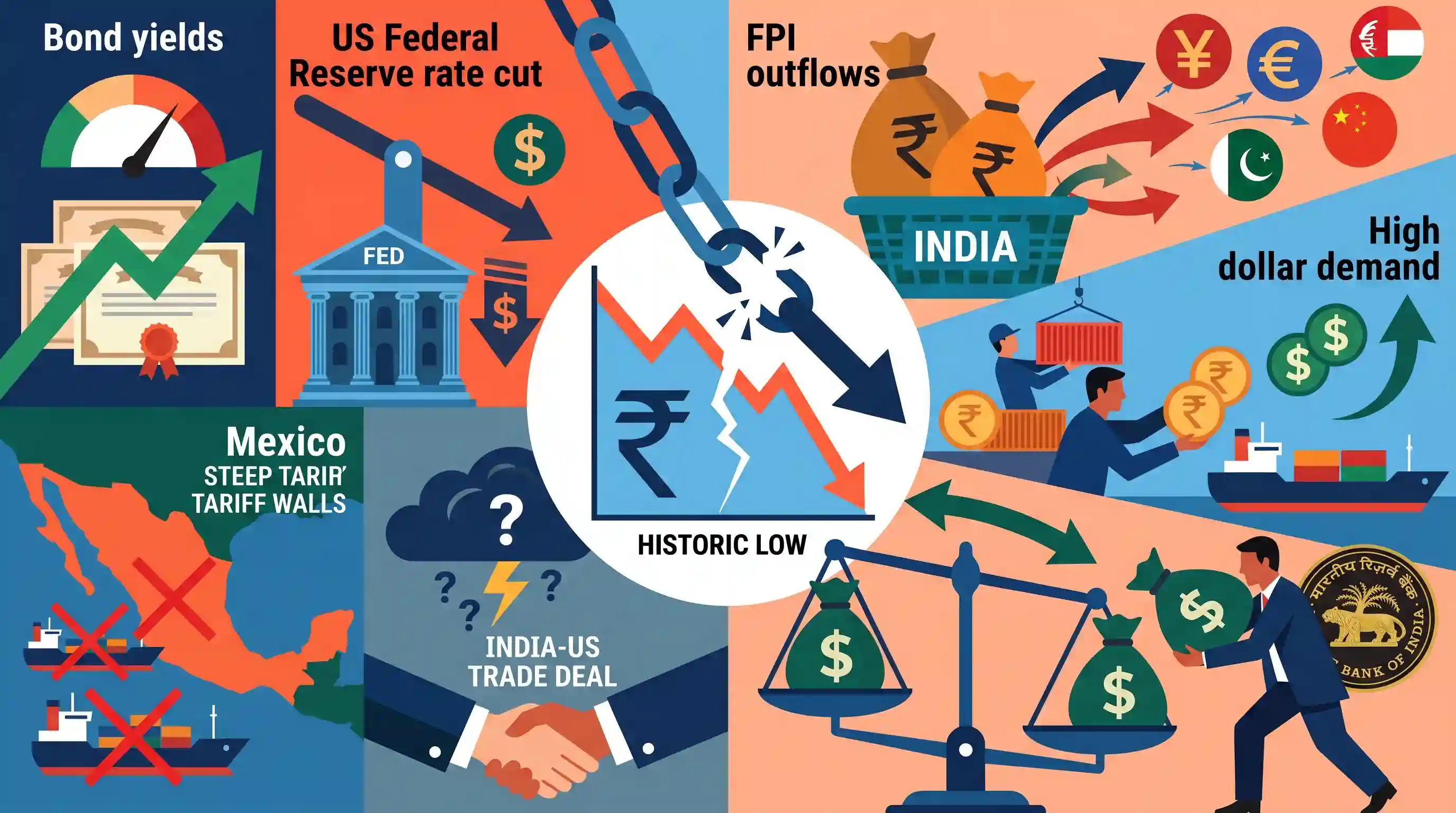
The Indian rupee slumped to a historic intra-day low of 90.48 against the U.S. dollar, heavily pressured by sustained foreign fund outflows, robust dollar demand from importers, and rising global bond yields. Geopolitical and trade concerns, notably Mexico's steep tariffs on Asian goods and an anticipated India-U.S. trade deal, amplified risk-aversion in the markets. Although a recent U.S. Federal Reserve rate cut slightly softened the dollar index globally, cross-border capital flight from India continued, prompting the Reserve Bank of India (RBI) to intervene via dollar sales to prevent a freefall.
Key Points
- The Indian rupee breached the psychological 90-per-dollar mark for the first time, hitting an all-time intra-day low of 90.48 before settling at 90.22.
- The sharp depreciation was primarily driven by heavy dollar demand from importers rushing to hedge exposures, alongside persistent sell-offs by Foreign Portfolio Investors (FPIs) in both equity and debt markets.
- Global macroeconomic pressures, including rising far-term bond yields in the U.S. and Japan, exacerbated capital outflows from emerging markets like India, despite a recent interest rate cut by the U.S. Federal Reserve.
- Trade anxieties fueled a risk-averse sentiment, triggered by reports of an impending India-U.S. trade deal and Mexico's imposition of tariffs up to 50% on goods from Asian countries.
- State-owned banks reportedly sold dollars on behalf of the Reserve Bank of India (RBI) to curb extreme volatility and cap the rupee's losses.
Important Terms
Foreign Portfolio Investors (FPIs)

Non-resident entities investing in Indian financial assets like stocks and bonds. FPI is often called 'hot money' due to its high mobility and impact on currency volatility.
UPSC context
GS Paper III: Capital Markets. Tests understanding of factors driving Rupee depreciation and capital account dynamics.
RBI Intervention
The central bank's active participation in the forex market, typically selling dollars from reserves, to prevent excessive Rupee volatility rather than defending a specific level.
UPSC context
GS Paper III: Monetary Policy. Tests knowledge of external sector management and forex reserve utility.
Currency Depreciation
A market-driven decrease in the value of the Rupee against foreign currencies. It increases the cost of imports (inflation) but can improve export competitiveness.
UPSC context
GS Paper III: Macroeconomics. Crucial for analyzing impacts on trade balance and current account deficit.
India-U.S. Trade Deal
A proposed bilateral agreement aimed at reducing trade barriers. In 2026, negotiations focused on an interim pact to lower tariffs on industrial and agricultural products.
UPSC context
GS Paper II: International Relations. Relevant for bilateral economic diplomacy and strategic trade partnerships.
U.S. Federal Reserve (Fed)
The central banking system of the U.S. Its interest rate decisions dictate global dollar liquidity and influence capital flows in and out of emerging markets.
UPSC context
GS Paper III: Global Economy. Important for understanding 'spillover effects' on India's financial stability.
Trade Protectionism
Policies like Mexico's 2026 tariffs (up to 50%) on non-FTA countries, used to protect domestic industries, which can disrupt global supply chains and pressure emerging currencies.
UPSC context
GS Paper II & III: Global Trade. Tests analysis of geopolitical shifts affecting India's export-oriented sectors.
Prelims Trap
The RBI deliberately devalued the Indian rupee to historic lows of 90 against the USD to boost India's export competitiveness.
In India's managed float system, a market-driven fall is "depreciation." "Devaluation" refers to a deliberate downward adjustment in a fixed exchange rate regime. Furthermore, RBI sells dollars to slow the fall, not cause it.
Static Concepts Connected
What is India's "Managed Floating" Exchange Rate regime?
- Market determined: The value of the rupee is fundamentally determined by the market forces of demand and supply in the forex market.
- RBI intervention: The central bank buys or sells foreign currency to curb excessive volatility and speculative attacks, rather than targeting a specific fixed exchange rate.
- Sterilization: RBI uses mechanisms like Open Market Operations (OMO) to neutralize the impact of forex interventions on domestic money supply.
Why do rising US bond yields trigger FPI outflows from emerging markets?
- Narrowing rate differential: Higher yields in the US reduce the interest rate differential, making the risk premium of investing in emerging markets less attractive to global investors.
- Safe-haven appeal: US Treasury bonds are considered risk-free assets. When their returns rise, investors pull capital from riskier emerging market equities and debt.
- Currency depreciation cycle: As FPIs exit, they sell local currency and buy dollars, leading to domestic currency depreciation and potential imported inflation.
Cross-Topic Patterns
Forex intervention vs. Domestic liquidity
RBI selling dollars to defend the rupee absorbs INR liquidity from the banking system. This can conflict with monetary policy goals, often requiring RBI to conduct sterilization operations.
Global protectionism & currency pressures
Mexico's tariffs on Asian goods and potential US trade barriers create export uncertainties. This weakens structural demand for the rupee precisely when capital accounts face FPI flight.

Expect a multi-statement Prelims question linking US bond yields, FPI outflows, and RBI's sterilization operations to manage the rupee.
Linked PYQs · 5
Linked PYQs · 5
- 2022PrelimsGS1
With reference to the Indian economy, consider the following statements: 1. If the inflation is too high, Reserve Bank of India (RBI) is likely to buy government securities. 2. If the rupee is rapidly depreciating, RBI is likely to sell dollars in the market. 3. If interest rates in the USA or European Union were to fall, that is likely to induce RBI to buy dollars. Which of the statements given above are correct?
- 2022PrelimsGS1
With reference to the Indian economy, consider the following statements: 1. An increase in Nominal Effective Exchange Rate (NEER) indicates the appreciation of rupee. 2. An increase in the Real Effective Exchange Rate (REER) indicates an improvement in trade competitiveness. 3. An increasing trend in domestic inflation relative to inflation in other countries is likely to cause an increasing divergence between NEER and REER. Which of the above statements are correct?
- 2021PrelimsGS1
Consider the following statements : The effect of devaluation of a currency is that it necessarily 1. improves the competitiveness of the domestic exports in the foreign markets 2. increases the foreign value of domestic currency 3. improves the trade balance Which of the above statements is/are correct?
- 2019PrelimsGS1
Which one of the following is not the most likely measure the Government/RBI takes to stop the slide of Indian rupee?
- 2012MainsGS2
Discuss the likely negative impact of the protectionist measures proposed by the US on India's software industry.
