Social Justice and Unfulfilled Constitutional Goals at Seventy Five
Source:The Hindu ↗
Why It Matters
Evaluating the Republic's progress at 75 is a highly probable theme for UPSC Mains (both GS2 Polity and Essay), particularly regarding the fulfillment of constitutional ideals like social and economic democracy as envisioned by Dr. B.R. Ambedkar.
Summary
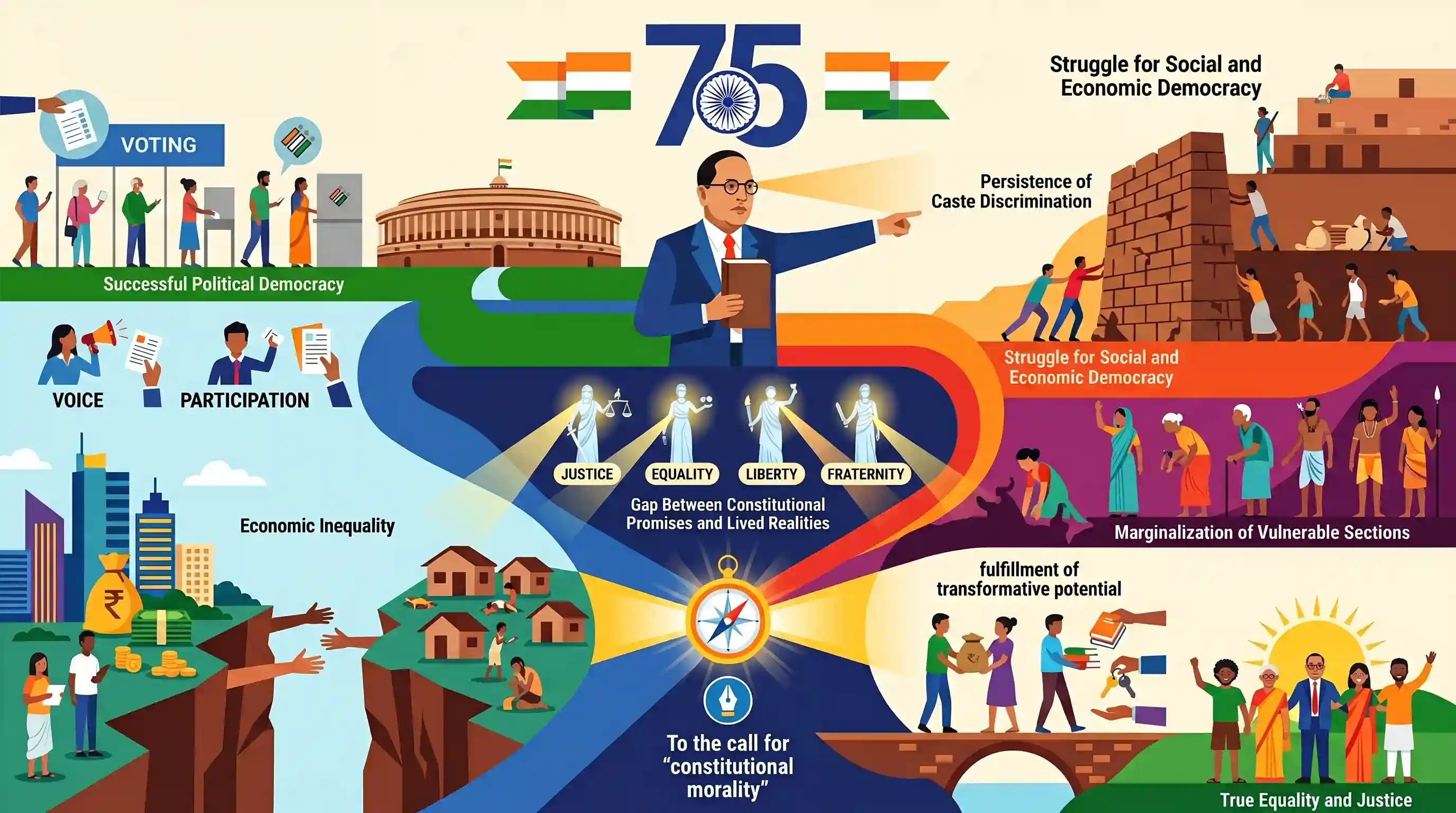
The article reflects on the 75th anniversary of the Indian Republic, assessing its trajectory through the lens of Dr. B.R. Ambedkar's vision. It emphasizes Ambedkar’s "unfinished agenda," pointing out that while India has successfully sustained political democracy, it still struggles to achieve social and economic democracy. The persistence of caste discrimination, economic inequality, and the marginalization of vulnerable sections highlights the gap between constitutional promises and lived realities. The piece calls for a deeper adherence to "constitutional morality" to fulfill the transformative potential of the Constitution and ensure true equality and justice for all citizens.
Key Points
- Evaluates the progress of the Indian Republic over 75 years against Dr. B.R. Ambedkar’s foundational vision for the nation.
- Highlights Ambedkar's distinction between political democracy (one person, one vote) and social/economic democracy (one person, one value), noting the latter remains unfulfilled.
- Underscores the persistent challenges of caste discrimination, structural inequality, and the marginalization of underprivileged communities.
- Stresses the need to embrace constitutional morality to bridge the gap between the Constitution's transformative ideals and ground realities.
- Calls for a renewed commitment to social justice and equitable development to complete Ambedkar's unfinished agenda.
Important Terms
Constitutional Morality

Adherence to the core values and spirit of the Constitution, such as justice and equality, beyond its literal text. It guides governance and prevents arbitrary power.
UPSC context
GS II (Polity/Judiciary) and GS IV (Ethics). Tests understanding of democratic values and judicial interpretations.
Social Democracy
A social system where liberty, equality, and fraternity are the fundamental principles of life, aimed at dismantling hierarchies like the caste system.
UPSC context
GS II (Social Justice). Tests knowledge of Dr. Ambedkar’s vision and inclusive governance.
Economic Democracy
A system ensuring equitable distribution of resources and opportunities to prevent exploitation, aiming for the ideal of 'one man, one value' in economic life.
UPSC context
GS II (DPSP) and GS III (Inclusive Growth). Tests link between constitutional principles and economic justice.
Constitution of India
The supreme law of India, establishing the country as a sovereign, socialist, secular, democratic republic. It provides the framework for governance and protects fundamental rights.
UPSC context
GS II (Polity). Core topic testing historical underpinnings, features, and amendments.
Constituent Assembly
The elected body that drafted the Indian Constitution between 1946 and 1949. Chaired by Dr. Rajendra Prasad, with Dr. Ambedkar leading the Drafting Committee.
UPSC context
GS II (Historical Underpinnings). Tests knowledge of the framing process and key personalities.
Indian Republic
Refers to the sovereign state status India achieved on January 26, 1950, marked by the commencement of the Constitution and the end of dominion status.
UPSC context
GS I (Post-Independence Consolidation) and GS II (Preamble). Relevant for milestones in India's democratic journey.
Prelims Trap
"The concept of 'Constitutional Morality' is explicitly defined in the Constitution of India."
The Constitution does not explicitly mention or define Constitutional Morality. It is a judicial innovation rooted in Ambedkar’s Constituent Assembly speeches, originally derived from historian George Grote.
Static Concepts Connected
How did Ambedkar and Gandhi differ in their approach to caste?
- Ambedkar's approach: Advocated for the complete "Annihilation of Caste" through state-led legal safeguards, political empowerment, and dismantling the systemic religious framework.
- Gandhi's approach: Relied on moral persuasion, heart-change, and constructive work (Harijan upliftment) to reform the Varna system from within, without destroying the underlying occupational division.
- Core divergence: Ambedkar saw caste as inherently oppressive requiring systemic destruction; Gandhi viewed untouchability as a societal distortion of a functional ideal.
What constitutes 'Constitutional Morality' in Indian polity?
- Origin: Coined by historian George Grote, it was popularized in India by Dr. B.R. Ambedkar to emphasize that democratic values must be deliberately cultivated.
- Core meaning: Strict adherence to core constitutional principles (equality, liberty, fraternity) over majoritarian societal norms, religious customs, or prevailing public morality.
- Judicial application: The Supreme Court has used it extensively (e.g., Navtej Singh Johar, Sabarimala) to strike down discriminatory traditions in favor of constitutional ideals.
Cross-Topic Patterns
Socio-economic democracy and DPSP
Ambedkar’s "life of contradictions" speech underpins the Directive Principles (Part IV), framing the ongoing post-independence struggle to translate political equality into equitable wealth distribution and economic justice.
Caste politicization in electoral democracy
GS1/GS2 linkage: Caste hasn't been annihilated but morphed into a tool for political mobilization and pressure groups, reflecting the complexities of the unfinished agenda alongside contemporary reservation sub-categorization demands.

Expect a GS2 Mains question comparing Ambedkar's vision of socio-economic democracy with the contemporary sub-categorization of SC/STs.
Linked PYQs · 5
Linked PYQs · 5
- 2025MainsGS2
"Constitutional morality is the fulcrum which acts as an essential check upon the high functionaries and citizens alike...." In view of the above observation of the Supreme Court, explain the concept of constitutional morality and its application to ensure balance between judicial independence and judicial accountability in India.
- 2021MainsGS2
‘Constitutional Morality’ is rooted in the Constitution itself and is founded on its essential facets. Explain the doctrine of ‘Constitutional Morality’ with the help of relevant judicial decisions.
- 2015MainsGS1
Mahatma Gandhi and Dr. B.R. Ambedkar, despite having divergent approaches and strategies, had a common goal of amelioration of the downtrodden. Elucidate.
- 2024MainsGS1
Despite comprehensive policies for equity and social justice, underprivileged sections are not yet getting the full benefits of affirmative action envisaged by the Constitution. Comment.
- 2018MainsGS1
Caste system is assuming new identities and associational forms. Hence, caste system cannot be eradicated in India." Comment.
