US Sanctions Waiver for Indian Refiners Amid Middle East Crisis
Source:Indian Express ↗
Why It Matters
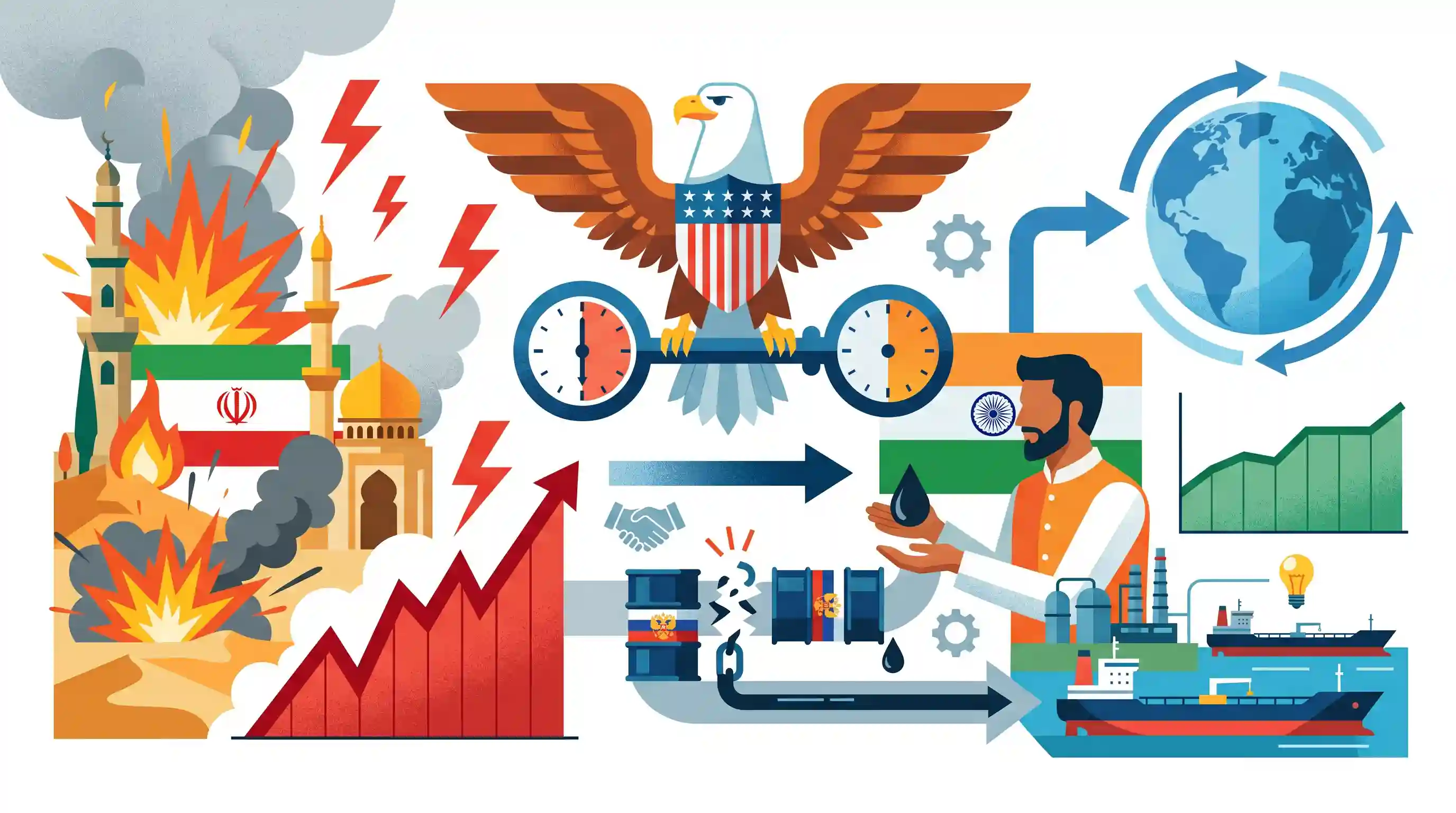
This highlights how major powers leverage economic sanctions and waivers strategically to manage global supply chains. For India, it demonstrates the success of its multi-aligned foreign policy in securing energy resources (energy security) despite overlapping geopolitical crises in Eastern Europe (Russia-Ukraine) and the Middle East (Iran-Israel-Lebanon).
Summary
The United States has granted Indian refiners a 30-day waiver to purchase Russian oil, temporarily easing sanctions pressure amid escalating conflicts in the Middle East. With an ongoing war involving Iran and recent strikes in Beirut, Lebanon, global energy markets are facing a severe supply crunch. The waiver allows India to continue importing Russian crude without violating the G7 price cap mechanism, thereby preventing a sharp spike in global oil prices. This development underscores India's pivotal role in stabilizing global energy supplies and highlights the pragmatic adjustments in US foreign policy when geopolitical crises threaten economic stability.
Key Points
- The US granted a 30-day sanctions waiver allowing Indian refiners to purchase Russian crude oil without facing penalties under the G7 price cap regime.
- The decision is driven by fears of a global energy supply crunch triggered by the escalating Iran war and recent military strikes in Beirut, Lebanon.
- By permitting Indian imports of Russian oil, the US aims to keep global oil prices stable, recognizing that a sudden disruption of Russian crude would exacerbate the Middle Eastern supply shock.
- The move validates India's pursuit of strategic autonomy in its foreign policy, successfully balancing its energy security needs with complex diplomatic relations involving the US, Russia, and the Middle East.
Important Terms
G7 Russian Oil Price Cap

A mechanism by G7, EU, and Australia prohibiting services (insurance/shipping) for Russian oil sold above $60/barrel to limit Moscow's war revenue while maintaining global supply.
UPSC context
GS Paper II (International Relations) and GS Paper III (Economy); tests understanding of global economic statecraft and energy diplomacy.
US Sanctions
Penalties imposed by the U.S. government (often via OFAC) to restrict economic activity with targeted nations, entities, or individuals to achieve foreign policy and national security goals.
UPSC context
GS Paper II; crucial for understanding the impact of developed countries' policies on India’s strategic and economic interests.
Energy Security
The uninterrupted availability of energy sources at an affordable price, involving long-term investments and short-term ability to respond to supply-demand changes.
UPSC context
GS Paper III (Energy/Infrastructure); tests knowledge of India's import dependency and strategies to mitigate global supply chain disruptions.
Strait of Hormuz
A vital maritime chokepoint between the Persian Gulf and the Gulf of Oman through which approximately one-fifth of global oil consumption passes daily.
UPSC context
GS Paper I (Geography) and GS Paper II (Geopolitics); key for understanding West Asian stability and its direct impact on India.
Indian Refiners
Industrial facilities (e.g., IOCL, Reliance) that process crude oil into petroleum products; they are critical actors in managing India's fuel supply and navigating international trade restrictions.
UPSC context
GS Paper III (Economy); relevant for questions on industrial growth, trade balance, and the impact of global oil price volatility.
Group of Seven (G7)
An informal forum of seven of the world's most advanced economies (US, UK, France, Germany, Italy, Canada, Japan) that coordinates global economic and security policies.
UPSC context
GS Paper II (International Groupings); tests knowledge of major global institutions and their influence on international norms and sanctions.
Prelims Trap
The G7 price cap completely prohibits the import of Russian crude oil by non-G7 nations like India.
The cap does not ban imports; it only blocks Western shipping and insurance services if the oil is purchased above the capped price, ensuring global market supply.
Static Concepts Connected
How does the G7 Price Cap mechanism on Russian crude oil function?
- Core Mechanism: It restricts access to Western maritime insurance, finance, and shipping for Russian oil transport.
- The Condition: These vital services are only permitted if the crude is purchased at or below a predetermined cap (e.g., $60 per barrel).
- Strategic Objective: It aims to simultaneously reduce Russian oil revenues to fund its war while keeping global energy markets supplied to prevent massive price spikes.
How do global oil price shocks impact India's macroeconomic stability?
- Current Account Deficit: Since India imports over 80% of its crude oil, sudden price spikes massively inflate the import bill, directly widening the CAD.
- Imported Inflation: Higher crude prices cascade into domestic fuel, freight, and manufacturing costs, elevating retail and wholesale inflation.
- Currency Depreciation: Increased demand for US Dollars to pay for expensive oil imports puts downward pressure on the Indian Rupee, causing depreciation.
Cross-Topic Patterns
Map: Levant Region & Global Chokepoints
Escalations involving Iran and Lebanon directly impact the Levant region and Strait of Hormuz. UPSC frequently pairs West Asian conflict zones with critical maritime trade chokepoints.
Strategic Autonomy & Economic Statecraft
India's ability to negotiate US sanction waivers—similar to past CAATSA or Chabahar exemptions—exemplifies its multi-alignment strategy, balancing Western strategic ties with core domestic energy needs.

Expect a multi-statement Prelims question interlinking G7 price cap mechanics, US sanctions waivers, and Middle East map locations.
Linked PYQs · 4
Linked PYQs · 4
- 2025MainsGS2
"Energy security constitutes the dominant kingpin of India's foreign policy, and is linked with India's overarching influence in Middle Eastern countries.” How would you integrate energy security with India's foreign policy trajectories in the coming years?
- 2012MainsGS2
How have the US sanctions against Iran affected India's bilateral relations with Iran?
- 2022PrelimsGS1
The term "Levant" often heard in the news roughly corresponds to which of the following regions?
- 2017PrelimsGS1
Mediterranean Sea is a border of which of the following countries? 1. Jordan 2. Iraq 3. Lebanon 4. Syria Select the correct answer using the code given below:
