Indian Railways Approves Regional Infra Projects
Source:Indian Express ↗
Why It Matters
Infrastructure investment, particularly in critical transport sectors like the Railways, is vital for driving rapid and inclusive economic growth. Understanding the allocation of capital expenditure for regional connectivity projects helps candidates analyze government priorities in addressing logistical bottlenecks and implementing the National Rail Plan.
Summary
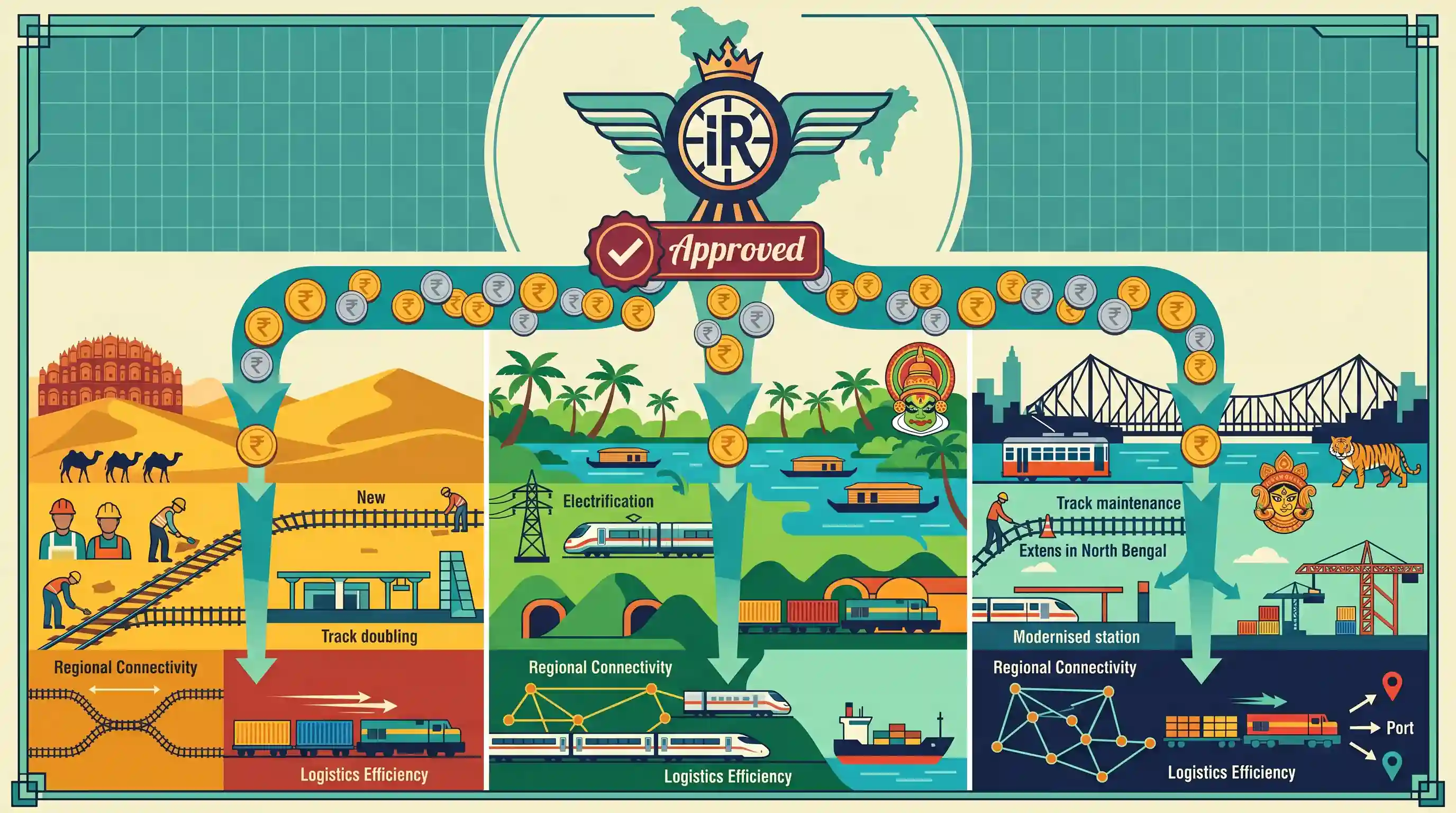
Indian Railways has approved infrastructure development projects worth Rs 872 crore across Rajasthan, Kerala, and West Bengal to boost regional connectivity and logistics efficiency.
Key Points
- Indian Railways has sanctioned Rs 872 crore for various infrastructure projects across Rajasthan, Kerala, and West Bengal.
- The sanctioned projects aim to enhance rail network capacity, reduce logistical bottlenecks, and improve overall connectivity in these states.
- Such targeted capital expenditure by the Railways plays a crucial role in modernizing transport infrastructure and supporting regional economic growth.
Important Terms
National Rail Plan (NRP) 2030

A strategic roadmap released in 2020 to create a future-ready railway system, aiming to increase rail's freight modal share from 27% to 45% by 2030.
UPSC context
GS Paper 3: Infrastructure and Planning; critical for questions on logistics efficiency and sustainable transportation targets.
Gati Shakti Cargo Terminal (GCT)
Multi-modal logistics hubs developed under a 2021 policy to boost freight revenue and reduce logistics costs through private investment and public-private partnerships.
UPSC context
GS Paper 3: Infrastructure and Investment Models; relevant for multi-modal connectivity and the PM Gati Shakti National Master Plan.
Capital Expenditure (Capex)
Funds utilized by the government for large-scale physical assets like track doubling and modernizing coaches to stimulate economic growth and enhance long-term capacity.
UPSC context
GS Paper 3: Indian Economy and Budgeting; tests understanding of fiscal stimulus and the multiplier effect on core sectors.
Operating Ratio
A financial metric representing the ratio of working expenses to gross earnings; a lower ratio indicates higher profitability and greater surplus for internal investment.
UPSC context
GS Paper 3: Indian Economy; a standard indicator for assessing the financial health and efficiency of public sector undertakings.
Multi-modal Connectivity
The seamless integration of various transport modes (rail, road, water) to facilitate efficient movement of goods and people, reducing overall logistics bottlenecks.
UPSC context
GS Paper 3: Infrastructure; essential for discussing the Gati Shakti Master Plan and improving India's global logistics ranking.
Prelims Trap
"Indian Railways currently accounts for the majority of India's freight modal share, reducing overall logistics costs."
Aspirants often assume railways dominate bulk freight. However, roadways currently carry ~71% of India's freight. The National Rail Plan aims to increase the railway share to 45% by 2030.
Static Concepts Connected
What is the Capital Expenditure (CapEx) Multiplier Effect?
- Definition: The proportional increase in national income/GDP generated by an increase in government capital spending.
- CapEx vs RevEx: CapEx yields a higher multiplier (~2.45) compared to revenue expenditure (~0.99) because it creates productive, long-term physical assets.
- Crowding-in Effect: Consistent public CapEx removes logistical bottlenecks, lowers business costs, and crowds-in private investment over time.
What are the core targets of the National Logistics Policy (NLP) 2022?
- Cost Reduction: Reduce India's logistics costs from the historical 13-14% of GDP to global benchmarks (around 8%) by 2030.
- LPI Ranking: Improve India's ranking in the World Bank's Logistics Performance Index (LPI) to be among the top 25 by 2030.
- Digital Integration: Implement a Unified Logistics Interface Platform (ULIP) to break departmental silos and ensure seamless multi-modal connectivity.
Cross-Topic Patterns
PM Gati Shakti & Fiscal Federalism
Railway CapEx expansions are increasingly tied to the PM Gati Shakti platform, heavily linking central infrastructure outlays with the 50-year interest-free CapEx loans granted to states under fiscal federalism schemes.
Carbon Intensity of Freight & NDCs
Shifting India's freight modal share from road (71%) to rail (27%) directly serves the 'Panchamrit' climate goals, as rail freight is significantly less carbon-intensive per ton-kilometer than trucking.

Expect a multi-statement Prelims question integrating CapEx economic multipliers with the National Rail Plan's modal share targets.
Linked PYQs · 3
Linked PYQs · 3
- 2022MainsGS3
Why is Public Private Partnership (PPP) required in infrastructural projects ? Examine the role of PPP model in the redevelopment of Railway Stations in India.
- 2025PrelimsGS1
Consider the following statements : I. Indian Railways have prepared a National Rail Plan (NRP) to create a 'future ready' railway system by 2028. II. 'Kavach' is an Automatic Train Protection system developed in collaboration with Germany. III. 'Kavach' system consists of RFID tags fitted on track in station section. Which of the statements given above are not correct?
- 2021MainsGS3
“Investment in infrastructure is essential for more rapid and inclusive economic growth.” Discuss in the light of India's experience.
