Indian Railways Targets Freight Growth and Passenger Amenities
Source:Indian Express ↗
Why It Matters
Indian Railways is a critical component of India's macroeconomic infrastructure. Shifting freight from road to rail reduces the country's logistics costs, thereby improving the global competitiveness of Indian manufacturing and exports while promoting environmentally sustainable transport.
Summary
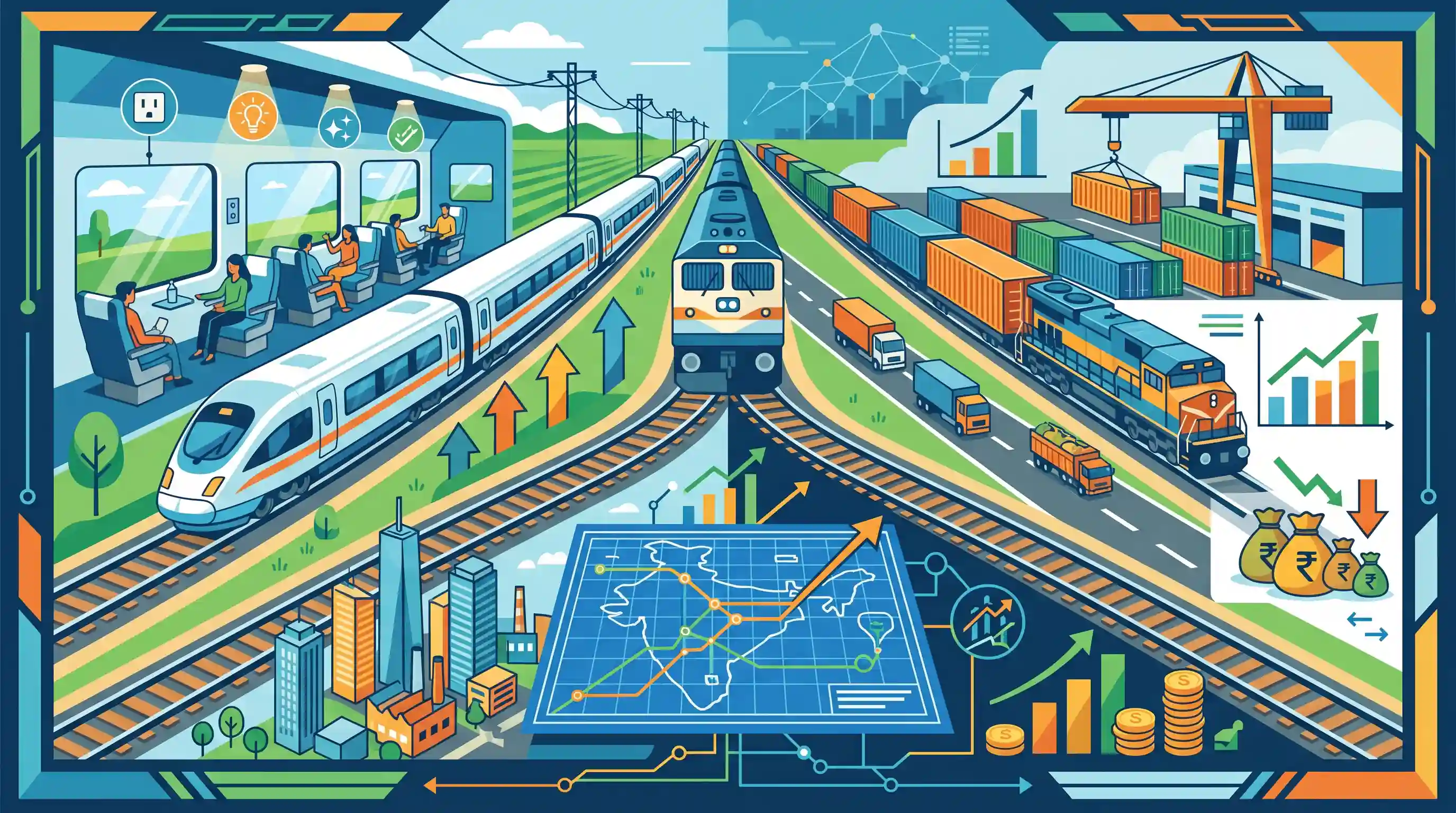
The article discusses the upcoming reform push by Indian Railways, which balances passenger-friendly initiatives with economic and operational upgrades. Key focus areas include deploying cleaner coaches and improving onboard amenities to elevate the travel experience. Concurrently, the railways aim to substantially increase freight loading capacity and efficiency. By capturing a larger share of the cargo market from road transport, these reforms are designed to lower India's overall logistics costs, boost the financial health of the railways, and align with broader infrastructure goals like the National Rail Plan and Dedicated Freight Corridors.
Key Points
- Indian Railways is rolling out a reform agenda focused on enhancing both passenger experience and freight operational efficiency.
- Passenger-centric upgrades prioritize cleaner coaches, better sanitation amenities, and the expansion of modern train fleets like Vande Bharat.
- To boost revenue and reduce national logistics costs, the railways are aggressively targeting higher freight loading to shift cargo transport from road to rail.
- Long-term infrastructure upgrades align with the National Rail Plan to create a future-ready, financially viable, and high-capacity network by 2030.
Important Terms
National Rail Plan (NRP) 2030

A strategic roadmap to create a 'future-ready' railway system by 2030, aiming to increase the rail share in freight from 27% to 45% to reduce carbon emissions.
UPSC context
GS-3: Infrastructure; tests knowledge of long-term infrastructure planning and modal shifts in transport for economic efficiency.
Dedicated Freight Corridor (DFC)
High-capacity, high-speed railway routes used exclusively for goods transport, designed to decongest passenger lines and reduce transit time and logistics costs.
UPSC context
GS-3: Infrastructure; important for questions on logistics bottlenecks, industrial corridors, and public-private partnerships.
Logistics Cost
The total expenditure incurred in moving goods from origin to consumption; India aims to reduce this from ~14% to 8% of GDP to improve global competitiveness.
UPSC context
GS-3: Economy; critical for understanding 'Make in India,' export competitiveness, and the 'Ease of Doing Business' framework.
Vande Bharat Express
Indigenously designed semi-high-speed, self-propelled train sets (Train 18) developed under the 'Make in India' initiative to modernize passenger travel with world-class amenities.
UPSC context
GS-3: Indigenization of Technology; reflects India's progress in rail technology and self-reliance (Atmanirbhar Bharat).
Indian Railways
The national carrier under the Ministry of Railways, undergoing massive reforms to balance social obligations with commercial viability through infrastructure upgrades and freight expansion.
UPSC context
GS-3: Infrastructure/Economic Growth; focuses on public sector reforms, modernization, and the fiscal health of state-owned enterprises.
Prelims Trap
Indian Railways currently commands the highest modal share of freight transport in India.
Road transport dominates India's freight sector (~65%). Railways currently hold only ~27% modal share, which the National Rail Plan aims to increase to 45% by 2050.
Static Concepts Connected
What is the 'Operating Ratio' in the context of Indian Railways?
- Definition: The metric showing how much money is spent to earn one rupee; a ratio of 98% means 98 paise is spent to earn 1 Rupee.
- Significance: It is the primary macroeconomic indicator of the Railways' financial health and operational efficiency.
- Cross-subsidization: High freight tariffs are routinely used to offset massive losses in the passenger segment to keep the ratio manageable.
What are the core objectives of Dedicated Freight Corridors (DFCs)?
- Core Concept: Broad gauge railway lines constructed exclusively for freight transport, cleanly separating heavy cargo traffic from passenger trains.
- Decongestion: They unburden the saturated passenger network, allowing passenger trains to run on time while increasing average freight train speeds from 22 kmph to 50+ kmph.
- Cost reduction: Essential for reducing India's overall logistics cost from 14-16% of GDP down to the global benchmark of 8%.
Cross-Topic Patterns
Modal shift & India's climate targets
Shifting freight from road to rail is a critical lever for achieving India's Nationally Determined Contribution (NDC) target of reducing the emissions intensity of its GDP by 45% by 2030.
Capex & the Union Budget merger
The 2017 merger of the Railway Budget with the General Budget shifted massive capital expenditure burdens to the central exchequer, enabling rapid DFC and Vande Bharat rollouts despite poor railway operating ratios.

Expect a multi-statement Prelims question linking PM Gati Shakti, DFCs, and the National Rail Plan's 45% modal share target.
Linked PYQs · 3
Linked PYQs · 3
- 2022MainsGS3
Why is Public Private Partnership (PPP) required in infrastructural projects ? Examine the role of PPP model in the redevelopment of Railway Stations in India.
- 2025PrelimsGS1
Consider the following statements : I. Indian Railways have prepared a National Rail Plan (NRP) to create a 'future ready' railway system by 2028. II. 'Kavach' is an Automatic Train Protection system developed in collaboration with Germany. III. 'Kavach' system consists of RFID tags fitted on track in station section. Which of the statements given above are not correct?
- 2021MainsGS3
“Investment in infrastructure is essential for more rapid and inclusive economic growth.” Discuss in the light of India's experience.
