Indian Railways Passenger Traffic and Freight Growth in FY25
Source:Indian Express ↗
Why It Matters
The performance metrics of Indian Railways are vital indicators of the nation's economic health and logistical efficiency. Growth in both passenger and freight traffic reflects the impact of ongoing infrastructure modernization, capacity augmentation, and policies aimed at enhancing connectivity and economic growth.
Summary
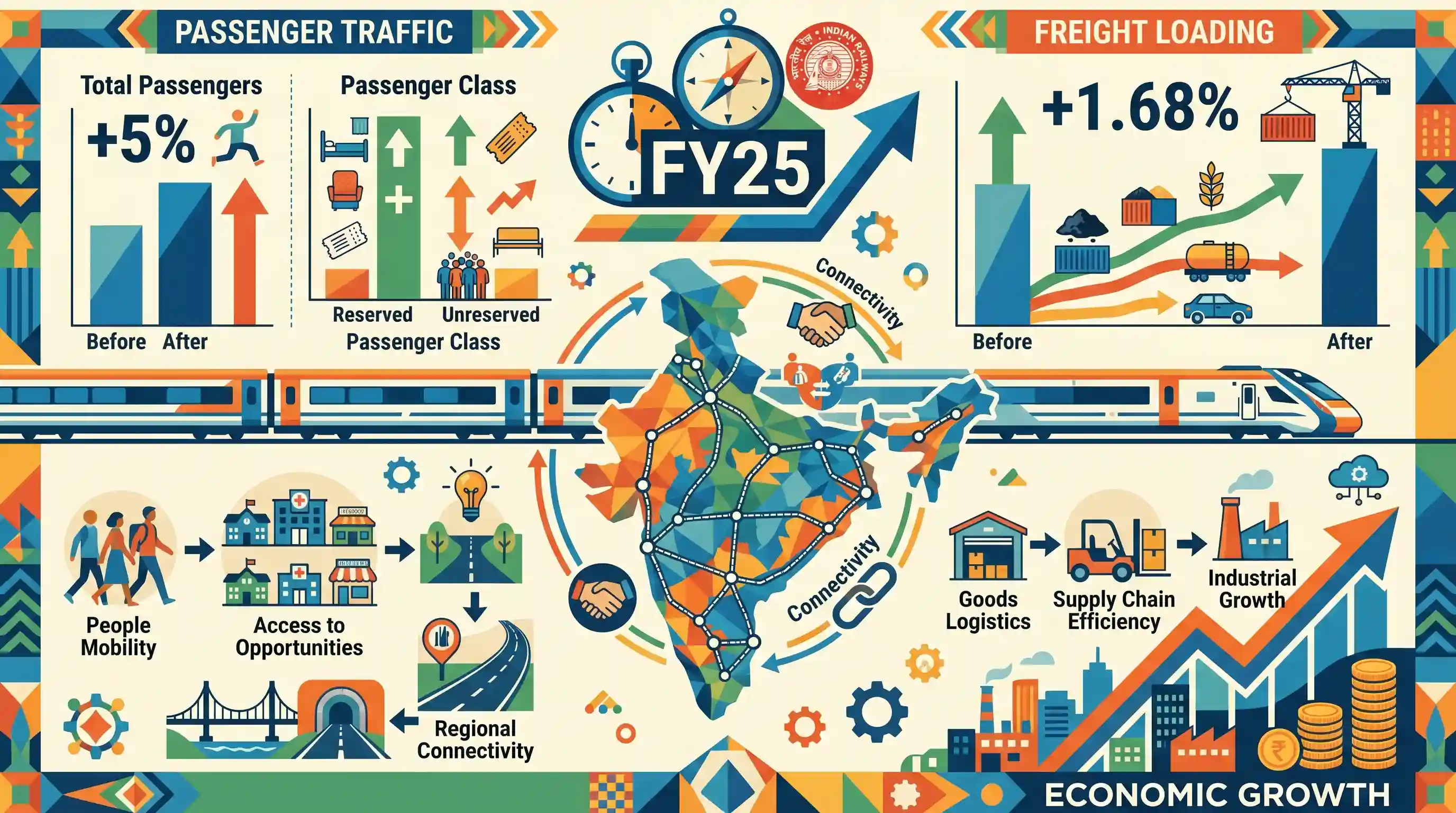
In FY25, Indian Railways witnessed a 5% jump in passenger traffic, primarily fueled by an increase in reserved class travel. Simultaneously, freight loading experienced a growth of 1.68%, highlighting the transporter's continued expansion in both passenger mobility and goods logistics. This performance underscores the critical role of railways in facilitating economic activity and regional connectivity in India.
Key Points
- Indian Railways recorded a 5% increase in passenger traffic in FY25.
- The growth in passenger traffic was significantly driven by a rise in reserved class travel.
- Freight loading by the national transporter grew by 1.68% during the same fiscal year.
- The data reflects steady operational growth in both passenger mobility and goods logistics, indicating a robust performance of core transport infrastructure.
Important Terms
Indian Railways

India's national rail transporter and the world's fourth-largest network, providing essential passenger and freight services while serving as the backbone of the country's logistics infrastructure.
UPSC context
GS Paper III (Infrastructure: Railways). Tests knowledge of the national transporter's economic impact and operational milestones.
Dedicated Freight Corridors (DFCs)
Specialized, high-capacity railway tracks designed exclusively for goods transport, aimed at separating freight from passenger traffic to increase speed, reduce costs, and enhance capacity.
UPSC context
GS Paper III (Logistics/Infrastructure). Critical for understanding supply chain efficiency and the separation of traffic modes.
National Rail Plan (NRP) 2030
A strategic blueprint aimed at creating a 'future-ready' railway system by 2030, specifically targeting an increase in the rail freight modal share from 27% to 45%.
UPSC context
GS Paper III (Economic Development/Planning). Relevant for questions on long-term infrastructure goals and carbon emission reductions.
PM Gati Shakti
A National Master Plan for Multi-modal Connectivity launched in 2021 to ensure integrated planning and synchronized implementation of infrastructure projects across 16 ministries.
UPSC context
GS Paper II (Government Policies) and Paper III (Infrastructure). Tests understanding of integrated planning to reduce logistics bottlenecks.
Logistics Cost
The total expenditure involved in moving and storing goods, which India aims to lower from approximately 13-14% of GDP to the global benchmark of 8%.
UPSC context
GS Paper III (Indian Economy). A key indicator of industrial competitiveness and the success of the National Logistics Policy.
Modal Share
The proportion of total transport (freight or passenger) handled by a specific mode, such as rail, relative to others like road, air, or water.
UPSC context
GS Paper III (Infrastructure). Important for analyzing the shift from road to rail for economic and environmental benefits.
Vande Bharat Express
Indigenous semi-high-speed self-propelled train sets that have modernized Indian passenger travel and significantly contributed to the growth in reserved class revenue.
UPSC context
GS Paper III (Science & Technology/Infrastructure). Tests knowledge of 'Make in India' and modernization of public transport.
Prelims Trap
Passenger earnings constitute the primary source of revenue for Indian Railways due to high ridership.
Despite massive passenger volumes, railways rely heavily on freight traffic to generate majority revenue, utilizing it to cross-subsidize artificially low passenger fares.
Static Concepts Connected
What does the Operating Ratio signify for Indian Railways?
- Definition: It measures operating expenses as a percentage of revenue earned. A lower ratio indicates better financial health.
- Current Status: It remains persistently high (projected ~98.4% for FY26), meaning 98 rupees are spent to earn 100 rupees.
- Impact: High ratios leave minimal internal surplus for capital upgrades, safety modernization, and capacity expansion.
What are the core targets of the National Rail Plan 2030?
- Freight Share: Increase the modal share of railways in freight transportation from the current ~27% to 45% by 2030.
- Future-proofing: Create operational capacity by 2030 that is sufficient to cater to projected demand up to 2050.
- Decarbonization: Support India's net-zero emissions target by promoting energy-efficient rail transport over carbon-heavy road transport.
Cross-Topic Patterns
Railways & National Logistics Policy
Shifting freight from road to rail via Dedicated Freight Corridors is central to the National Logistics Policy's goal of reducing India's logistics costs to global single-digit averages.
Cross-subsidization & Structural Inflation
High rail freight tariffs, designed to subsidize passenger fares, artificially inflate transport costs for core commodities like coal and cement, feeding broader macroeconomic inflation.

Expect a multi-statement question on railway economics linking Operating Ratio, cross-subsidization, and National Rail Plan targets.
Linked PYQs · 2
Linked PYQs · 2
- 2022MainsGS3
Why is Public Private Partnership (PPP) required in infrastructural projects ? Examine the role of PPP model in the redevelopment of Railway Stations in India.
- 2021MainsGS3
“Investment in infrastructure is essential for more rapid and inclusive economic growth.” Discuss in the light of India's experience.
