Jan Vishwas Act and Indian Railways New Penalty Rules
Source:Indian Express ↗
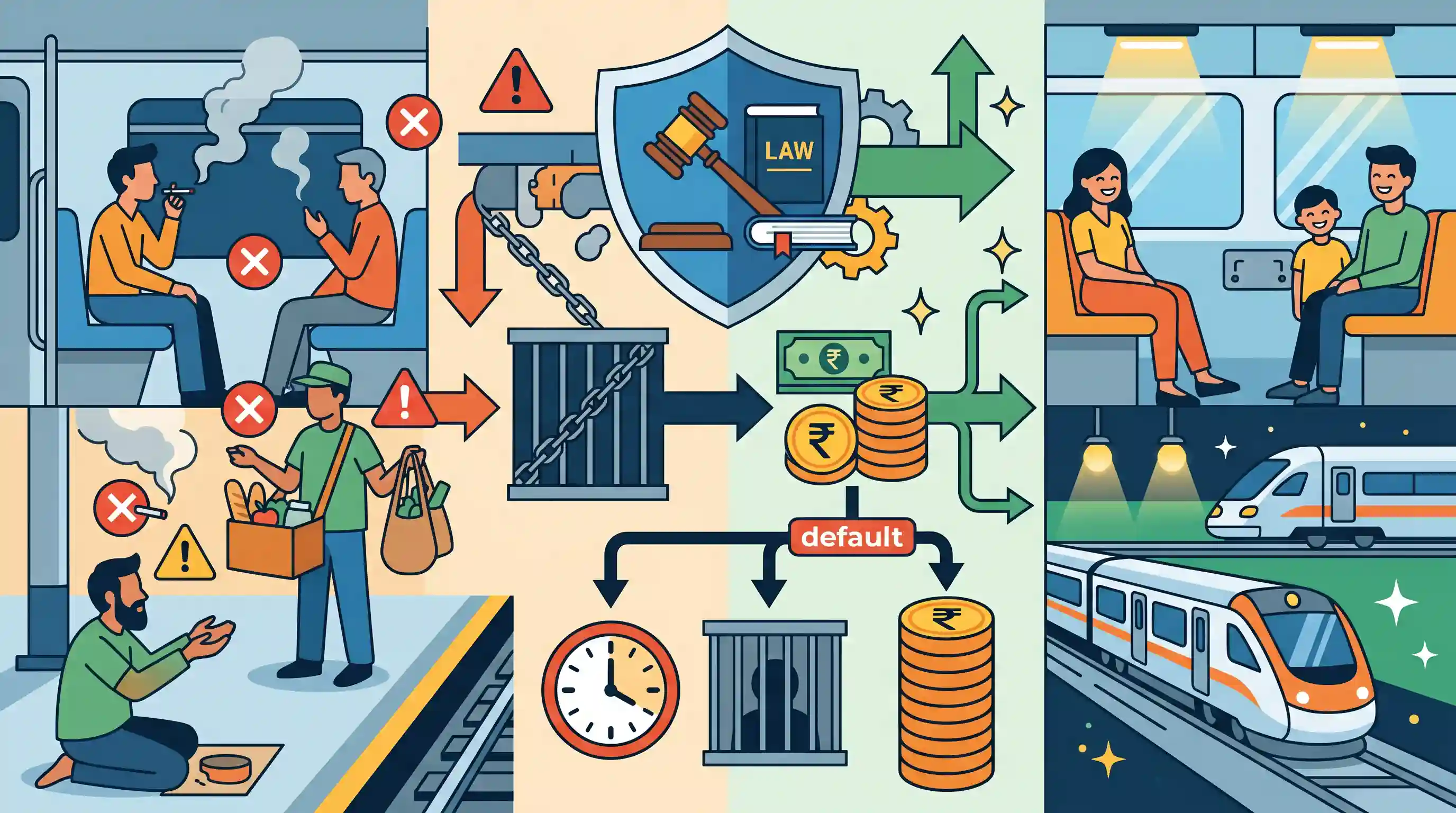
Why It Matters
It provides a concrete example of how the Jan Vishwas Act, 2023 is being applied in real-world governance to convert minor criminal offences into strict civil penalties, improving the ease of living and public infrastructure management.
Summary
Indian Railways has introduced new penalty rules to curb public nuisances such as smoking, unauthorised hawking, and begging in trains and on railway premises. Enacted under the Jan Vishwas (Amendment of Provisions) Act, 2023, which amends the Railways Act of 1989, the rules impose a strict fine of Rs 2,000 for these offences. In cases of default, offenders may face up to three months in prison or an additional fine of Rs 5,000. The implementation highlights the government's approach to rationalising legal provisions—substituting immediate criminal prosecution for minor offences with severe financial deterrents—to effectively improve public infrastructure governance and passenger experience.
Key Points
- Indian Railways has implemented new rules enforcing a strict fine of Rs 2,000 for smoking, begging, and unauthorised hawking on trains and premises.
- The rules are enacted under the Jan Vishwas (Amendment of Provisions) Act, 2023, which modifies Sections 144 and 167 of the Railways Act, 1989.
- The regulations aim to enhance passenger comfort and safety by deterring nuisance-causing activities through structured monetary penalties.
- Failure to pay the fine can result in imprisonment for up to three months, a fine up to Rs 5,000, or both, ensuring strict compliance despite the overarching decriminalisation approach.
Important Terms
Jan Vishwas (Amendment of Provisions) Act

A landmark legislation aimed at decriminalizing minor, technical, or procedural offenses across multiple Central Acts. It replaces imprisonment with monetary penalties to reduce judicial backlog and promote trust-based governance.
UPSC context
GS II (Government Policies) & GS III (Economy). Tests knowledge of regulatory reforms and ease of doing business.
Railways Act, 1989
The primary legislative framework governing India's railway system. Recent amendments under the Jan Vishwas initiative have significantly increased fines for public nuisances like smoking (Rs 2,000) and unauthorized hawking.
UPSC context
GS III (Infrastructure: Railways). Evaluates understanding of statutory frameworks governing national transport and passenger safety.
Decriminalization of Minor Offenses
The policy shift of reclassifying low-gravity criminal acts into civil or administrative violations. This allows authorities to impose immediate financial deterrents instead of pursuing lengthy criminal litigation for minor lapses.
UPSC context
GS II (Governance/Judiciary). Relates to judicial reforms and reducing the pendency of cases in Indian courts.
Ease of Living
A governance objective focused on simplifying citizens' interactions with the state. In railways, this involves creating a safe, disciplined, and nuisance-free travel environment through rationalized penalties and improved enforcement.
UPSC context
GS II (Governance). Measures the effectiveness of government interventions in improving public welfare and administrative efficiency.
Railway Protection Force (RPF)
A specialized security force under the Ministry of Railways. The new rules empower personnel to impose and recover penalties on the spot for minor violations like smoking and begging.
UPSC context
GS III (Security). Tests knowledge of agencies responsible for protecting critical infrastructure and maintaining public order.
Prelims Trap
The Jan Vishwas Act completely abolishes imprisonment for minor offences across all amended Acts.
Imprisonment is not entirely eliminated. It remains as a default penalty; if the civil fine is not paid, offenders still face prosecution and potential jail time.
Static Concepts Connected
What are the key features of the Jan Vishwas Act 2023?
- Civil penalties: Replaces initial criminal prosecution for minor offences with structured monetary fines across 42 Central Acts.
- Adjudicating Officers: Empowers administrative officials to levy penalties directly, bypassing court trials to reduce judicial pendency.
- Dynamic escalation: Automatically increases minimum fines and penalties by 10% every three years to account for inflation.
How is legislative power over Railways distributed in India?
- Union List: Railways fall under Entry 22 of the Union List (List I) in the Seventh Schedule.
- Exclusive jurisdiction: Parliament holds exclusive power to enact and amend laws like the Railways Act, 1989.
Cross-Topic Patterns
Judicial pendency & administrative adjudication
Shifting minor offences to civil penalties levied by administrative officers directly addresses the massive backlog of petty criminal cases clogging India's subordinate judiciary.
Decriminalisation vs Default Punishment
Despite the push for trust-based governance, state capacity relies on a coercive 'default clause' (imprisonment) to enforce the actual collection of these new civil fines.

Expect a 2026 Prelims statement testing the Jan Vishwas Act's unique provision of automatic 10% penalty escalation every three years.
Linked PYQs · 1
Linked PYQs · 1
- 2022MainsGS3
Why is Public Private Partnership (PPP) required in infrastructural projects ? Examine the role of PPP model in the redevelopment of Railway Stations in India.
