Indian Railways Approves Infrastructure Projects Across Four States
Source:Indian Express ↗
Why It Matters
Demonstrates the government's ongoing capital expenditure push on transport infrastructure, which is highly relevant to the GS3 syllabus topic on Infrastructure (Railways) and its direct role in facilitating rapid and inclusive economic growth.
Summary
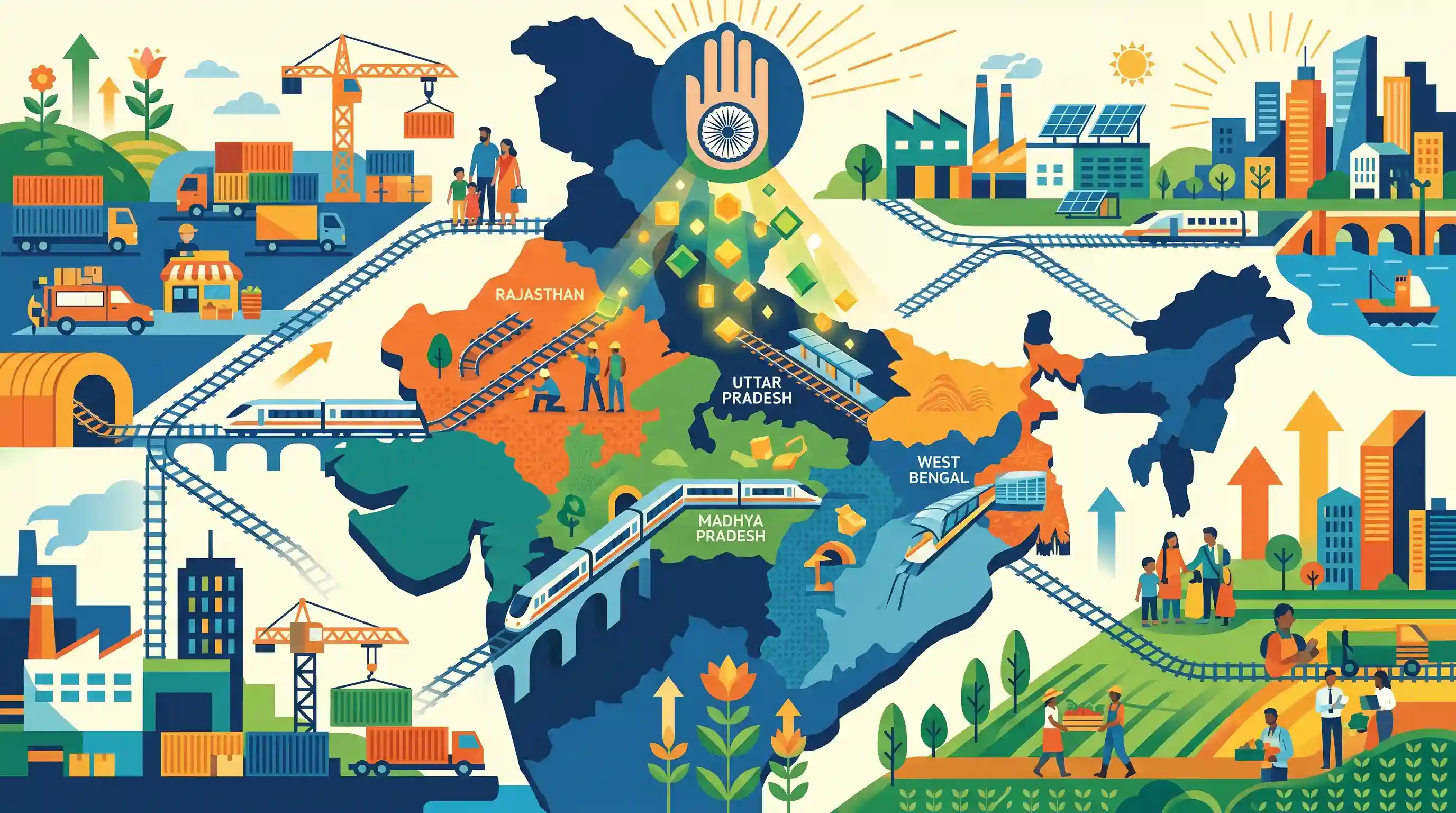
The Indian Railways has approved new infrastructure projects worth Rs 1,334 crore covering the states of Uttar Pradesh, Rajasthan, Madhya Pradesh, and West Bengal. This capital investment is intended to expand and modernize the railway network, thereby enhancing regional connectivity and improving logistics. Such infrastructure development is crucial for accelerating inclusive economic growth and improving the overall transport framework in the country.
Key Points
- Indian Railways has approved new infrastructure projects valued at Rs 1,334 crore.
- The projects will be implemented across four states: Uttar Pradesh, Rajasthan, Madhya Pradesh, and West Bengal.
- These investments are aimed at boosting regional connectivity, upgrading transport logistics, and facilitating smoother movement of goods and passengers.
- The development aligns with the government's broader capital expenditure push in the infrastructure sector to spur inclusive economic growth and generate employment.
Important Terms
Indian Railways

The world's fourth-largest national railway system under single management, serving as the "backbone" of India's transport infrastructure for both passenger and heavy freight movement.
UPSC context
GS Paper III (Infrastructure); tests understanding of transport's role in economic growth and regional integration.
PM Gati Shakti
A transformative National Master Plan for multi-modal connectivity, integrating various infrastructure schemes (like Bharatmala and Sagarmala) to ensure seamless movement of people and goods.
UPSC context
GS Paper III (Infrastructure/Logistics); central to questions on integrated planning and reducing logistics bottlenecks.
Logistics Efficiency
The streamlining of transportation and supply chains to reduce time and costs; India aims to lower logistics costs from ~14% of GDP to global benchmarks.
UPSC context
GS Paper III (Economy/Infrastructure); critical for industrial competitiveness and export-led growth.
Capital Expenditure (Capex)
Funds used by the government to acquire, maintain, or improve physical assets like rail lines; railway investments have a high 'multiplier effect' on the economy.
UPSC context
GS Paper III (Budgeting/Economy); focuses on fiscal stimulus and long-term asset creation.
Multi-modal Connectivity
The integrated use of different transport modes (rail, road, air, water) to provide seamless, efficient, and cost-effective last-mile connectivity for passengers and freight.
UPSC context
GS Paper III (Infrastructure); essential for supply chain resilience and National Logistics Policy goals.
Infrastructure Multiplier Effect
An economic principle where investment in infrastructure (like railways) generates total economic output significantly greater than the original investment through job creation and industrial demand.
UPSC context
GS Paper III (Economy); explains why high-value railway projects are prioritized for inclusive growth.
Prelims Trap
The National Rail Plan 2030 aims to achieve a 100% modal share for railways in India's freight transport.
The actual target under the National Rail Plan 2030 is to increase the railways' modal share in freight to 45% (from ~27%), not 100%.
Static Concepts Connected
What are the core features of the PM Gati Shakti Master Plan?
- Integrated Planning: Brings 16 infrastructure-related ministries together on a centralized digital platform to break departmental silos.
- GIS-based Mapping: Utilizes an integrated Geographic Information System (GIS) portal with over 200 layers for spatial planning and clearance monitoring.
- Logistics Efficiency: Aims to optimize multi-modal connectivity, reduce overarching logistics costs, and improve the turnaround time for freight.
What is the 'Kavach' system in Indian Railways?
- Indigenous ATP: An indigenously developed Automatic Train Protection (ATP) system designed to achieve Safety Integrity Level 4 (SIL-4) standards.
- Auto-Braking: Automatically applies brakes if the locomotive pilot fails to do so, preventing Signal Passing At Danger (SPAD) and collisions.
- RFID Technology: Uses Radio Frequency Identification (RFID) tags placed on tracks and station yards for real-time track and position identification.
Cross-Topic Patterns
Rail freight & National Logistics Policy
Increasing the railway freight share to 45% is critical to the National Logistics Policy's objective of reducing India's overarching logistics cost to single digits, aligning with global averages.
Infrastructure expansion & PPP Models
Station redevelopment (Amrit Bharat) and new rail lines increasingly rely on Public-Private Partnerships, bringing models like Hybrid Annuity (HAM) and Build-Operate-Transfer (BOT) into focus.

Expect a 2026 multi-statement question linking National Rail Plan's 45% freight target with PM Gati Shakti and Kavach tech details.
Linked PYQs · 2
Linked PYQs · 2
- 2021MainsGS3
“Investment in infrastructure is essential for more rapid and inclusive economic growth.” Discuss in the light of India's experience.
- 2022MainsGS3
Why is Public Private Partnership (PPP) required in infrastructural projects ? Examine the role of PPP model in the redevelopment of Railway Stations in India.
