Railway infrastructure management for mega religious festivals
Source:Indian Express ↗
Why It Matters
This news item highlights the vital role of public infrastructure (Indian Railways) in managing religious tourism and mass mobility. It serves as a practical example for GS3 (Infrastructure, Disaster and Crowd Management) and GS1 (Indian Heritage and Culture), showing how administrative machinery prepares for mega-events like the Rath Yatra to prevent mishaps while ensuring seamless connectivity.
Summary
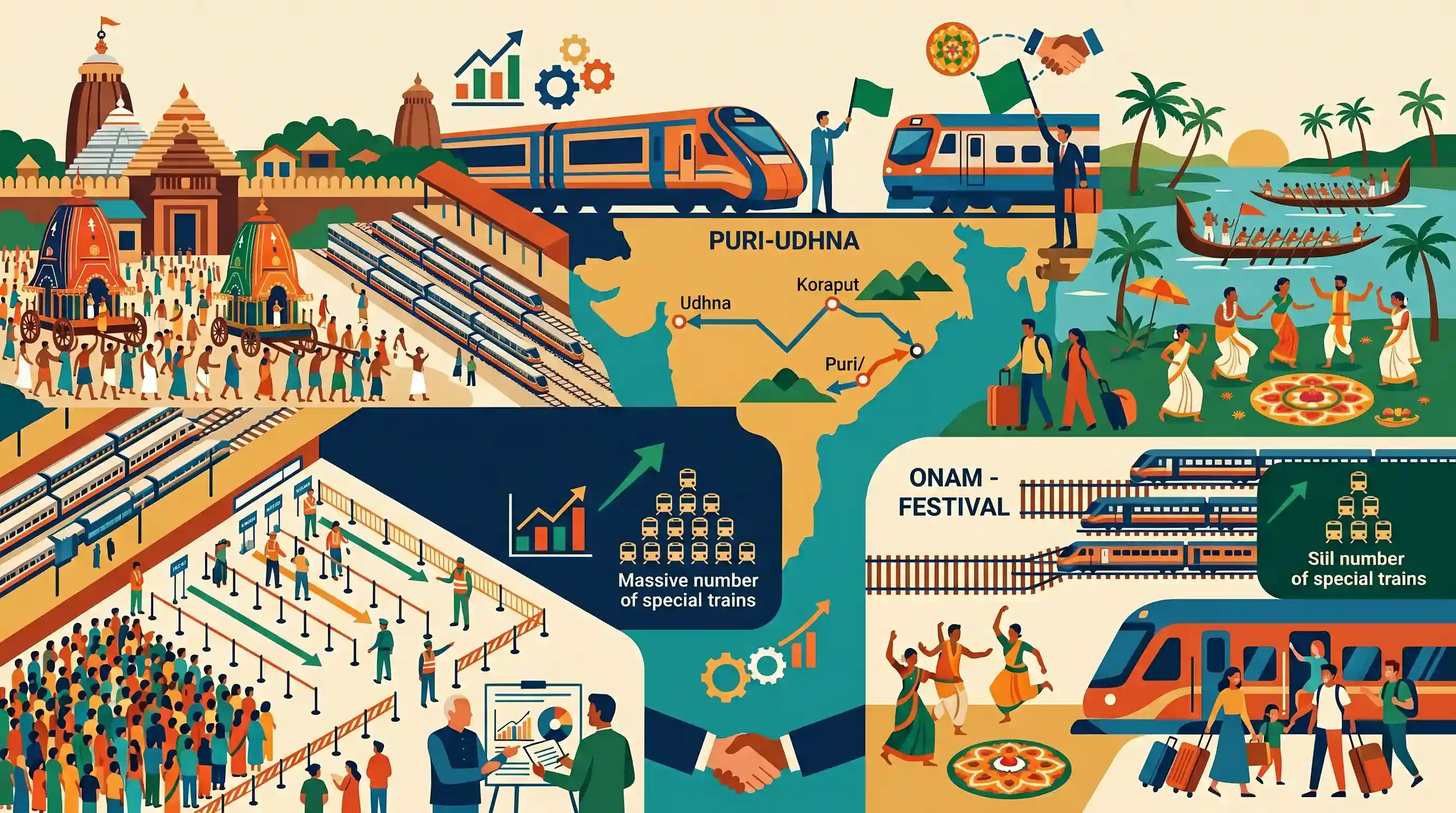
To accommodate massive crowd turnouts for upcoming festivals, Indian Railways announced the operation of over 300 special trains for the Puri Jagannath Rath Yatra and 100 special trains for Onam in Kerala. Railway Minister Ashwini Vaishnaw reviewed infrastructural and safety preparations at Puri railway station, including the establishment of a massive temporary holding area for over 30,000 devotees to streamline crowd control. Additionally, two new train services—the Puri-Koraput Express and the Brahmapur-Udhna Amrit Bharat Express—were flagged off to boost connectivity and support religious tourism.
Key Points
- Indian Railways will operate over 300 special trains for the Puri Rath Yatra in Odisha and 100 special trains for the Onam festival in Kerala to manage the immense festive travel rush.
- During his visit to Odisha, Union Railway Minister Ashwini Vaishnaw flagged off two new train services: the Puri-Koraput Express and the Brahmapur-Udhna Amrit Bharat Express.
- Significant emphasis is being placed on crowd management and public safety, with the development of a large holding area at Puri railway station capable of accommodating over 30,000 devotees.
- The massive deployment of special trains highlights the critical role of transport infrastructure in facilitating domestic tourism, cultural integration, and public administration during mega religious assemblies.
Important Terms
Puri Jagannath Rath Yatra

An ancient, annual nine-day Hindu chariot festival in Puri, Odisha, where deities Jagannath, Balabhadra, and Subhadra are pulled in massive wooden chariots to the Gundicha Temple.
UPSC context
GS Paper 1 (Art & Culture): Tests knowledge of temple architecture, Kalinga style, and regional festivals.
Onam
A major ten-day annual harvest festival celebrated in Kerala, commemorating the return of the legendary King Mahabali, featuring floral decorations, boat races, and traditional feasts.
UPSC context
GS Paper 1 (Art & Culture): Tests understanding of harvest festivals, folk art forms, and cultural practices.
Amrit Bharat Express
A flagship, non-AC superfast sleeper train service developed by Indian Railways, using push-pull technology to deliver low-cost, comfortable, and modern long-distance travel for common passengers.
UPSC context
GS Paper 3 (Infrastructure): Tests concepts of railway modernization, inclusive mass transit, and regional connectivity.
East Coast Railway
One of the 19 operational zones of Indian Railways, headquartered in Bhubaneswar, Odisha, playing a critical role in mineral freight transport and passenger tourism corridors.
UPSC context
GS Paper 1 & 3: Tests geography of transport networks and infrastructure's role in regional economy.
Prelims Trap
The Kalinga architecture of the Puri Jagannath Temple is classified as a regional sub-style of Dravidian temple architecture.
Kalinga architecture is actually a regional sub-style of the Nagara (North Indian) school, not Dravidian, despite its geographic proximity to southern states.
Static Concepts Connected
What are the defining architectural features of the Kalinga sub-style of temple architecture?
- Deula Classification: Temples consist of Rekha Deula (curvilinear sanctum), Pidha Deula (pyramidal assembly hall), and Khakhara Deula (barrel-vaulted shrines).
- Linear Alignment: Four distinct chambers—Vimana, Jagamohana, Natamandapa, and Bhogamandapa—are constructed in a single, continuous axial alignment.
- Decorative Contrast: Exteriors feature dense, intricate sculptural carvings, while the interior walls of the sanctum are kept strictly plain and unembellished.
What are the key NDMA guidelines for effective crowd management at religious assemblies?
- Density Threshold: Crowd density must be kept below 5 persons per square meter to prevent progressive crowd collapse and crush injuries.
- Staging Areas: Temporary physical holding areas must be built outside main venues to regulate and step-down inflow velocity.
- Capacity Limits: Venue inflow rates must be dynamically calibrated against safe evacuation exit times rather than total static floor space.
Cross-Topic Patterns
Festival tourism and regional economic integration
Large-scale festivals like Rath Yatra and Onam act as economic multipliers, requiring synchronized multi-state transport networks that bridge cultural heritage and regional tourism economies.
Mass transit safety and NDMA compliance
The deployment of special trains and temporary holding facilities shows how public transport projects must actively integrate NDMA crowd safety standards to prevent disasters during mega-assemblies.

UPSC may combine Kalinga temple architecture evolution with Sangam-era references to festivals like Onam in a single culture question.
Linked PYQs · 2
Linked PYQs · 2
- 2026PrelimsGS1
Which of the following temples has/have a Nagara-style shikhara ? 1. Malegitti Shivalaya, Badami 2. Huchimalligudi Temple, Aihole 3. Dashavatara Temple, Deogarh 4. Virupaksha Temple, Pattadakal Select the answer using the code given below :
- 2021MainsGS3
“Investment in infrastructure is essential for more rapid and inclusive economic growth.” Discuss in the light of India's experience.
