Bihar partners with Indian Potash Ltd for two new sugar mills
Source:The Hindu ↗
Why It Matters
The article highlights key industrial and agrarian policy shifts in Bihar, focusing on agro-industries, grassroots cooperative frameworks for vegetable marketing, and the re-adoption of central crop insurance schemes. These are highly relevant for BPSC Prelims topics on Bihar's economy and government initiatives.
Summary
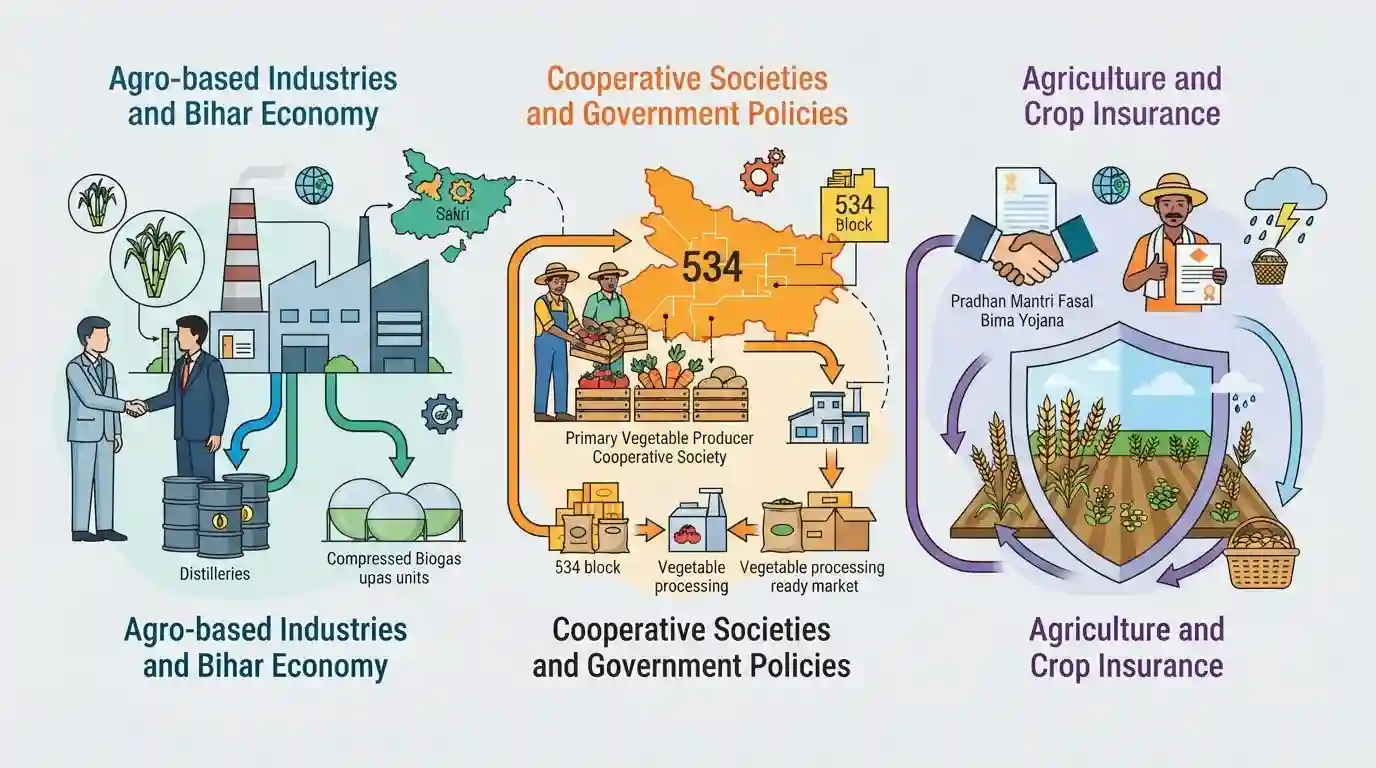
Under the 'Samriddh Udyog-Sashakt Bihar' initiative of the Saat Nischay-3 programme, the Bihar government has partnered with Indian Potash Ltd (IPL) to set up two new sugar mills in Sakri and Raiyam. These facilities will feature modern add-ons like distilleries and compressed biogas units. Additionally, the state cabinet approved the 'Bihar State Cooperative Policy, 2026', emphasizing a vegetable processing scheme that includes establishing Primary Vegetable Producer Cooperative Societies in all 534 blocks under VegFed. In a major agricultural shift, Bihar also green-lit the implementation of the central Pradhan Mantri Fasal Bima Yojana (PMFBY) for crop insurance from the 2026-27 Rabi season.
Key Points
- Indian Potash Ltd (IPL) will establish and operate two sugar mills with distilleries, cogeneration, and CBG units in Sakri (Madhubani) and Raiyam (Darbhanga) under Bihar's 'Saat Nischay-3' programme.
- The Bihar Cabinet approved the 'Bihar State Cooperative Policy, 2026' to strengthen rural cooperative frameworks.
- Primary Vegetable Producer Cooperative Societies (PVCS) will be formed across all 534 blocks to boost vegetable processing and marketing under the nodal agency VegFed.
- Bihar approved the implementation of the Pradhan Mantri Fasal Bima Yojana (PMFBY) starting from the Rabi season of 2026-27 to provide comprehensive crop insurance.
Important Terms
Pradhan Mantri Fasal Bima Yojana (PMFBY)

Launched in 2016, this national crop insurance scheme offers highly subsidized premium rates (2% Kharif, 1.5% Rabi) to protect farmers against financial losses from natural calamities, pests, and post-harvest risks.
UPSC context
Essential for GS Paper 3 (Agriculture). Tests knowledge of rural safety nets, farmer risk mitigation, and agricultural subsidies.
Bihar State Cooperative Policy, 2026
A comprehensive state framework aimed at modernizing cooperative societies. It expands their roles beyond agriculture into non-traditional sectors like dairy, green energy, and tourism to boost rural employment.
UPSC context
Relevant for GS Paper 2 & 3 (Government Policies, Cooperatives). Tests understanding of cooperative diversification and rural development strategies.
VegFed
The Bihar State Vegetable Processing and Marketing Cooperative Federation Limited. It directly links vegetable farmers with national and international buyers, establishing processing infrastructure and retail outlets to eliminate middlemen.
UPSC context
Highly relevant for GS Paper 3 (Agricultural Marketing, Supply Chain). Highlights state-led cooperative models in horticulture and food processing.
Primary Vegetable Producer Cooperative Societies (PVCS)
Grassroots, block-level farmer cooperatives formed under VegFed. They aggregate vegetable produce and provide farmers with working capital, market access, and fairer prices.
UPSC context
Relevant for GS Paper 3 (Food Processing, Supply Chain Management). Highlights the role of grassroots agricultural organizations in boosting farmer incomes.
Samriddh Udyog-Sashakt Bihar
An industrial revitalization initiative operating under Bihar's Saat Nischay-3 programme. It notably focuses on reopening closed sugar mills and converting them into modern integrated bioenergy and ethanol complexes.
UPSC context
Important for GS Paper 3 (Industrial Policy, Bio-energy). Tests state interventions that integrate agro-industries with renewable energy generation.
Prelims Trap
"PMFBY is mandatory for states to implement and compulsory for farmers with crop loans."
PMFBY is optional for states. Furthermore, since Kharif 2020, enrollment is completely voluntary for all farmers, including loanee farmers, removing the mandatory premium deduction.
Static Concepts Connected
What is the premium and funding structure of the PMFBY?
- Farmer caps: Premium is capped at 2% for Kharif crops, 1.5% for Rabi crops, and 5% for commercial/horticultural crops.
- Subsidy sharing: The remaining actuarial premium burden is shared equally between the Centre and States (90:10 for NE/Himalayan states).
- Voluntary enrollment: Since 2020, the scheme has been made completely voluntary for all farmers, including loanee farmers.
How do integrated sugar mills contribute to the circular economy?
- Bagasse cogeneration: Sugarcane fiber residue is burned to generate renewable electricity, powering the mill and feeding grids.
- Molasses distillation: By-products like B-heavy and C-heavy molasses are distilled to produce ethanol for fuel blending.
- Press mud to CBG: The solid waste from juice filtration is processed in bio-digesters to yield Compressed Biogas (CBG).
Cross-Topic Patterns
Sugar Industry + National Biofuel Policy
The shift of sugar mills towards ethanol and Compressed Biogas (CBG) aligns with India's E20 target and the GOBARdhan scheme, transforming agro-processing into an energy security pillar.
PMFBY + Cooperative Federalism
Bihar replacing its state scheme to rejoin PMFBY highlights the fiscal and operational flexibilities states exercise within Centrally Sponsored Schemes.

Expect a multi-statement question linking PMFBY's voluntary enrollment status with state-level scheme adoption trends in 2026.
Linked PYQs · 4
Linked PYQs · 4
- 2023BPSC_PRELIMSGS1
Which food industry dominates among the agro-based industries in Bihar?
- 2018BPSC_PRELIMSGS1
Which type of industries has potentials and prospects in Bihar?
- 2023BPSC_PRELIMSGS1
What is the policy measure adopted by the Government of India to improve the system of agricultural marketing?
- 2018BPSC_PRELIMSGS1
Which scheme was recognized as world's largest insurance scheme launched in India in September 2018?
