Patent Refusal: Balancing Public Health and Pharmaceutical Innovation
Source:The Hindu ↗
কেন এটি গুরুত্বপূর্ণ
This development underscores India's stringent patent framework, especially regarding pharmaceuticals, balancing innovation incentives with affordable public health access for critical illnesses like drug-resistant tuberculosis.
সারসংক্ষেপ
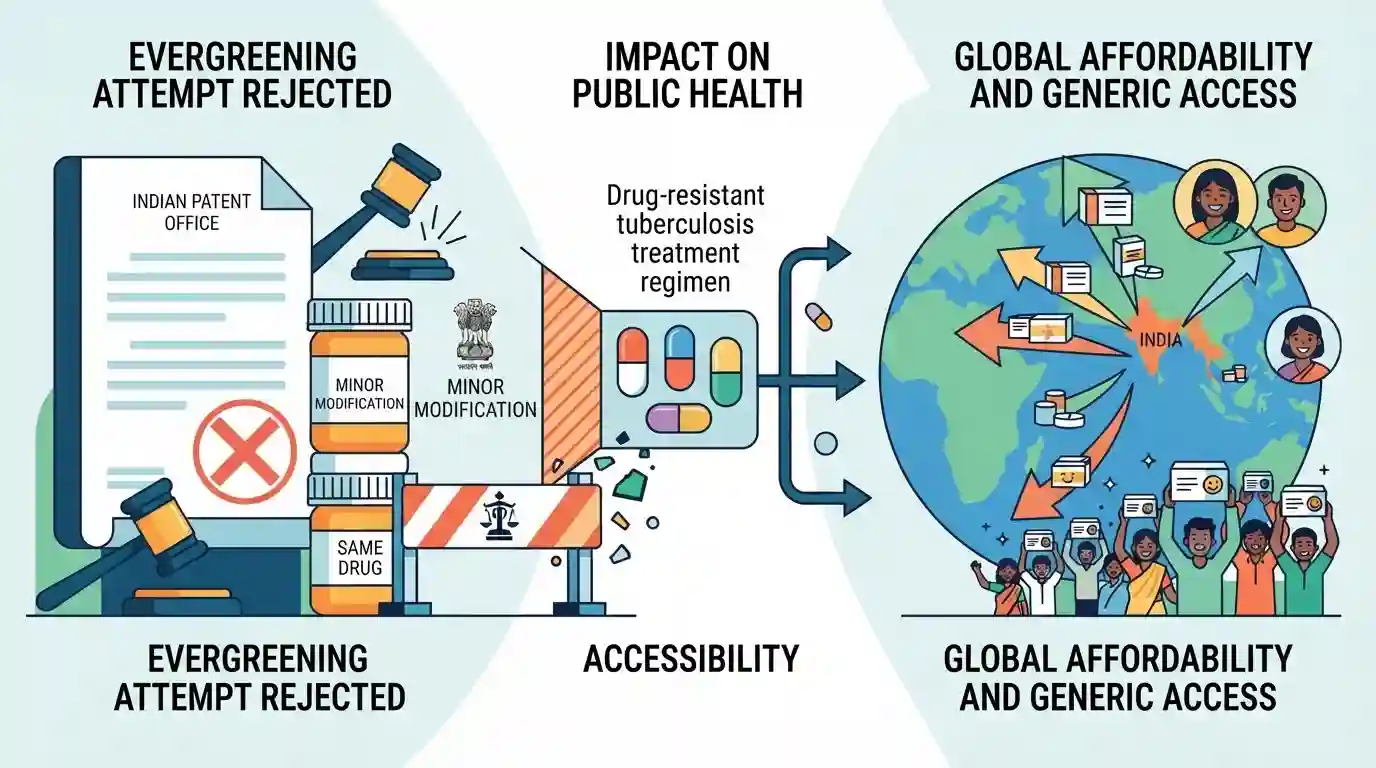
The Indian Patent Office has rejected a patent application for a drug-resistant tuberculosis treatment regimen, a move hailed by public health advocates as a major victory for affordable healthcare and generic medicine accessibility in India and globally.
মূল বিষয়
- The Indian Patent Office rejected a patent application for a drug-resistant tuberculosis (TB) treatment regimen, preventing monopolistic pricing and ensuring cheaper generic availability.
- The decision highlights the crucial balance between intellectual property rights (IPR) and public health access, particularly for life-saving drugs in developing nations.
- Rejections under Indian patent laws often leverage provisions like Section 3(d) to prevent evergreening and protect affordable healthcare access.
গুরুত্বপূর্ণ শব্দ
Indian Patents Act 1970

The primary legislation governing patent law in India, enacted to encourage inventions and balance private monopoly rights with public health objectives and generic medicine availability.
UPSC context
UPSC Prelims/Mains (GS Paper III - Economy / IPR): Tests understanding of statutory provisions balancing innovation and affordable access to medicines.
Section 3(d) of the Patents Act
A key provision in India's patent law that prevents evergreening by requiring new forms of known substances to show significantly enhanced therapeutic efficacy before receiving patent protection.
UPSC context
UPSC Prelims/Mains (GS Paper III - IPR & Public Health): Essential for questions on TRIPS compliance, evergreening, and affordable healthcare access.
Indian Patent Office
The statutory body under the Ministry of Commerce and Industry responsible for granting or rejecting patent applications in India according to national laws.
UPSC context
UPSC Prelims (GS Paper III): Tests institutional roles in implementing intellectual property rights and pharmaceutical governance.
সংযুক্ত স্থির ধারণা
What are the key anti-evergreening provisions under the Indian Patents Act, 1970?
- Section 3(d) Rule: Stipulates that new forms of known substances or mere combinations must show 'significantly enhanced therapeutic efficacy' to be patentable.
- Section 3(e) Exclusions: Excludes mere admixtures from patentability unless a synergistic effect of properties is established.
- Section 3(i) Restriction: Excludes any process for the medicinal, surgical, curative, or prophylactic treatment of human beings or animals.
আন্তঃবিষয় প্যাটার্ন
IPR vs. Public Health Flexibilities under TRIPS
India's strict application of Section 3(d) reinforces its role as the 'pharmacy of the developing world', intersecting global health security with TRIPS flexibilities.
Public Health Interventions & National TB Goals
Rejection of DR-TB regimens directly impacts national elimination targets (like India's National TB Elimination Programme) by keeping essential second-line drugs affordable.

Expect statement-based questions on Section 3(d) exceptions, TRIPS flexibilities, and anti-evergreening mechanisms in Prelims.
সংযুক্ত PYQ · 3
সংযুক্ত PYQ · 3
- 2024MainsGS3
What is the present world scenario of intellectual property rights with respect to life materials? Although, India is second in the world to file patents, still only a few have been commercialized. Explain the reasons behind this less commercialization.
- 2013MainsGS3
Bringing out the circumstances in 2005 which forced amendment to the section 3(d) in Indian Patent Law, 1970, discuss how it has been utilized by the Supreme Court in its judgement in rejecting Novratis' patent application for 'Glivec'. Discuss briefly the pros and cons of the decision.
- 2024MainsGS2
In a crucial domain like the public healthcare system the Indian State should play a vital role to contain the adverse impact of marketisation of the system. Suggest some measures through which the State can enhance the reach of public healthcare at the grassroots level.
