Indian NGO REACH Wins Kochon Prize for TB Elimination Efforts
Source:The Hindu ↗
Why It Matters
The recognition of an Indian NGO for global excellence in public health underscores the indispensable role of civil society and community-based organizations in achieving national health targets like TB elimination, directly aligning with GS2 syllabus requirements on governance and the role of NGOs.
Summary
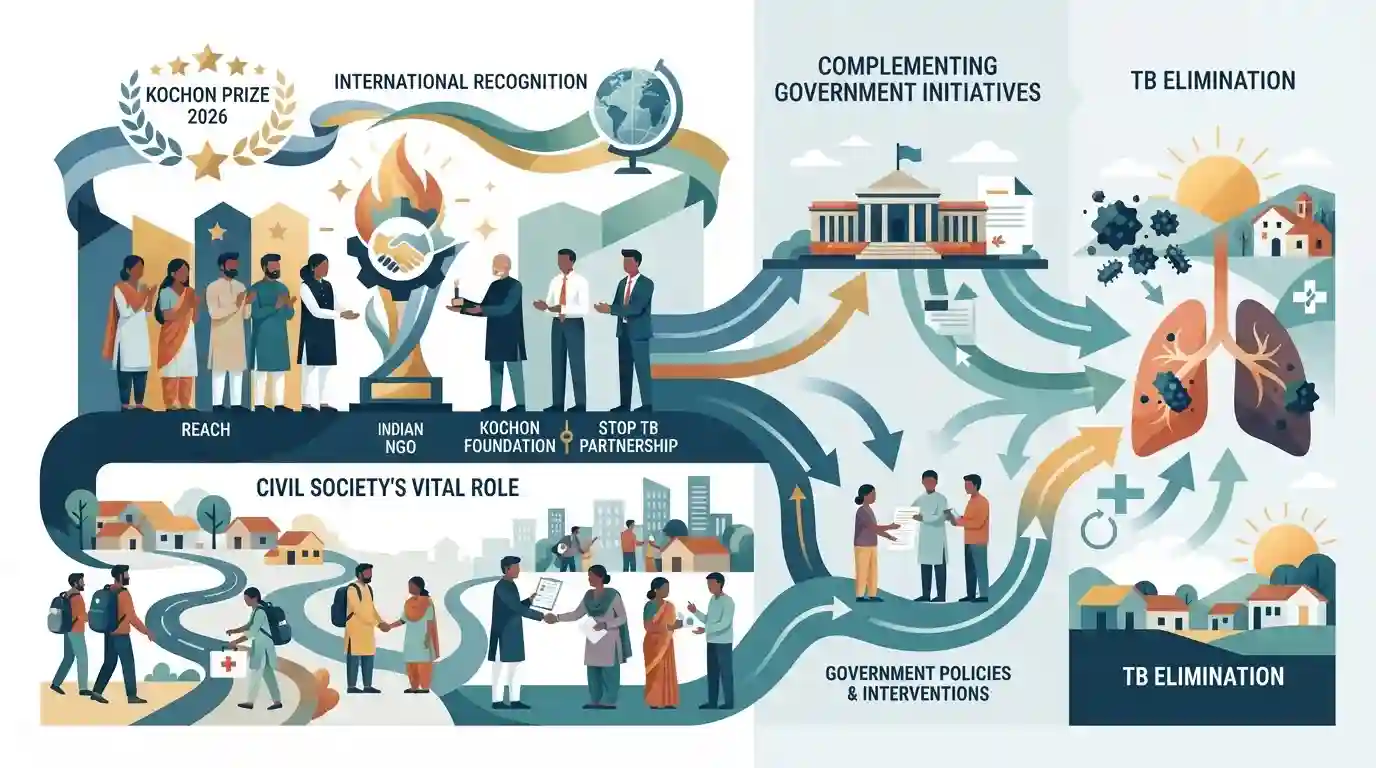
The Indian non-governmental organization REACH (Reaching the Unreached) has been honored with the Kochon Prize 2026 for its pioneering efforts and dedication to tuberculosis (TB) elimination. Awarded by the Kochon Foundation in partnership with the Stop TB Partnership, the international recognition highlights civil society's vital role in complementing government initiatives toward achieving public health goals like ending TB.
Key Points
- The Indian NGO REACH (Reaching the Unreached) has been awarded the prestigious Kochon Prize 2026 for its stellar contributions to tuberculosis (TB) elimination.
- The award, carrying a $65,000 prize, is presented annually by the Kochon Foundation and the Stop TB Partnership to individuals or organizations making a notable contribution to combating TB.
- REACH has played a crucial role in community mobilization, patient support, advocacy, and bridging gaps in public health delivery under India's tuberculosis control framework.
- Highlighting the critical role of civil society organizations (CSOs) and NGOs in complementing state-led public health delivery, especially for infectious diseases like TB.
Important Terms
Kochon Prize

An international award established in 2006 by the Kochon Foundation and Stop TB Partnership, dedicated to recognizing significant contributions and innovations toward tuberculosis prevention, diagnosis, and treatment.
UPSC context
GS Paper II (International Relations / Health Issues) - Tests awareness of global awards, health partnerships, and initiatives against tuberculosis.
REACH (Reaching the Unreached)
An Indian non-governmental organization focused on community health, education, and advocacy, recognized internationally for its people-centered approach to tuberculosis elimination and care.
UPSC context
GS Paper II (Social Justice / NGOs) - Highlights the vital role of civil society and grassroots NGOs in complementing state public health policies.
Stop TB Partnership
A global network hosted by the WHO working to eliminate tuberculosis as a public health problem by coordinating international efforts, funding, and partnerships.
UPSC context
GS Paper II (International Organizations & Health) - Evaluates multilateral frameworks and global health governance in tackling communicable diseases like TB.
Kochon Foundation
A South Korea-based foundation established by Chong-Kun Lee, dedicated to supporting medical research, healthcare access, and global initiatives against tuberculosis, notably through the Kochon Prize.
UPSC context
GS Paper II (International Relations) - Important for questions concerning global philanthropic organizations partnering with UN bodies on public health.
Static Concepts Connected
What are the core components and goals of India's National Tuberculosis Elimination Programme (NTEP)?
- Goal & Timeline: Rebranded from RNTCP, NTEP aims to eliminate TB in India by 2025, ahead of the global Sustainable Development Goal target of 2030.
- Key Strategies: Focuses on universal access to quality TB diagnosis, treatment adherence support, decentralized screening, and private sector engagement.
- Digital & Support: Involves Nikshay portal for case tracking and Nikshay Poshan Yojana for direct benefit transfers to support nutritional needs of patients.
Cross-Topic Patterns
Public Health Delivery + Civil Society Governance
The recognition of NGO REACH illustrates how civil society and local community networks are legally and functionally integrated into state-driven welfare delivery frameworks.

Kochon Prize + NTEP targets likely to be tested via statement-based MCQs on institutional mechanisms for TB elimination.
Linked PYQs · 2
Linked PYQs · 2
- 2021MainsGS2
Can Civil Society and Non-Governmental Organizations present an alternative model of public service delivery to benefit the common citizen? Discuss the challenges of this alternative model.
- 2015MainsGS2
How can the role of NGOs be strengthened in India for development works relating to protection of the environment? Discuss throwing light on the major constraints.
