Indian Navy maritime strategy and power projection in western waters
Source:The Hindu ↗
Why It Matters
This article provides concrete examples of India's coercive naval diplomacy and its critical role in ensuring regional maritime security. It illustrates India's capability to project power against state actors (Pakistan) while also securing Sea Lanes of Communication (SLOCs) from non-state threats (pirates and Houthis), which is highly relevant for GS3 Security and GS2 International Relations.
Summary
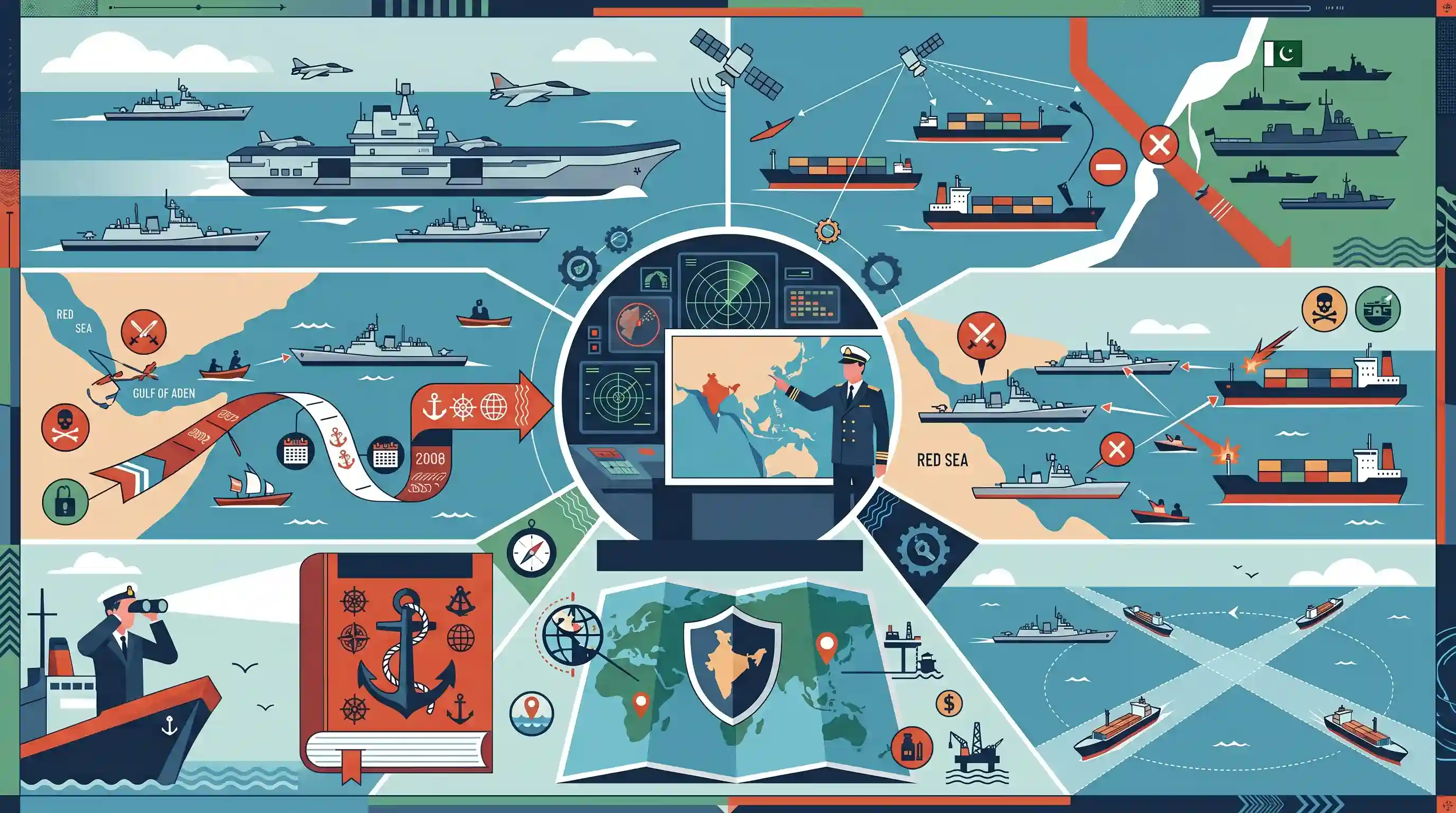
The article highlights the Indian Navy's robust strategic and operational capabilities as articulated by Naval Chief Admiral Dinesh K. Tripathi. During 'Operation Sindoor', the swift deployment of naval assets, including a Carrier Battle Group in the northern Arabian Sea, effectively contained the Pakistan Navy and disrupted Pakistan's maritime trade. Additionally, the Navy demonstrated its role as a net security provider by sustaining continuous anti-piracy operations in the Gulf of Aden since 2008 and extensively deploying ships to protect international trade from Houthi attacks in the Red Sea. The newly released 'Indian Maritime Doctrine 2025' reflects India's proactive stance in safeguarding its maritime interests and ensuring freedom of navigation in the Indo-Pacific region.
Key Points
- The Indian Navy's assertive deployment during 'Operation Sindoor', including a Carrier Battle Group, confined the Pakistan Navy to the Makran coast.
- This naval blockade posture severely impacted Pakistan's economy by causing global shipping lines to avoid its ports and leading to increased insurance premiums.
- India has maintained continuous anti-piracy deployments in the Gulf of Aden since 2008 to protect global maritime trade.
- In response to recent Houthi threats in the Red Sea, the Indian Navy deployed 40 capital ships, ensuring the safe passage of $6.5 billion worth of trade over 11 months.
- The updated 'Indian Maritime Doctrine 2025' was released, outlining the Navy's strategic vision amidst evolving geopolitical dynamics.
Important Terms
Operation Sindoor

A 2025 tri-service military response to the Pahalgam terror attack, involving a de facto naval blockade that confined the Pakistan Navy to the coast and demonstrated India's 'compellence' strategy.
UPSC context
GS Paper III: Internal Security and Border Management; tests knowledge of India's evolving deterrence posture and joint-service operations against cross-border terrorism.
Indian Maritime Doctrine 2025
The Indian Navy's apex strategic document (2025) that formalizes the 'No War, No Peace' operational category, emphasizing multi-domain operations, grey-zone warfare, and integration with national visions like Viksit Bharat 2047.
UPSC context
GS Paper II & III: International Relations and Security; tests understanding of India's maritime strategy and its proactive role in the Indo-Pacific.
No War, No Peace (NWNP)
A strategic concept in the 2025 Doctrine describing the grey zone between peace and conflict, where nations use coercion, hybrid tactics, and sub-conventional pressure without triggering full-scale war.
UPSC context
GS Paper III: Security; essential for analyzing contemporary threats like hybrid warfare and maritime grey-zone challenges.
Net Security Provider
India's self-envisioned role in the Indian Ocean Region (IOR), providing safety, stability, and humanitarian assistance while protecting global sea lanes from piracy and militant threats.
UPSC context
GS Paper II: International Relations; critical for questions on India's leadership in the IOR and the SAGAR initiative.
Carrier Battle Group (CBG)
A primary naval formation centered around an aircraft carrier, supported by destroyers, frigates, and submarines, used for high-end power projection and establishing maritime dominance.
UPSC context
GS Paper III: Defense Technology and Security; tests knowledge of naval assets crucial for sea-control and deterrence.
Houthi Attacks (Maritime Context)
Yemen-based militant group whose drone and missile attacks on Red Sea shipping since 2023 have disrupted global trade, prompting Indian naval deployments for merchant vessel protection.
UPSC context
GS Paper II & III: International Relations and Security; concerns the impact of non-state actors on global supply chains and India's economic security.
Prelims Trap
"Operation Sindoor was a major Indian Navy evacuation mission from the conflict-ridden Red Sea."
Operation Sindoor was a strategic naval compellence and sea denial operation in the Arabian Sea against Pakistan, not a civilian evacuation mission.
Static Concepts Connected
What does being a "Net Security Provider" mean for India?
- Core Concept: A state addressing regional maritime security concerns, such as piracy, disaster relief (HADR), and capacity building for littoral nations.
- Strategic Shift: Marks India's transition from a primarily defensive naval posture to a proactive guarantor of stability in the Indian Ocean Region (IOR).
- Key Examples: Sustained anti-piracy patrols in the Gulf of Aden since 2008 and joint exercises like MILAN.
What are the vital maritime choke points near the Red Sea?
- Bab el-Mandeb: A strategic strait connecting the Red Sea to the Gulf of Aden, crucial for traffic moving towards the Suez Canal.
- Suez Canal: An artificial sea-level waterway in Egypt connecting the Mediterranean Sea to the Red Sea, enabling direct Europe-Asia shipping.
Cross-Topic Patterns
Naval Doctrine + PM Gati Shakti
The 2025 Maritime Doctrine uniquely links naval power with domestic economic frameworks like Sagarmala and PM Gati Shakti, proving maritime security is now viewed as a macroeconomic pillar.
Grey-zone warfare + Chokepoint security
The formal recognition of 'no-war, no-peace' (NWNP) connects traditional state-level naval deterrence (Operation Sindoor) with combating non-state asymmetric threats like Houthi drone strikes in shipping lanes.

Expect a multi-statement Prelims question integrating 'Net Security Provider', Red Sea chokepoint geography, and 'Operation Sindoor' in 2026.
Linked PYQs · 4
Linked PYQs · 4
- 2025MainsGS3
Why is maritime security vital to protect India's sea trade? Discuss maritime and coastal security challenges and the way forward.
- 2022MainsGS3
What are the maritime security challenges in India ? Discuss the organisational, technical and procedural initiatives taken to improve the maritime security.
- 2014MainsGS2
With respect to the South China sea, maritime territorial disputes and rising tension affirm the need for safeguarding maritime security to ensure freedom of navigation and over flight throughout the region. In this context, discuss the bilateral issues between India and China.
- 2024PrelimsGS1
Consider the following statements : Statement-I : Sumed pipeline is a strategic route for Persian Gulf oil and natural gas shipments to Europe. Statement-II : Sumed pipeline connects the Red Sea with the Mediterranean Sea. Which one of the following is correct in respect of the above statements?
