Indian Navy ADITI 30 Contract for High Power Microwave Systems
Source:The Hindu ↗
Why It Matters
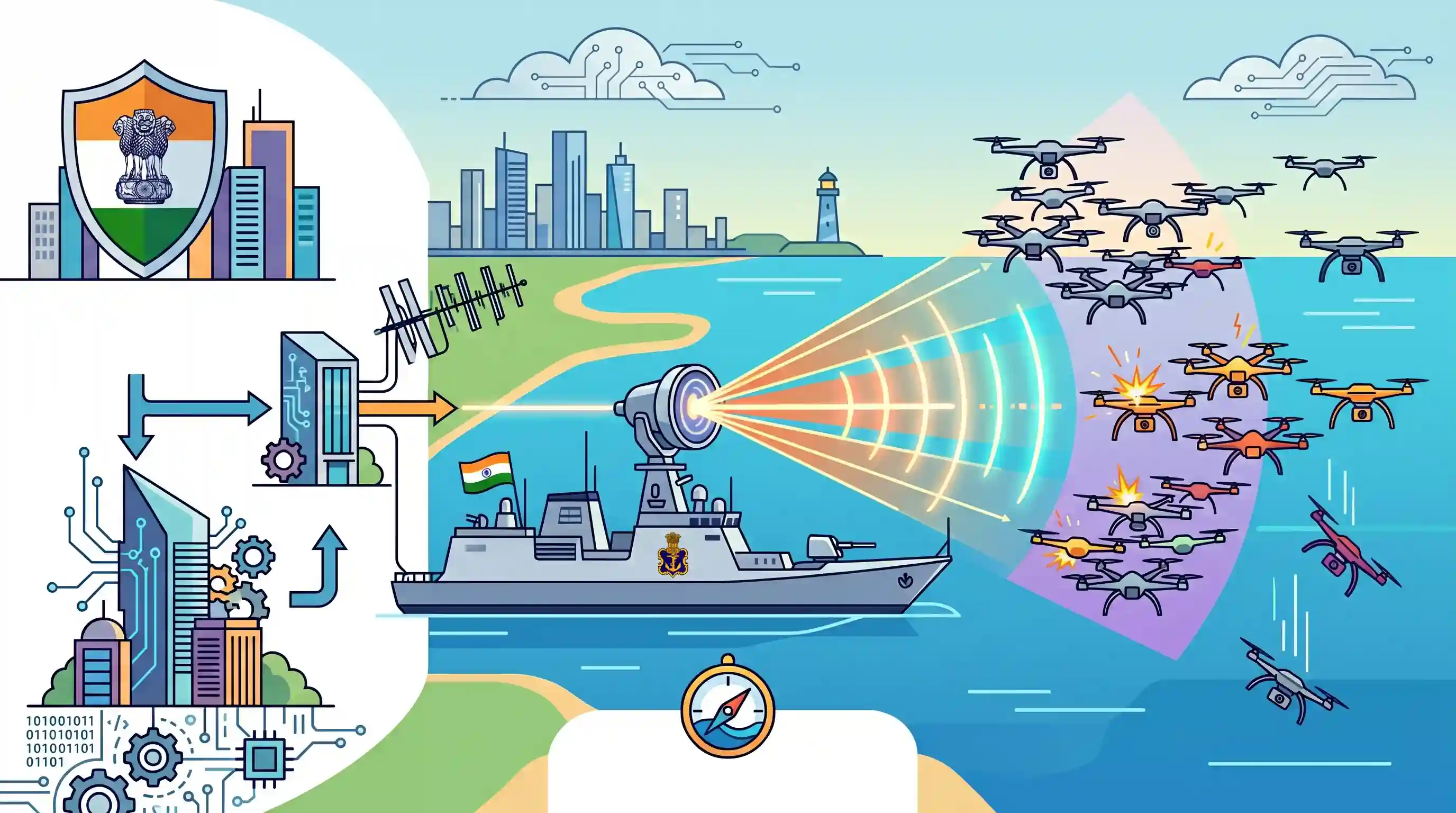
Demonstrates India's strategic shift toward non-kinetic warfare capabilities (like HPMs) to counter modern asymmetric threats such as drone swarms. It also highlights the successful implementation of the iDEX framework in fostering deep-tech private sector involvement for defence indigenisation.
Summary
The Indian Navy has awarded a contract under the ADITI 3.0 scheme to Bengaluru-based deep-tech startup Tonbo Imaging for the development of High Power Microwave (HPM) systems. HPMs are a type of Directed Energy Weapon (DEW) designed to non-kinetically disrupt or destroy adversary electronics, making them highly effective against emerging threats such as drone swarms. This initiative is facilitated by the Innovations for Defence Excellence (iDEX) and the Defence Innovation Organisation (DIO) under the Ministry of Defence. The move underscores India's strategy to leverage private sector innovation for defence indigenisation and to equip its armed forces with advanced, asymmetric warfare capabilities.
Key Points
- The Indian Navy awarded the ADITI 3.0 contract to startup Tonbo Imaging for developing High Power Microwave (HPM) systems.
- HPM systems are non-kinetic Directed Energy Weapons (DEWs) that disrupt or disable adversary electronics, sensors, and communication nodes.
- They are especially effective against asymmetric threats like drone swarms, offering a strategic advantage in modern warfare.
- The ADITI scheme operates under the Innovations for Defence Excellence (iDEX) framework to mature and induct deep-tech solutions from the private sector into the armed forces.
- The contract emphasizes India's push towards defence indigenisation and self-reliance (Atmanirbhar Bharat) in niche military technologies.
Important Terms
ADITI Scheme

A Ministry of Defence initiative under iDEX providing grants up to ₹25 crore to startups for developing critical and strategic deep-tech technologies for the Armed Forces.
UPSC context
GS3 (Science & Tech, Internal Security); tests knowledge of government initiatives for self-reliance in strategic and disruptive defence technologies.
Innovations for Defence Excellence (iDEX)
Launched in 2018, it is the flagship framework to foster innovation in defence and aerospace by engaging startups, MSMEs, and innovators through funding and R&D support.
UPSC context
GS3 (Internal Security, S&T); tests understanding of the defence startup ecosystem and indigenous technology development.
High Power Microwave (HPM) system
A type of Directed Energy Weapon (DEW) that emits intense electromagnetic pulses to disrupt or destroy electronic circuitry in adversary systems like drone swarms.
UPSC context
GS3 (Science & Technology); focuses on technical awareness of non-kinetic warfare and advanced counter-drone strategies.
Directed Energy Weapons (DEWs)
Weapons that use concentrated electromagnetic energy (lasers, microwaves, or particle beams) to damage or disable targets at the speed of light without using kinetic projectiles.
UPSC context
GS3 (Security, S&T); critical for understanding future warfare, asymmetric threats, and India's modernization goals.
Defence Innovation Organisation (DIO)
A non-profit Section 8 company founded by HAL and BEL under the Ministry of Defence to administratively manage and fund the iDEX framework.
UPSC context
GS3 (Internal Security); tests knowledge of the institutional framework governing public-private partnerships in defence production.
Defence Indigenisation
The strategic process of developing and manufacturing military equipment and technology within India to reduce import dependency and achieve Atmanirbharta (self-reliance).
UPSC context
GS3 (Indian Economy, Security); core theme regarding industrial policy, self-reliance, and 'Make in India' in strategic sectors.
Prelims Trap
"The Defence Innovation Organisation (DIO) is a statutory body functioning under the DRDO."
DIO is not a statutory body or DRDO lab; it is a not-for-profit Section 8 company formed by defence PSUs HAL and BEL.
Static Concepts Connected
What are Directed Energy Weapons (DEWs) and their primary operational categories?
- Core Definition: Weapons that utilize concentrated electromagnetic energy, rather than kinetic projectiles, to incapacitate, damage, or destroy enemy equipment and facilities.
- Primary Categories: Broadly divided into High-Energy Lasers (HEL) which cause physical/thermal damage, and High Power Microwaves (HPM) which fry electronics and sensors without physical impact.
- Tactical Advantages: They offer speed-of-light delivery, precision, a nearly infinite magazine capacity (as long as power is supplied), and extremely low cost-per-shot compared to conventional missiles.
What is the organizational and structural framework of iDEX?
- Core Objective: To foster innovation and technology development in Aerospace and Defence by engaging MSMEs, start-ups, individual innovators, R&D institutes, and academia.
- Nodal Agency: It is funded and managed by the Defence Innovation Organisation (DIO), a Section 8 not-for-profit company founded by HAL and BEL.
- Financial Support: Through schemes like ADITI, it provides significant grants (up to ₹25 crore) to propel the research, development, and induction of deep-tech military solutions.
Cross-Topic Patterns
Drone swarms + Asymmetric border threats
HPMs provide a cost-effective counter-swarm technology. This connects defence procurement directly to GS-3 internal security modules regarding border management, cross-border smuggling, and rogue drone threats.
Private sector + Defence R&D paradigm
Using non-profit corporate structures (DIO) to fund private deep-tech startups shifts India's defence R&D model away from the traditional DRDO-monopoly paradigm, blending economic decentralization with national security.

Expect a 2026 Prelims question mixing the Section 8 structure of DIO, ADITI funding limits, and the non-kinetic nature of HPM weapons.
Linked PYQs · 2
Linked PYQs · 2
- 2023MainsGS3
The use of unmanned aerial vehicles (UAVs) by our adversaries across the borders to ferry arms/ammunitions, drugs, etc., is a serious threat to the internal security. Comment on the measures being taken to tackle this threat.
- 2022MainsGS3
What are the maritime security challenges in India ? Discuss the organisational, technical and procedural initiatives taken to improve the maritime security.
