Indian LPG Tankers Navigate Strait of Hormuz Amid West Asia Crisis
Source:Indian Express ↗
Why It Matters
The article perfectly illustrates India's strategic vulnerability regarding energy security and import dependence. It underscores the importance of the Strait of Hormuz as a geopolitical chokepoint and highlights how diplomatic maneuvering (e.g., relations with Iran) is essential to safeguard India's economic interests amid West Asian conflicts, a direct linkage to GS2 foreign policy themes.
Summary
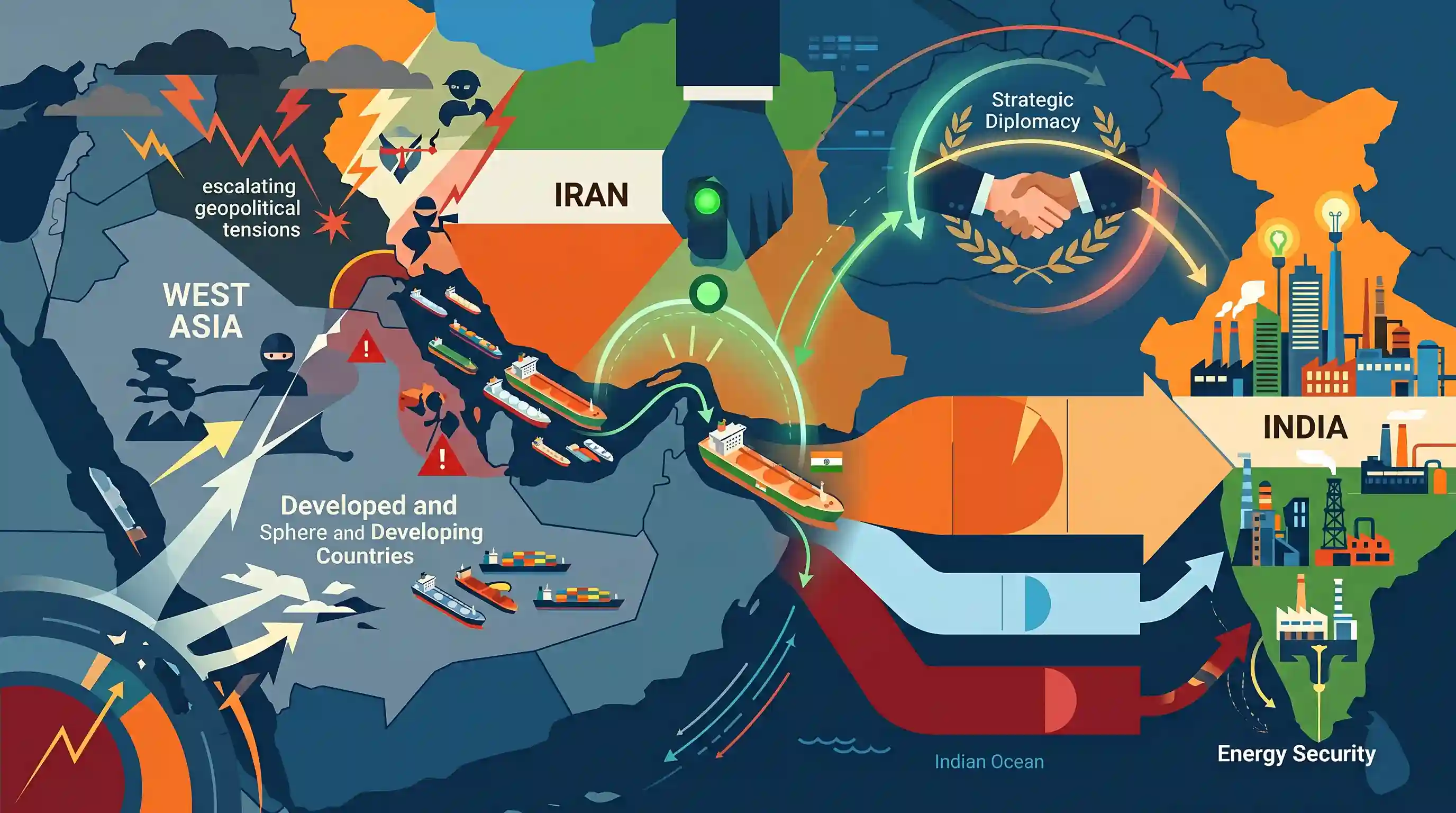
As geopolitical tensions escalate in West Asia, India's energy imports remain highly exposed to disruptions in the Strait of Hormuz. Despite the ongoing conflict, two India-flagged LPG tankers recently navigated the strait, with 18 more Indian vessels present in the Persian Gulf. The Strait of Hormuz is a vital maritime chokepoint connecting the Persian Gulf to the Gulf of Oman. India's energy security is deeply dependent on this route, with 90% of its LPG, 50% of its LNG, and 40% of its crude oil imports passing through it. While India imports 60% of its total LPG requirement, its diplomatic ties have helped mitigate immediate risks; Iran has thus far permitted passage for ships from friendly nations like India. This scenario highlights the critical intersection of energy security, maritime trade vulnerabilities, and the importance of strategic diplomacy in West Asia.
Key Points
- Two India-flagged LPG tankers successfully transited the Strait of Hormuz despite escalating tensions in West Asia, with 18 other Indian vessels still operating in the Persian Gulf.
- The Strait of Hormuz, connecting the Persian Gulf to the Gulf of Oman, is a critical global maritime chokepoint essential for energy transportation.
- India is highly dependent on this shipping route, which handles 90% of its LPG imports, 50% of its LNG imports, and 40% of its crude oil imports.
- India's strategic and diplomatic relations in the region provide a buffer, as Iran has historically allowed safe passage for vessels from friendly nations, ensuring continuity in India's energy supply chain.
Prelims Trap
"The Strait of Hormuz is a vital maritime chokepoint connecting the Persian Gulf to the Red Sea."
UPSC frequently swaps bordering water bodies for strategic straits. The Strait of Hormuz connects the Persian Gulf to the Gulf of Oman, while the Red Sea is connected to the Gulf of Aden via Bab el-Mandeb.
Static Concepts Connected
Which major water bodies do key West Asian chokepoints connect?
- Strait of Hormuz: Connects the Persian Gulf to the Gulf of Oman and the Arabian Sea. It is the world's most important oil transit chokepoint.
- Bab el-Mandeb: Connects the Red Sea to the Gulf of Aden and the Arabian Sea, serving as a critical link between the Mediterranean Sea and the Indian Ocean.
- Suez Canal: Connects the Mediterranean Sea directly to the Red Sea, offering the shortest maritime route between Europe and the lands lying around the Indian and western Pacific oceans.
What is India's Strategic Petroleum Reserves (SPR) program?
- Core Purpose: Created as a buffer against short-term global supply disruptions, managed by the Indian Strategic Petroleum Reserves Limited (ISPRL).
- Phase I Locations: Located in underground rock caverns at Visakhapatnam, Mangaluru, and Padur, holding millions of metric tonnes of crude.
- Phase II Expansion: Approved for Chandikhol (Odisha) and further expansion at Padur, operating under a Public-Private Partnership (PPP) model to enhance commercial viability.
Cross-Topic Patterns
Energy chokepoints and PM Ujjwala Yojana
Disruptions in the Strait of Hormuz threaten the affordability of LPG imports, directly jeopardizing the sustained use of clean cooking fuels under India's socio-economic PM Ujjwala Yojana.
De-hyphenated diplomacy and strategic autonomy
India's ability to navigate Iranian waters safely during Western-led tensions perfectly exemplifies its de-hyphenated West Asia policy, balancing relations between Iran, Arab states, and Israel.
Imported inflation & Current Account Deficit
Supply chain chokepoints inflate freight and insurance costs, directly widening India's Current Account Deficit (CAD) and triggering imported inflation that complicates the RBI's inflation targeting.

Expect a multi-statement Prelims question matching West Asian straits (Hormuz/Bab el-Mandeb) with India's specific energy import shares.
Linked PYQs · 3
Linked PYQs · 3
- 2017MainsGS2
The question of India's Energy Security constitutes the most important part of India's economic progress. Analyze India's energy policy cooperation with West Asian countries.
- 2025MainsGS2
"Energy security constitutes the dominant kingpin of India's foreign policy, and is linked with India's overarching influence in Middle Eastern countries.” How would you integrate energy security with India's foreign policy trajectories in the coming years?
- 2024PrelimsGS1
Consider the following statements : Statement-I : Sumed pipeline is a strategic route for Persian Gulf oil and natural gas shipments to Europe. Statement-II : Sumed pipeline connects the Red Sea with the Mediterranean Sea. Which one of the following is correct in respect of the above statements?
