Structural Economic Challenges and Risks for Indian Investors
Source:The Hindu ↗
কেন এটি গুরুত্বপূর্ণ
The distinction between headline GDP growth and actual structural economic health (productivity, job creation, broad-based consumption) is a core theme for Mains GS3. Understanding vulnerabilities like stagflation, low equilibrium growth, and FII capital flight is essential for analyzing macroeconomic stability and the necessity for structural reforms in private investment and employment generation.
সারসংক্ষেপ
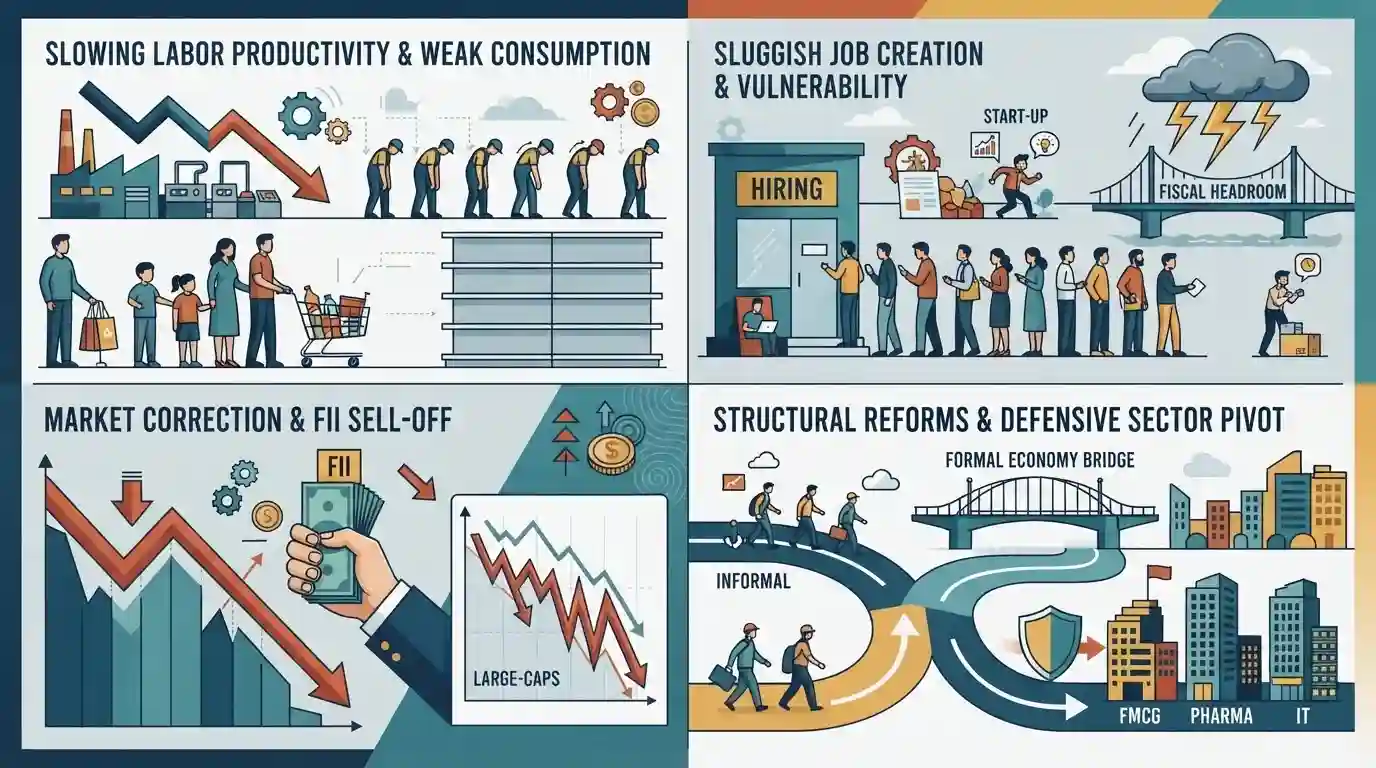
The article details deep-seated structural challenges in the Indian economy that threaten sustained stock market optimism. Experts highlight a 'low equilibrium' scenario characterized by slowing labor productivity, weak and uneven household consumption, and sluggish job creation. These factors, alongside limited fiscal headroom, make the economy vulnerable to stagflation and external shocks. Consequently, high stock valuations—particularly in the mid- and small-cap segments—have prompted massive sell-offs by Foreign Institutional Investors (FIIs). Investors are being advised to pivot towards defensive sectors like FMCG, Pharma, and IT, while policymakers are urged to focus on bridging the formal-informal economic divide and spurring broad-based private investment rather than relying on overstated headline growth figures.
মূল বিষয়
- India's economy may be trapped in a 'low equilibrium' growth path marked by weak consumption, slowing productivity, and a lack of job creation.
- Experts warn that headline GDP figures may overstate economic strength, masking underlying vulnerabilities to external shocks and rising stagflation risks.
- Uneven household consumption and limited government space for further fiscal consolidation pose significant macroeconomic headwinds.
- High valuations, especially in mid-cap and small-cap stocks, have led to heavy capital flight by Foreign Institutional Investors (FIIs).
- Investors are advised to transition to safer, defensive bets such as FMCG, Pharma, IT, Telecom, large private banks, and cement.
- There is an urgent need to revive broad-based private investment and bridge the divide between the organized and informal sectors.
গুরুত্বপূর্ণ শব্দ
Foreign Institutional Investors (FIIs)

Overseas institutional entities (like pension funds, mutual funds, and hedge funds) that invest in a country's financial markets (such as equity and debt) without seeking management control.
UPSC context
GS Paper III (Economy). Tested under Mobilization of Resources, Financial Markets, and capital flows (FDI vs FPI/FII).
Stagflation
An unfavorable macroeconomic condition characterized by a stagnant economic growth rate, high unemployment, and persistently rising price levels (inflation) occurring simultaneously.
UPSC context
GS Paper III (Economy). Tests conceptual clarity on inflation dynamics, monetary policy trade-offs, and macroeconomic instability.
Foreign Portfolio Investment (FPI)
Investment in financial assets of another country (stocks, bonds, G-Secs) by foreign individuals or institutions, typically representing passive ownership of less than 10% of a company’s capital.
UPSC context
GS Paper III (Economy). Relevant for understanding foreign capital flows, balance of payments, and SEBI regulations governing market liquidity.
Fiscal Headroom
The financial flexibility or available budgetary space a government has to increase public spending or handle economic shocks without breaching its set fiscal deficit targets.
UPSC context
GS Paper III (Economy). Vital for understanding Government Budgeting, fiscal policy constraints, and macroeconomic stabilization.
Formal-Informal Divide
The socio-economic disparity in India's labor market between formal workers (who have job security, contracts, and social benefits) and informal workers (who lack legal protection and social safety nets).
UPSC context
GS Paper III (Economy & Employment). Tests understanding of labor market structural issues, inclusive growth, and informal sector vulnerability.
Defensive Sectors
Industries (like FMCG, Pharmaceuticals, and Utilities) that sell essential goods and services, experiencing stable demand and steady financial performance regardless of overall economic cycles.
UPSC context
GS Paper III (Markets & Investments). Tested under capital market dynamics, investment patterns, and portfolio hedging strategies during recessions.
প্রিলিমস ফাঁদ
Consistent headline GDP growth automatically translates to proportional job creation across sectors in India.
India experiences 'jobless growth' where capital-intensive technologies in non-agri sectors boost output but suppress job elasticity. High GDP growth does not guarantee employment.
সংযুক্ত স্থির ধারণা
How does India differentiate Foreign Portfolio Investment (FPI/FII) from FDI?
- 10% Threshold: Under SEBI and RBI regulations, if an individual foreign investor acquires 10% or more of a listed Indian company's equity capital, it is classified as FDI.
- Strategic vs Passive: FDI involves long-term strategic corporate control, whereas FPI/FII is passive, highly liquid 'hot money' prone to rapid capital flight during market downturns.
Why does Stagflation create a macroeconomic policy trap for the RBI?
- Dual Crisis: Stagflation is an economic anomaly that simultaneously presents high retail inflation, high unemployment, and stagnant overall economic growth.
- The Policy Bind: Raising interest rates to fight inflation suppresses growth further, whereas cutting rates to stimulate demand severely exacerbates existing inflationary pressures.
আন্তঃবিষয় প্যাটার্ন
Jobless Growth & Demographic Dividend
Capital-intensive non-agricultural growth suppresses labor elasticity, threatening to turn India’s demographic dividend into a demographic disaster due to persistent structural unemployment.
K-shaped Recovery & Defensive Sectors
The market pivot to defensive sectors (FMCG, Pharma) mirrors weak mass household consumption, directly tying into debates on India's K-shaped recovery and the formal-informal divide.

Expect a 2026 Prelims question linking FPI capital flight rules (10% threshold) to stagflation dynamics and structural jobless growth.
সংযুক্ত PYQ · 5
সংযুক্ত PYQ · 5
- 2023MainsGS3
Most of the unemployment in India is structural in nature. Examine the methodology adopted to compute unemployment in the country and suggest improvements.
- 2022MainsGS3
Economic growth in the recent past has been led by increase in labour productivity." Explain this statement. Suggest the growth pattern that will lead to creation of more jobs without compromising labour productivity.
- 2020MainsGS3
Define potential GDP and explain its determinants. What are the factors that have been inhibiting India from realizing its potential GDP?
- 2011PrelimsGS1
Economic growth is usually coupled with
- 2011PrelimsGS1
Both Foreign Direct Investment (FDI) and Foreign Institutional Investor (FII) are related to investment in a country. Which one of the following statements best represents an important difference between the two?
