Indian Grey Hornbills breeding success in Gir forest ecosystem
Source:indianmasterminds ↗
Why It Matters
Highlights a successful local species reintroduction model in a major Indian national park (Gir). The ecological role of hornbills as seed dispersers ('farmers of the forest') and the specific conservation techniques used are highly relevant for environment and biodiversity questions in GPSC Prelims.
Summary
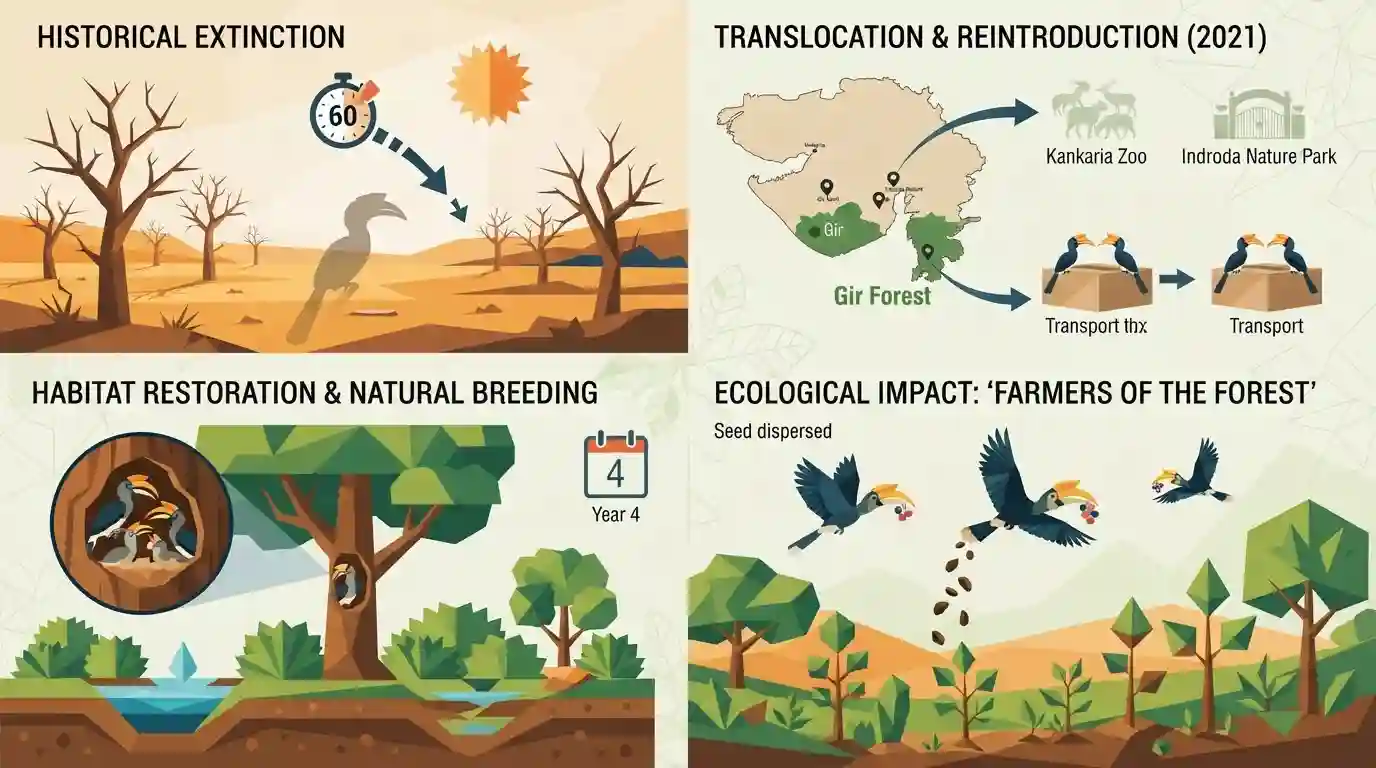
The Indian Grey Hornbill has achieved a major conservation milestone by successfully breeding in the Gir forest of Gujarat for the fourth consecutive year. The species had faced local extinction in the region approximately 60 years ago. In 2021, authorities initiated a reintroduction effort by translocating pairs from Kankaria Zoo and Indroda Nature Park. The success of the project is attributed to favorable habitat restoration and a breeding strategy allowing parent birds to rear their own young within naturalized enclosures. Ecologically known as 'farmers of the forest', the presence of hornbills is expected to significantly enhance seed dispersal and the long-term health of Gir's dry deciduous ecosystem.
Key Points
- The Indian Grey Hornbill has successfully bred in Gujarat's Gir forest for the fourth consecutive year, following a local extinction event spanning six decades.
- The reintroduction program was initiated in 2021 by bringing hornbill pairs from Kankaria Zoo and Indroda Nature Park into Gir.
- The breeding success relied on allowing parent birds to rear their own chicks inside designated enclosures, a method differing from techniques used for vultures or the Great Indian Bustard.
- Indian Grey Hornbills are recognized as 'farmers of the forest' due to their critical ecological role as seed dispersers, aiding in the natural regeneration of forest ecosystems.
Important Terms
Indian Grey Hornbill

A medium-sized bird (Ocyceros birostris) native to the Indian subcontinent. Classified as 'Least Concern' by the IUCN, it plays a crucial role in seed dispersal and was successfully reintroduced to Gujarat's Gir forest.
UPSC context
GS-3 (Biodiversity). Tests awareness of species in news, IUCN status, and wildlife reintroduction programs.
Extirpation (Local Extinction)
The condition where a species ceases to exist in a specific geographic area, though it still survives elsewhere globally. The Indian Grey Hornbill suffered this local extinction in Gir approximately 60 years ago.
UPSC context
GS-3 (Environment). Differentiates between local ecological loss and global extinction; highly relevant for conservation biology.
Kankaria Zoo
An ex-situ conservation facility located in Ahmedabad, Gujarat. Officially known as the Kamla Nehru Zoological Garden, it provided hornbill pairs for the successful translocation and breeding project in Gir.
UPSC context
GS-3 (Environment). Highlights the role of zoological parks in captive breeding and species translocation efforts.
Indroda Nature Park
An eco-educational park and ex-situ conservation center in Gandhinagar, Gujarat. Managed by the GEER Foundation, it is known as India's "Jurassic Park" for its dinosaur fossils and supplied birds for Gir.
UPSC context
GS-3 (Biodiversity). Important for ex-situ conservation sites and its unique status as a premier fossil site.
Farmers of the Forest
An ecological nickname for hornbills and other frugivorous species. By consuming fruits and excreting intact seeds over vast areas, they facilitate natural forest regeneration and maintain ecological balance.
UPSC context
GS-3 (Ecology). Tests understanding of ecological niches, specifically the role of keystone species in seed dispersal.
Gir Dry Deciduous Ecosystem
A semi-arid, teak-dominated forest ecosystem in Gujarat's Saurashtra region. While globally famous as the Asiatic lion's last refuge, its biodiversity is currently being enhanced through the restoration of native bird species.
UPSC context
GS-1/GS-3. Tests knowledge of Indian forest classifications, flora/fauna habitats, and protected areas.
Prelims Trap
All Indian hornbill species are strictly restricted to dense, wet tropical rainforests for survival.
The Indian Grey Hornbill is highly adaptable and thrives in dry deciduous forests, scrublands, and urban landscapes, unlike evergreen-dependent species like the Great Hornbill.
Static Concepts Connected
What ecological role and nesting behavior define Indian Hornbills?
- Seed dispersal: They act as 'farmers of the forest' by digesting fruit pulp and dispersing intact, viable seeds over vast forest ranges.
- Cavity nesting: Females seal themselves inside tree cavities during nesting, relying entirely on the male to deliver food through a narrow slit.
What are the primary ecological features of the Gir Forest ecosystem?
- Vegetation type: Dominated by tropical dry deciduous forests, particularly dry teak forests, mixed with thorn scrub and savanna-like grasslands.
- Key fauna: It is the last wild refuge of the Asiatic Lion, sharing the habitat with leopards, chital, and chousingha.
Cross-Topic Patterns
Ex-situ to in-situ transitions
Moving birds from zoos to Gir highlights how ex-situ breeding serves as a direct genetic reservoir for active in-situ ecosystem restoration.
Adaptive vs selective avian habitats
Contrasting the adaptable Indian Grey Hornbill (dry deciduous) with the sensitive Great Hornbill (evergreen) reveals how species niche breadth influences rewilding success.

UPSC may contrast avian conservation techniques, comparing Gir's naturalized parent-rearing with GIB's intensive artificial incubation.
Linked PYQs · 3
Linked PYQs · 3
- 2026GPSC_PRELIMSGS1
The 'Great Indian Bustard (GIB)' (Ghorad) is frequently seen in the news in the context of wildlife conservation efforts in western India. Consider the following statements regarding this species: 1. Currently, the highest surviving wild population of the Great Indian Bustard in India is located in the semi-arid grasslands of Gujarat. 2. It is a long-distance migratory bird that travels from Central Asia to the Indian subcontinent to escape harsh winters. Which of the above statement(s) is/are correct?
- 2026GPSC_PRELIMSGS1
Consider the following pairs: Tree Species - Associated Forest Type 1. Rosewood (Dalbergia latifolia) - Tropical Wet Evergreen Forests 2. Teak (Tectona grandis) - Tropical Moist Deciduous Forests 3. Khejri (Prosopis cineraria) - Tropical Thorn Forests 4. Sundari (Heritiera fomes) - Littoral and Swamp Forests 5. Deodar (Cedrus deodara) - Mountainous Sub-Tropical Broad-leaves Forests Which of the above pairs are correctly matched?
- 2025GPSC_PRELIMSGS1
In which states of India are Tropical evergreen forests found? 1. On the eastern slopes of the Western Ghats 2. In the Andaman and Nicobar islands 3. On the Aravalli mountain range 4. On the hills of the north-eastern region Select the correct option from the following.
