India and EU optimistic about concluding free trade agreement
Source:The Hindu ↗
Why It Matters
The conclusion of an India-EU FTA would mark a pivotal shift in India's economic diplomacy with developed nations. Understanding the bottlenecks, particularly climate-linked trade barriers like CBAM, is crucial for analyzing modern trade protectionism and its implications for developing economies. Additionally, the IMEC underscores India's strategic push for multipolar connectivity.
Summary
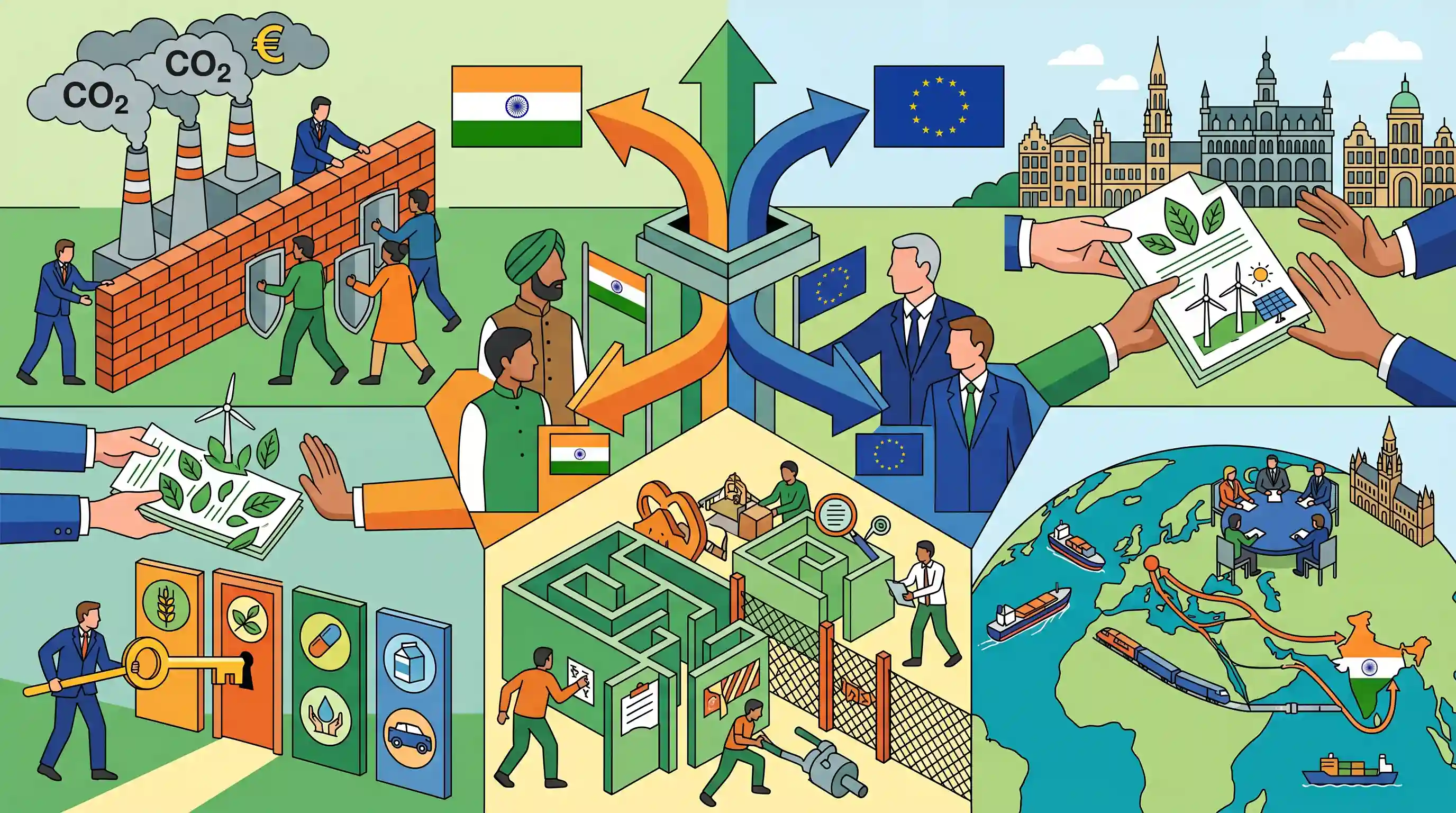
Negotiations for a Free Trade Agreement (FTA) between India and the European Union are gaining momentum, with officials from both sides expressing optimism about concluding the deal by the end of the year. The renewed push follows the completion of elections in both India and the European Parliament. However, significant structural and ideological differences remain. The primary stumbling block is the EU's introduction of the Carbon Border Adjustment Mechanism (CBAM) and its insistence on integrating Trade and Sustainable Development commitments into the trade pact. India strongly opposes linking environmental and climate action mandates directly with trade agreements, viewing them as potential protectionist tools and non-tariff barriers. Furthermore, the EU is demanding substantial tariff reductions in traditionally protected Indian sectors such as agriculture, dairy, pharmaceuticals, and automobiles. Conversely, Indian negotiators are concerned about stringent European quality standards and non-tariff barriers limiting Indian exports. In a related geopolitical development, Indian and European officials also convened in Brussels to strategize the implementation of the India-Middle East-Europe Economic Corridor (IMEC), reflecting a broader mutual interest in enhancing strategic and economic connectivity.
Key Points
- India and the European Union are engaged in intense negotiations with the goal of finalizing a Free Trade Agreement (FTA) by the end of the year, following the recent Lok Sabha and European Parliament elections.
- Key hurdles in the FTA talks include the EU's proposed Carbon Border Adjustment Mechanism (CBAM) and its insistence on linking trade with environmental and sustainable development standards, which India opposes as protectionist.
- Other contentious issues involve India's protective tariffs on agriculture, dairy, and automotive sectors, contrasted with Indian concerns over stringent EU non-tariff barriers and standard certifications.
- Parallel to trade negotiations, officials convened in Brussels to strategize on the India-Middle East-Europe Economic Corridor (IMEC), aiming to advance connectivity despite ongoing conflicts in West Asia.
Important Terms
India-EU Free Trade Agreement (FTA)

A comprehensive bilateral agreement aimed at reducing or eliminating tariffs and non-tariff barriers on goods and services between India and the EU to boost trade, services, and high-quality foreign investment.
UPSC context
GS Paper II (International Relations); evaluates trade diplomacy, market access, and the transition toward comprehensive economic partnerships between major democratic economies.
Carbon Border Adjustment Mechanism (CBAM)
An EU policy that taxes imports of carbon-intensive products (like steel and aluminum) based on their production-related emissions to prevent carbon leakage and ensure parity with EU producers.
UPSC context
GS Paper III (Environment & Economy); tests green protectionism, WTO rules, and the Common But Differentiated Responsibilities (CBDR) principle.
India-Middle East-Europe Economic Corridor (IMEC)
A strategic infrastructure project linking India, the Middle East, and Europe through a network of ports, railways, and digital cables, serving as an alternative to China’s Belt and Road Initiative.
UPSC context
GS Paper II (International Relations); assesses connectivity geopolitics, strategic autonomy, and regional stability in West Asia and the Indo-Pacific.
Trade and Sustainable Development (TSD)
Specific chapters in EU trade pacts that enforce binding commitments to international labor and environmental standards, often contested by developing nations as potential non-tariff barriers to trade.
UPSC context
GS Paper II (International Relations); focuses on the linkage between international trade law and social/environmental mandates in modern treaty negotiations.
Non-Tariff Barriers (NTBs)
Trade restrictions other than taxes, including quality standards, sanitary regulations, and certification requirements, that can hinder exports by increasing compliance costs for manufacturers in developing nations.
UPSC context
GS Paper III (Economy); tests export competitiveness, sanitary and phytosanitary (SPS) measures, and global trade regulatory frameworks.
Prelims Trap
The Carbon Border Adjustment Mechanism (CBAM) applies uniformly to all Indian exports to the European Union.
CBAM currently targets only specific carbon-intensive sectors (iron, steel, cement, aluminium, fertilizers, hydrogen, electricity). It does not apply to all exports like textiles, agriculture, or IT.
Static Concepts Connected
What constitutes Non-Tariff Barriers (NTBs) in international trade?
- Definition: Trade restrictions that do not involve a direct tax or duty, often used to protect domestic industries under the guise of quality control.
- SPS Measures: Sanitary and Phytosanitary measures, such as strict chemical residue limits or hygiene rules, frequently used by the EU to block agricultural and dairy imports.
- TBTs: Technical Barriers to Trade, including complex packaging, environmental labeling, and standard certifications that drastically increase compliance costs for developing nation exporters.
How does a standard FTA differ from a CECA and a CEPA?
- Free Trade Agreement: Focuses primarily on eliminating or reducing tariffs on a positive or negative list of traded goods between two entities.
- CECA: Comprehensive Economic Cooperation Agreement: covers goods, but also gradually extends to limited services and investments.
- CEPA: Comprehensive Economic Partnership Agreement: the widest scope, deeply integrating goods, services, investments, intellectual property rights (IPR), and dispute settlement.
Cross-Topic Patterns
Climate action as a trade barrier
The EU's CBAM and Deforestation Regulation blur the lines between climate commitments (UNFCCC) and trade protectionism (WTO), becoming a core North-South friction point in global forums.
IMEC's parallel strategic diplomacy
Economic integration with Europe is advancing simultaneously through FTA negotiations and physical connectivity via IMEC, serving as a multi-pronged counter-strategy to China's Belt and Road Initiative.

Expect a multi-statement Prelims question testing the exact sectors targeted by CBAM, juxtaposed against WTO rules on Non-Tariff Barriers.
Linked PYQs · 5
Linked PYQs · 5
- 2011MainsGS2
Compared to the South Asian Free Trade Area (SAFTA), the Bay of Bengal Initiative for Multisectoral Technical and Economic Cooperation Free Trade Area (BIMSTEC FTA) seems to be more promising." Critically evaluate.
- 2014MainsGS2
The aim of Information Technology Agreements (ITAs) is to lower all taxes and tariffs on information technology products by signatories to zero. What impact would such agreements have on India's interests?
- 2022MainsGS3
Discuss global warming and mention its effects on the global climate. Explain the control measures to bring down the level of greenhouse gases which cause global warming, in the light of the Kyoto Protocol, 1997.
- 2023MainsGS3
What are the direct and indirect subsidies provided to farm sector in India? Discuss the issues raised by the World Trade Organization (WTO) in relation to agricultural subsidies.
- 2025MainsGS2
"Energy security constitutes the dominant kingpin of India's foreign policy, and is linked with India's overarching influence in Middle Eastern countries.” How would you integrate energy security with India's foreign policy trajectories in the coming years?
