India US technology diplomacy and artificial intelligence talks
Source:The Hindu ↗
Why It Matters
Highlights the increasing role of technology diplomacy and economic partnerships in shaping the India-US strategic relationship, particularly focusing on future-critical domains like AI, quantum computing, and supply chain security.
Summary
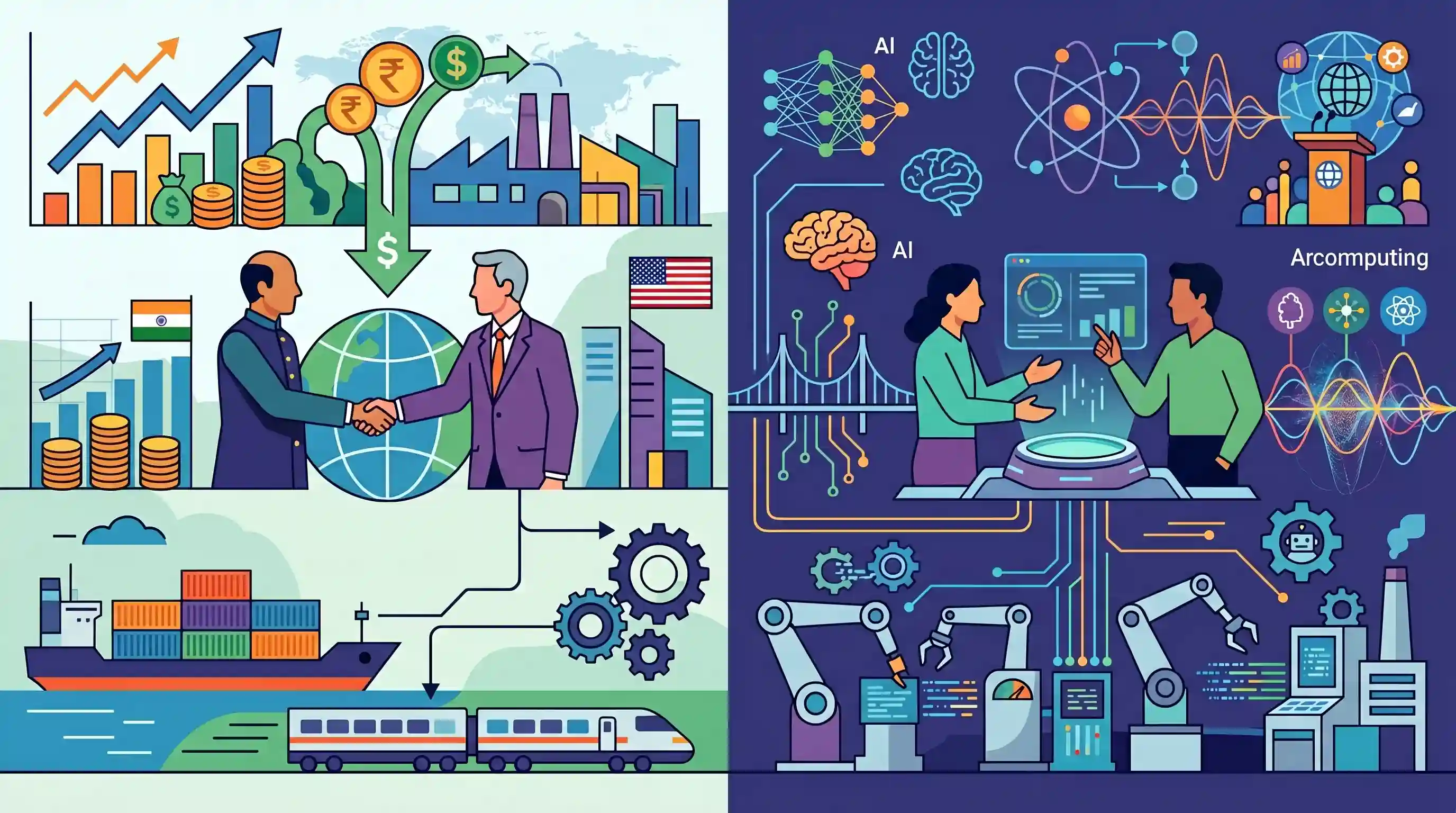
Indian Ambassador to the US, Vinay Mohan Kwatra, held strategic discussions with prominent US business and tech leaders. In his meeting with Walmart US President Chris Nicholas, conversations centered on expanding investments in India and enhancing supply chain resilience. Separately, he engaged with SCSP CEO Ylli Bajraktari to exchange perspectives on the future of Artificial Intelligence, Physical AI, Quantum computing, and broader tech cooperation ahead of the India-US Forum.
Key Points
- Indian Ambassador to the US, Vinay Mohan Kwatra, met with Walmart CEO Chris Nicholas to discuss the company's investments in India, potential expansion, and improving supply chain resilience.
- Kwatra also engaged with SCSP CEO Ylli Bajraktari to discuss the future of emerging technologies like Quantum, AI, and Physical AI.
- The meetings underscore the growing importance of tech diplomacy and bilateral economic cooperation ahead of the upcoming India-US Forum in New Delhi.
Important Terms
Special Competitive Studies Project (SCSP)

A non-partisan U.S. initiative focused on strengthening long-term national competitiveness in artificial intelligence and other emerging technologies to shape the global techno-economic landscape.
UPSC context
GS Paper 2 (International Relations); critical for understanding India-US technological partnerships like iCET and strategic competition.
Physical AI
AI systems that perceive, reason, and act in the tangible world through bodies like robots and autonomous vehicles, moving intelligence from software into the physical economy.
UPSC context
GS Paper 3 (Science and Technology); represents the next frontier in automation, robotics, and industrial efficiency.
Supply Chain Resilience
The ability of a supply chain to anticipate, adapt to, and recover from disruptions by diversifying sources and reducing dependency on a single nation or supplier.
UPSC context
GS Paper 3 (Economy); vital for national economic security and initiatives like the Supply Chain Resilience Initiative (SCRI).
Tech Diplomacy
The use of diplomatic tools to engage tech sectors and negotiate global policies on emerging technologies to advance national interests and economic growth.
UPSC context
GS Paper 2 (International Relations); essential for managing cross-border digital standards and strategic tech-sharing agreements.
Quantum Computing
A field of computing that uses principles of quantum mechanics, such as superposition and entanglement, to solve complex problems significantly faster than classical computers.
UPSC context
GS Paper 3 (Science and Technology); a pillar of the National Quantum Mission and strategic bilateral cooperation.
Foreign Direct Investment (FDI)
Investment made by an individual or firm from one country into business interests located in another country, typically by establishing business operations or acquiring assets.
UPSC context
GS Paper 3 (Economy); critical for India's growth, infrastructure development, and integration into global value chains.
Prelims Trap
100% FDI under the automatic route is permitted in both single-brand and multi-brand retail trading in India.
100% FDI is allowed in single-brand retail and wholesale cash-and-carry, but multi-brand retail FDI is capped at 51% under the government approval route.
Static Concepts Connected
What are India's current FDI limits in the retail and e-commerce sectors?
- Single-brand retail: Allowed up to 100% under the automatic route, subject to local sourcing norms (30%) if FDI exceeds 51%.
- Multi-brand retail: Capped at 51% under the government approval route, with strict conditions on infrastructure investment and population minimums for stores.
- Wholesale & E-commerce: 100% FDI under automatic route is permitted in wholesale trading (cash-and-carry) and the marketplace model of e-commerce, but not in inventory-based e-commerce.
How does 'Physical AI' conceptually differ from traditional Generative AI?
- Embodiment: Integrates AI into physical entities (like robotics and drones) allowing them to interact dynamically with the real, three-dimensional world.
- Sensory Input: Relies heavily on real-time spatial computing, physics, and continuous multi-modal sensor data rather than static text or digital datasets.
- Physical Execution: Acts autonomously in physical environments to perform mechanical tasks (e.g., driverless cars, factory automation, surgical robots).
Cross-Topic Patterns
Tech diplomacy driving strategic partnerships
India-US tech cooperation via iCET and Quad critical technology working groups reflects a shift from traditional defense ties to techno-economic alliances countering Chinese supply chain dominance.
Retail FDI and MSME global integration
Global retail investments navigate FDI restrictions by utilizing wholesale routes, which helps build backend logistics and integrates Indian MSMEs into global supply chains.

Expect a 2026 Prelims question distinguishing Physical AI from Generative AI, or a Mains probe on iCET's role in India-US tech diplomacy.
Linked PYQs · 2
Linked PYQs · 2
- 2023MainsGS3
Introduce the concept of Artificial Intelligence (AI). How does Al help clinical diagnosis? Do you perceive any threat to privacy of the individual in the use of Al in healthcare?
- 2013MainsGS3
Discuss the impact of FDI entry into Multi-trade retail sector on supply chain management in commodity trade pattern of the economy.
