India and Bangladesh resume diplomatic engagement under new regime
Source:The Hindu ↗
Why It Matters
Bangladesh is central to India's 'Neighbourhood First' and 'Act East' policies. Smooth diplomatic relations and border stability are crucial for security in India's Northeast, connectivity initiatives, and counter-terrorism. Regime changes in Dhaka profoundly impact bilateral trade, border management, and overarching South Asian geopolitics, making this re-engagement critical for regional stability.
Summary
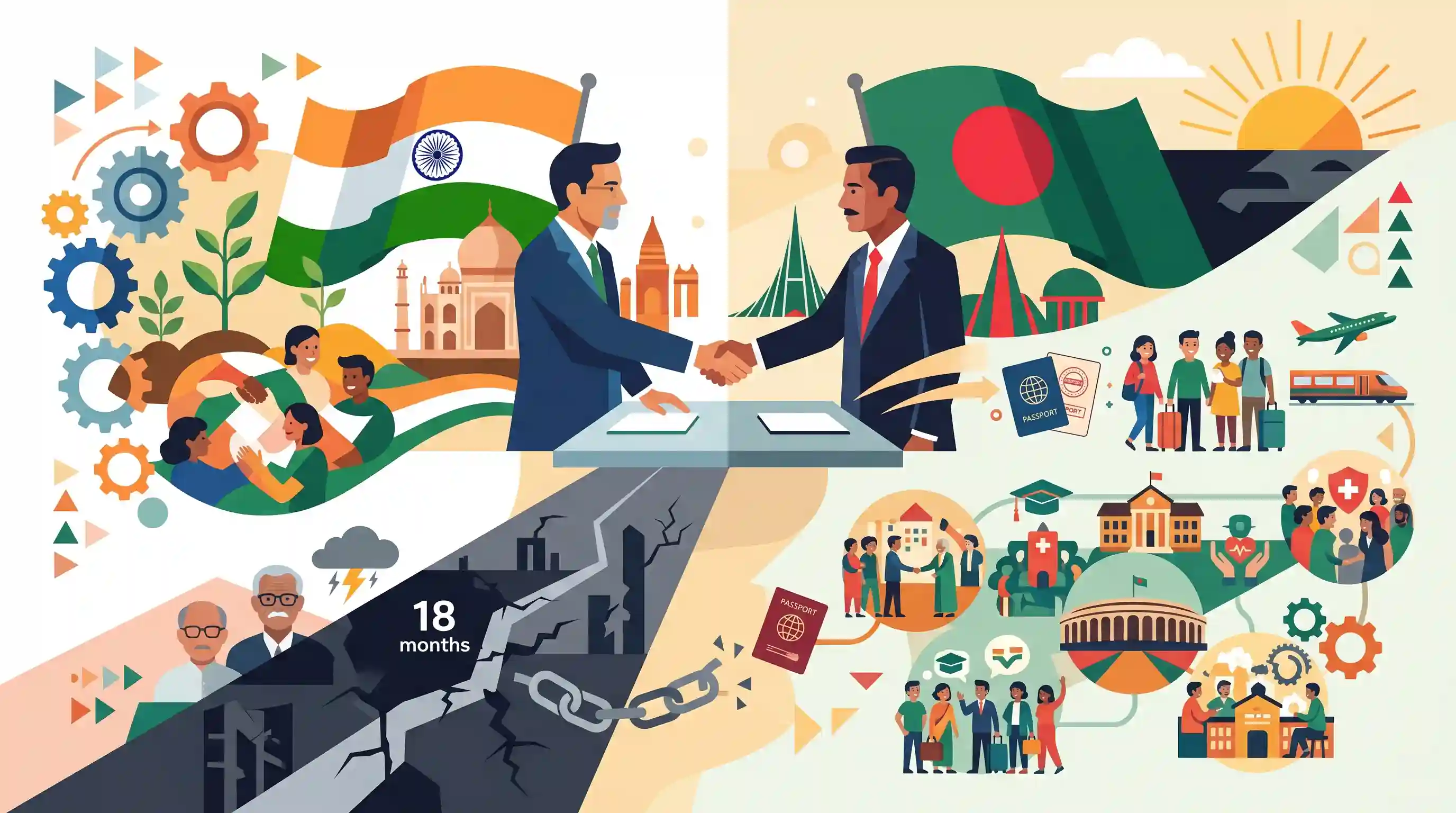
The Indian High Commissioner to Bangladesh, Pranay Verma, met with the newly appointed Bangladesh Foreign Minister, Khalilur Rahman, signaling a renewed diplomatic effort to strengthen bilateral ties. This strategic re-engagement follows the February 2026 election victory of the Bangladesh Nationalist Party (BNP) under Prime Minister Tarique Rahman, concluding 18 months of strained relations during Muhammad Yunus's interim rule. India emphasized its commitment to a "democratic, progressive, and inclusive" Bangladesh and discussed restarting standard visa operations to foster people-centric cooperation.
Key Points
- Indian High Commissioner Pranay Verma held talks with the newly appointed Bangladesh Foreign Minister Khalilur Rahman to strengthen bilateral relations.
- The meeting marks India's strategic re-engagement with Dhaka following the election of Prime Minister Tarique Rahman of the BNP.
- Tarique Rahman's government assumed power after a two-thirds majority win on February 12, 2026, ending 18 months of strained relations under Muhammad Yunus's interim rule.
- India signaled strong diplomatic support, with PM Modi congratulating the new PM and Lok Sabha Speaker Om Birla attending the swearing-in ceremony.
- Key discussions included restarting normal visa operations for Bangladeshi nationals to promote 'people-centric cooperation' and support for a democratic, inclusive Bangladesh.
Important Terms
Bangladesh Nationalist Party (BNP)

A major center-right political party in Bangladesh, currently led by Tarique Rahman. It emphasizes "Bangladesh Before All" and has historically had complex, sometimes strained, security and diplomatic relations with India.
UPSC context
GS Paper II: India and its neighborhood. Vital for understanding regional political shifts and their impact on India's security and strategic interests.
Neighborhood First Policy
India's primary foreign policy prioritizing immediate neighbors to ensure regional stability and economic integration. It focuses on connectivity, development assistance, and non-reciprocal support to foster a "secure and prosperous" periphery.
UPSC context
GS Paper II: International Relations. A cornerstone of Indian diplomacy; tested by political transitions in neighboring states like Bangladesh.
High Commissioner
The highest-ranking diplomatic representative sent from one Commonwealth country to another. While functionally identical to an Ambassador, the title signifies a shared historical link to the Commonwealth of Nations.
UPSC context
GS Paper II: Statutory/Regulatory/Quasi-judicial bodies. Differentiates diplomatic ranks and protocols within India's external affairs framework.
Interim Government (Bangladesh)
An extra-constitutional administration led by Nobel Laureate Muhammad Yunus (2024–2026) following Sheikh Hasina's ouster. It was tasked with implementing fundamental reforms and overseeing the transition back to democratic governance.
UPSC context
GS Paper II: India and its neighborhood. Relevant for analyzing how political instability and transitions in neighboring countries affect bilateral treaties.
Tarique Rahman
Current Prime Minister of Bangladesh and Chairperson of the BNP. His 2026 electoral victory marked the end of the interim administration and a significant shift in Bangladesh's political landscape.
UPSC context
GS Paper II: Important International institutions, agencies and fora. Key leadership changes impact bilateral engagement strategies and regional geopolitics.
People-to-people ties
The socio-cultural and economic linkages between citizens, including tourism, medical travel, and educational exchanges. These ties serve as a "soft power" foundation for formal diplomatic relations.
UPSC context
GS Paper II: Effect of policies and politics of countries on India's interests. Essential for sustainable bilateral cooperation and regional integration.
Prelims Trap
"All four member nations, including Bhutan and Bangladesh, are actively implementing the BBIN Motor Vehicles Agreement."
While Bangladesh, India, and Nepal are implementing the BBIN MVA for passenger and cargo protocols, Bhutan temporarily opted out due to environmental and infrastructural concerns.
Static Concepts Connected
What is the strategic significance of the Siliguri Corridor?
- Choke Point: A narrow strip (approx 20-22 km wide) in West Bengal connecting mainland India to the Northeast, vulnerable to severance during conflicts.
- Transit Dependency: Makes bilateral transit and transshipment agreements with Bangladesh (e.g., Chittagong/Mongla port access) crucial to reduce logistical costs.
- Alternative Routes: India is developing alternatives like the Kaladan Multi-Modal project (Myanmar) and inland waterways (Indo-Bangladesh Protocol Route).
How does Medical Value Travel (MVT) classify under WTO trade rules?
- GATS Mode 2: MVT falls under 'Mode 2' (Consumption Abroad) in the WTO's General Agreement on Trade in Services (GATS).
- Economic Impact: It is a major foreign exchange earner. Bangladesh remains India's largest source of foreign medical tourists, creating deep economic interdependence.
Cross-Topic Patterns
Northeast Insurgency & Regime Change
Past BNP-Jamaat regimes historically harbored groups like ULFA. India's pragmatic re-engagement is directly driven by internal security mandates to prevent safe havens from re-emerging along the porous eastern border.
Medical Tourism & Soft Power
Visa operations directly impact India's services trade. Bangladeshi nationals dominate India's Medical Value Travel (MVT), bridging diplomatic divides through 'Mode 2' (Consumption Abroad) economic dependency.
Countering the China-Pak Axis
India's swift outreach to the BNP—a historically adversarial party—signals a shift to pure realpolitik, prioritizing the strategic denial of Chinese and Pakistani influence in the Bay of Bengal.

India's regime-agnostic diplomacy in Bangladesh vs internal security in the Northeast is a high-probability 2026 Mains question.
Linked PYQs · 3
Linked PYQs · 3
- 2022MainsGS2
Do you think that BIMSTEC is a parallel organisation like the SAARC ? What are the similarities and dissimilarities between the two ? How are Indian foreign policy objectives realized by forming this new organisation?
- 2015MainsGS2
Project 'Mausam' is considered a unique foreign policy initiative of the Indian Government to improve relationship with its neighbours. Does the project have a strategic dimension? Discuss.
- 2020MainsGS3
Analyze internal security threats and transborder crimes along Myanmar, Bangladesh and Pakistan borders including Line of Control (LoC). Also discuss the role played by various security forces in this regard.
