European Union sanctions package and implications for India
Source:The Hindu ↗
Why It Matters
Highlights the inherent tension in India's strategic autonomy: balancing its expanding economic, trade, and technology partnerships with the West/EU against its historical defense and energy reliance on Russia (including managing the fallout of Western secondary sanctions).
Summary
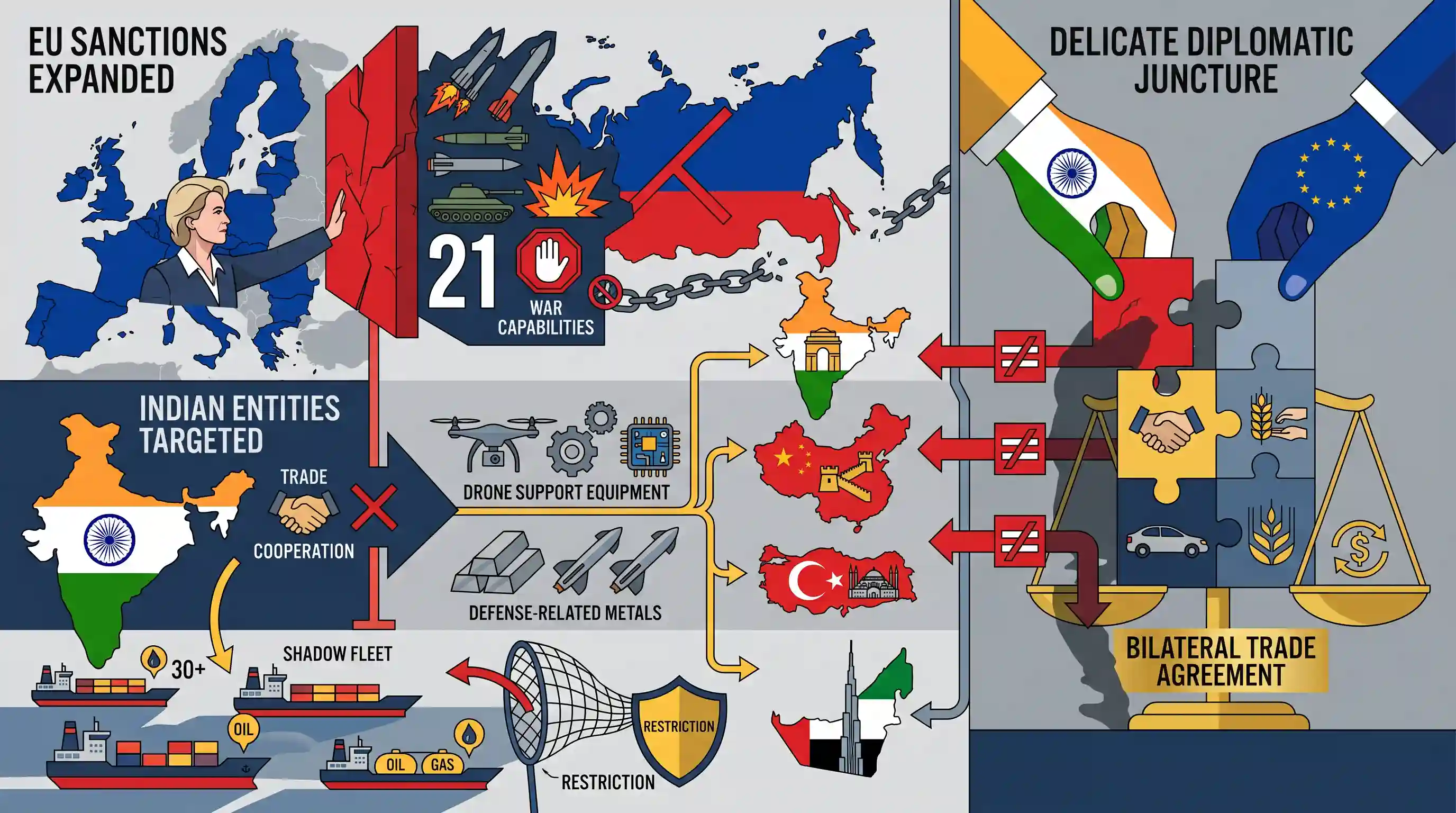
The European Commission, led by President Ursula von der Leyen, has introduced its 21st package of sanctions against Russia to further curtail its war capabilities. The expanded measures are particularly significant for India, as the new export control bans target Indian entities—alongside companies in China, Türkiye, and the UAE—suspected of supplying drone support equipment and defense-related metals to Moscow. The sanctions also broaden enforcement against Russia's "shadow fleet" by restricting 30 additional vessels used to bypass Western restrictions on Russian oil. The inclusion of Indian companies comes at a delicate diplomatic juncture, coinciding with ongoing efforts by New Delhi and Brussels to implement a bilateral trade agreement.
Key Points
- The European Commission proposed its 21st sanctions package against Russia, covering sectors like energy, crypto, financial services, and fisheries.
- The package introduces export controls targeting 50 companies across third nations, including China, the UAE, Türkiye, and notably, India, for allegedly supporting Russia's defense sector.
- Specific bans include equipment used to support drones and metals/alloys utilized in the aerospace and defense sectors.
- The sanctions expand action against Russia's "shadow fleet" by adding 30 vessels involved in circumventing Western oil transport restrictions to an already extensive sanctioned list.
- The inclusion of Indian entities presents a geopolitical complication as New Delhi and Brussels are currently navigating the implementation phase of a recently announced trade agreement.
Important Terms
EU 21st Sanctions Package

A 2026 set of restrictive measures by the EU targeting Russia's war economy, notably expanding export controls to non-Russian entities (including Indian firms) and further restricting the 'shadow fleet' and financial sectors.
UPSC context
GS Paper II (International Relations); tests understanding of how global geopolitical conflicts and major power policies directly impact Indian commercial and strategic interests.
India-EU Free Trade Agreement (FTA)
A comprehensive free trade agreement, concluded in early 2026, aimed at liberalizing trade in goods and services, reducing tariffs, and enhancing bilateral economic integration between India and the European Union.
UPSC context
GS Paper II (Bilateral Groupings); tests knowledge of trade diplomacy and the significance of India’s economic integration with major global markets.
Shadow Fleet
A clandestine network of commercial vessels, often aging and uninsured, that use deceptive maritime practices like disabling tracking systems to transport sanctioned oil and bypass international trade restrictions.
UPSC context
GS Paper III (Economy/Security); tests awareness of maritime trade complexities, sanctions evasion tactics, and implications for India's energy security and global compliance.
Dual-use Goods
Items, software, or technology that can be used for both civilian and military applications, often subject to export controls to prevent the enhancement of a country's military-industrial complex.
UPSC context
GS Paper III (Security/Trade); tests understanding of international export control regimes and the regulatory challenges Indian tech firms face in global supply chains.
European Commission
The executive branch of the European Union responsible for proposing legislation, implementing decisions, and managing the day-to-day business of the EU, including the administration of trade and sanctions programs.
UPSC context
GS Paper II (International Institutions); tests knowledge of the institutional architecture of key global partners and how their decisions shape global trade law.
Prelims Trap
"Secondary sanctions imposed by the EU are legally binding on all UN member states under international law."
Only UN Security Council sanctions are universally binding. EU/US secondary sanctions are unilateral measures with extraterritorial reach but lack universal legal mandate under international law.
Static Concepts Connected
What is a "shadow fleet" and how do vessels evade global sanctions?
- Definition: A covert network of commercial ships transporting sanctioned oil (e.g., Russian/Iranian crude) outside Western financial, maritime, and insurance systems.
- AIS spoofing: Vessels routinely turn off or manipulate Automatic Identification System (AIS) transponders to obscure their maritime movements.
- Flags of Convenience: Registering ships in nations with lax maritime regulations and oversight to avoid scrutiny and mask true ownership.
- Mid-sea transfers: Conducting ship-to-ship (STS) cargo transfers in international waters to mask the origin of the sanctioned oil.
What are the key pillars and historical friction points of the India-EU BTIA?
- Launch & Stagnation: Launched in 2007, the Broad-based Trade and Investment Agreement stalled in 2013 over tariff disputes before being officially relaunched in 2022.
- European demands: The EU historically demands steep tariff cuts on automobiles, wines, and dairy, alongside a stringent intellectual property (IP) regime.
- Indian demands: India heavily pushes for greater market access for its services sector, specifically Mode 4 (movement of natural persons/professionals).
- Newer frictions: The EU's Carbon Border Adjustment Mechanism (CBAM) and deforestation rules have emerged as major structural non-tariff barriers.
Cross-Topic Patterns
India-EU BTIA vs. Extraterritoriality
The ongoing BTIA talks face twin geopolitical hurdles: the EU's unilateral environmental barriers (CBAM) and its increasing use of extraterritorial secondary sanctions targeting Indian exporters.
Dark Shipping and Marine Ecology risks
"Shadow fleets" utilize aging, poorly maintained vessels with inadequate P&I insurance, creating severe risks of catastrophic, uncompensated oil spills in critical maritime chokepoints.

Expect a 2026 prelims multi-statement question contrasting UN Security Council sanctions with unilateral secondary sanctions (EU/US).
Linked PYQs · 3
Linked PYQs · 3
- 2018MainsGS2
In what ways would the ongoing US-Iran Nuclear Pact Controversy affect the national interest of India? How should India respond to this situation?
- 2012MainsGS2
How have the US sanctions against Iran affected India's bilateral relations with Iran?
- 2023MainsGS2
‘The expansion and strengthening of NATO and a stronger US-Europe strategic partnership works well for India.’ What is your opinion about this statement ? Give reasons and examples to support your answer.
