RBI Annual Report projects India GDP growth at 6.9 percent for FY27
Source:The Hindu ↗
Why It Matters
The RBI Annual Report is a crucial document for UPSC aspirants. It synthesizes the interplay of global geopolitical risks, macroeconomic indicators (GDP, CPI, Current Account), and geographic phenomena (El Niño, IOD) affecting Indian agriculture. Understanding these linkages is essential for answering analytical questions in GS3 Mains and factual concept-based questions in Prelims.
Summary
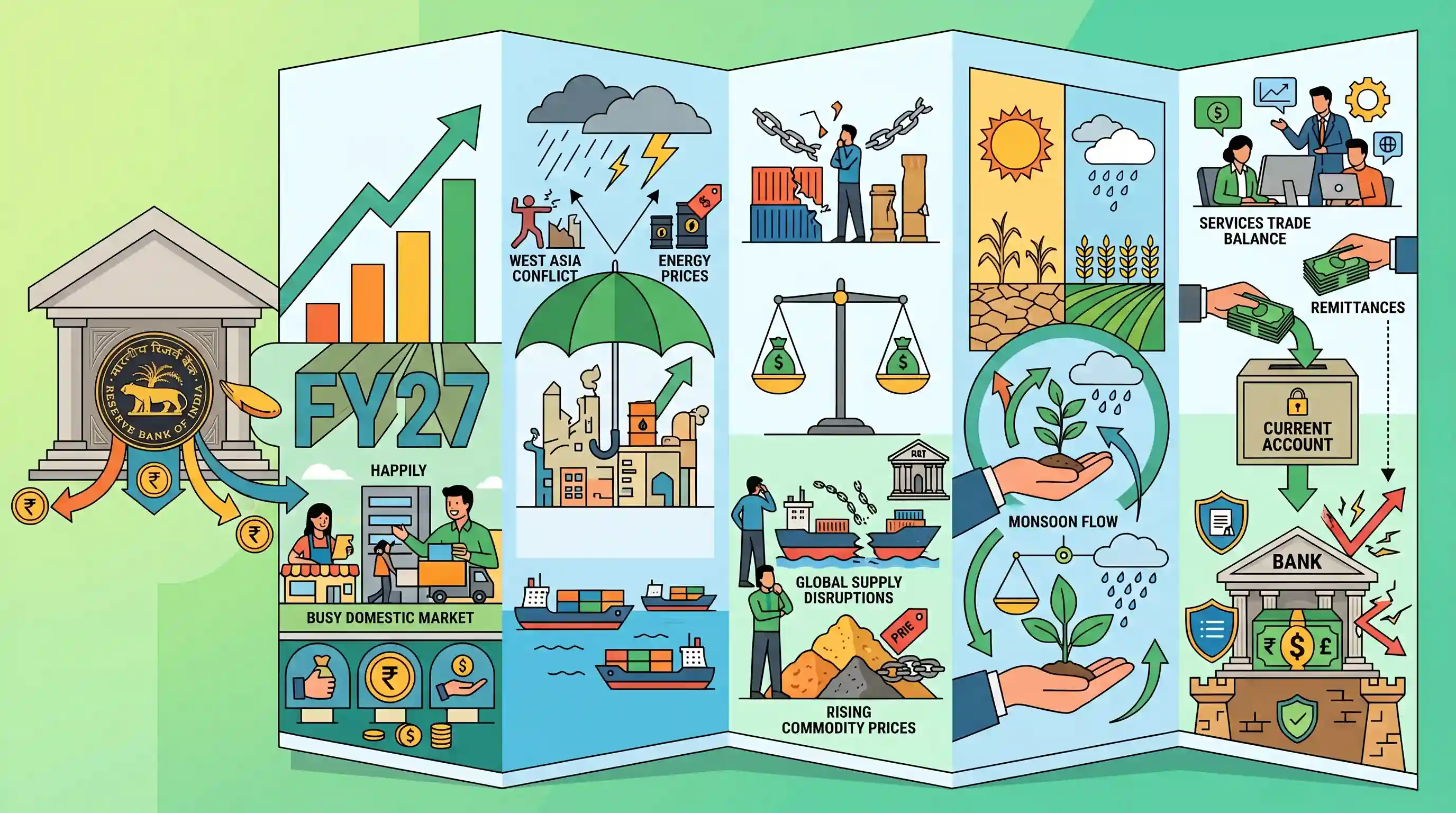
According to the Reserve Bank of India's (RBI) Annual Report for 2025-26, the Indian economy is expected to remain resilient with a projected real GDP growth of 6.9% for FY27. Strong macroeconomic fundamentals, robust domestic demand, and lower export dependence are anticipated to insulate the economy against global headwinds, including the ongoing West Asia conflict and elevated energy prices. The central bank projects CPI inflation at 4.6%, cautioning about upside risks from global supply disruptions and commodity prices. While agricultural prospects depend heavily on the south-west monsoon—with El Niño posing risks that could be partially countered by a positive Indian Ocean Dipole (IOD)—the services trade balance and remittances are expected to support the current account. Furthermore, prudent regulatory reforms have fortified the domestic banking sector against potential economic shocks.
Key Points
- RBI's Annual Report for 2025-26 projects India's real GDP growth at 6.9% and CPI inflation at 4.6% for FY27, citing strong domestic demand and stable policies.
- The West Asia conflict poses a dominant downside risk to global growth, with the IMF projecting global expansion to slow to 3.1% in 2026.
- Agricultural output faces downside risks from potential El Niño conditions, though an expected positive Indian Ocean Dipole (IOD) may help offset adverse effects on the monsoon.
- India's current account balance will be supported by a robust services trade balance and non-Gulf remittances, while the banking sector remains resilient with adequate capital buffers.
Important Terms
Reserve Bank of India (RBI)

India's central bank and regulatory body responsible for monetary policy, issuing currency, and overseeing the banking system to maintain financial stability.
UPSC context
GS Paper III: Monetary Policy and Economic Growth. Focus on its role in inflation targeting and financial regulation.
Four Labour Codes
A set of four legislative codes—Wages, Social Security, Industrial Relations, and Occupational Safety—consolidating 29 central labor laws to simplify compliance and boost productivity.
UPSC context
GS Paper III: Economic Development and Labour Reforms. Tests knowledge of structural reforms and their impact on employment.
CPI Inflation
A measure of the average change over time in the prices paid by urban and rural consumers for a representative basket of goods and services.
UPSC context
GS Paper III: Indian Economy and Inflation. Critical for understanding the RBI's 'flexible inflation targeting' framework.
Indian Ocean Dipole (IOD)
A climate phenomenon involving sea surface temperature differences between the western and eastern Indian Ocean, significantly influencing the Indian monsoon's strength.
UPSC context
GS Paper I: Geography; GS Paper III: Agriculture. Relevant for monsoon forecasting and food security.
Current Account Deficit (CAD)
A measurement of a country's trade where the value of the goods and services it imports exceeds the value of the products it exports.
UPSC context
GS Paper III: External Sector. Measures external economic health and vulnerability to global commodity price shocks.
Real GDP
An inflation-adjusted measure that reflects the value of all goods and services produced by an economy in a given year.
UPSC context
GS Paper III: Economic Growth and Development. Used to compare economic performance across different time periods.
International Monetary Fund (IMF)
A global organization that monitors economic developments, provides policy advice, and offers financial assistance to member countries to maintain global financial stability.
UPSC context
GS Paper III: Important International Institutions. Focus on its role in global governance and economic projections.
Prelims Trap
A positive Indian Ocean Dipole (IOD) worsens the adverse effects of El Niño on the Indian monsoon.
A positive IOD actually brings more rain to India, acting as a mitigating factor that offsets the rainfall-suppressing effects of El Niño.
Static Concepts Connected
How do El Niño and Positive IOD interact with the Indian Monsoon?
- El Niño: Abnormal warming of the central/eastern Pacific Ocean, which shifts atmospheric circulation and typically suppresses Indian monsoon rainfall.
- Positive IOD: Warmer sea surface temperatures in the western Indian Ocean relative to the east, which boosts convection and rainfall over India.
- Offsetting Effect: When occurring simultaneously, a positive IOD can counterbalance the drought-like conditions induced by El Niño.
How do remittances and services impact India's Current Account?
- Merchandise Deficit: India runs a structural trade deficit in goods, primarily driven by large-scale crude oil and gold imports.
- Invisibles Surplus: Net exports of services (IT/BPO) and inward remittances (private transfers) form a massive surplus in the 'invisibles' account.
- CAD Buffer: This invisibles surplus consistently bridges the merchandise trade gap, preventing the Current Account Deficit (CAD) from breaching danger levels.
Cross-Topic Patterns
West Asia geopolitics & India's CAD
Geopolitical shocks in West Asia inflate crude prices, widening India's merchandise trade deficit. However, non-Gulf remittances and robust IT exports act as crucial macroeconomic buffers against imported inflation.
Climate risks & Monetary Policy
UPSC increasingly links physical geography (El Niño/IOD) to the economy. Unpredictable monsoons cause food price spikes (cost-push inflation), directly challenging the RBI's inflation-targeting framework.

Expect a 2026 Prelims multi-statement question pairing El Niño/IOD mechanics with their downstream impact on RBI's inflation forecasting.
Linked PYQs · 3
Linked PYQs · 3
- 2017PrelimsGS1
With reference to 'Indian Ocean Dipole (IOD)' sometimes mentioned in the news while forecasting Indian monsoon, which of the following statements is/are correct? 1. IOD phenomenon is characterised by a difference in sea surface temperature between tropical Western Indian Ocean and tropical Eastern Pacific Ocean. 2. An IOD phenomenon can influence an El Nino's impact on the monsoon. Select the correct answer using the code given below:
- 2024MainsGS3
What are the causes of persistent high food inflation in India? Comment on the effectiveness of the monetary policy of the RBI to control this type of inflation.
- 2018MainsGS3
How would the recent phenomena of protectionism and currency manipulations in world trade affect macroeconomic stability of India?
