RBI Annual Report Projections on Macroeconomic Resilience
Source:The Hindu ↗
Why It Matters
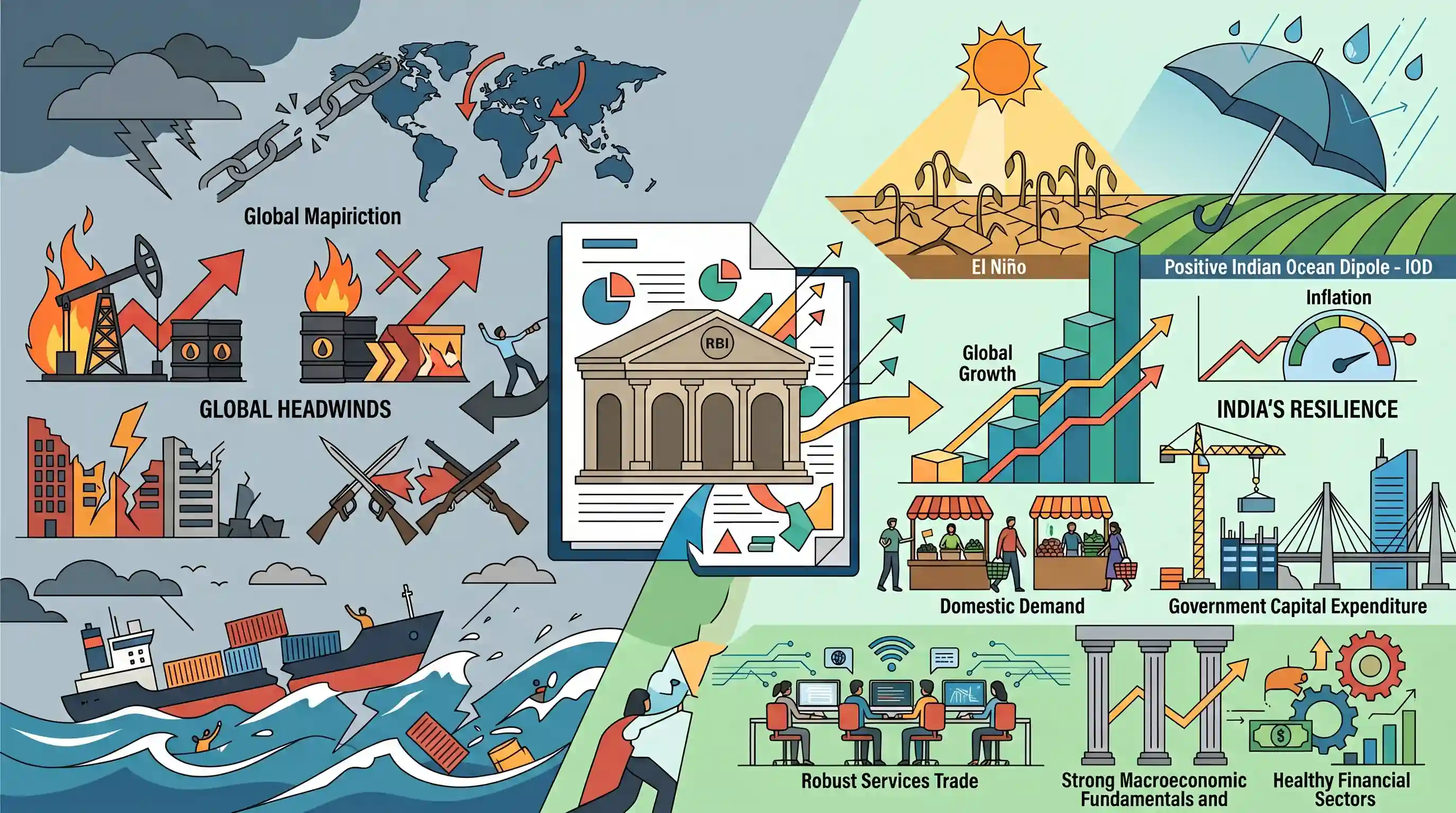
The RBI Annual Report is a definitive source for understanding India's macroeconomic health. This article is crucial for GS-3 (Economy) as it details how domestic fundamentals (capex, domestic demand) provide a buffer against external shocks (West Asia conflict, global inflation) and environmental risks (El Niño).
Summary
The Reserve Bank of India's (RBI) Annual Report for 2025-26 projects a resilient Indian economy for FY 2026-27, estimating real GDP growth at 6.9% and retail inflation at 4.6%. Although global growth is expected to remain moderate at 3.1% due to the lingering West Asia conflict, trade uncertainties, and elevated energy prices, India's strong macroeconomic fundamentals, domestic demand, and healthy financial sectors are predicted to drive growth. Potential downside risks to agriculture from El Niño may be buffered by a positive Indian Ocean Dipole (IOD). The RBI also highlighted the role of government capital expenditure and robust services trade in shielding the economy from external headwinds.
Key Points
- The RBI Annual Report 2025-26 projects India's real GDP growth at 6.9% and CPI inflation at 4.6% for FY 2026-27.
- India's economic resilience is underpinned by robust domestic demand, lower export dependency, healthy corporate and banking balance sheets, and sustained capital expenditure.
- Key global downside risks include the West Asia conflict, rising logistics and energy costs, and tighter global macroeconomic conditions, with the IMF forecasting 3.1% global growth in 2026.
- Domestic agricultural risks from potential El Niño conditions could be partly offset by the emergence of a positive Indian Ocean Dipole (IOD).
- India's services trade balance and inward remittances from non-Gulf countries are expected to support the current account balance despite global supply chain hurdles.
Important Terms
Reserve Bank of India (RBI)

India’s central bank responsible for regulating the banking system, managing foreign exchange reserves, and formulating monetary policy to maintain price stability while supporting economic growth.
UPSC context
GS Paper III: Indian Economy. Tests understanding of monetary policy, banking regulation, and central bank’s role in macroeconomic stability.
Four Labour Codes
A major reform consolidating 29 central labour laws into four simplified codes: Wages, Social Security, Industrial Relations, and Occupational Safety, Health and Working Conditions to boost ease of doing business.
UPSC context
GS Paper III: Economy & Labour Reforms. Focuses on structural reforms, formalization of work, and balancing industry flexibility with worker welfare.
Capital Expenditure (Capex)
Spending by the government on long-term productive assets like infrastructure (roads, railways) and machinery, characterized by a high 'multiplier effect' that stimulates broader economic productivity and growth.
UPSC context
GS Paper III: Fiscal Policy and Budgeting. Critical for understanding growth drivers, asset creation, and public-private investment dynamics.
Indian Ocean Dipole (IOD)
A climate phenomenon defined by the sea surface temperature difference between the western and eastern Indian Ocean; its positive phase strengthens the Indian monsoon and offsets El Niño’s negative effects.
UPSC context
GS Paper I (Geography) & III (Agriculture). Tests knowledge of climate drivers impacting India’s monsoon-dependent economy.
Real GDP Growth
An inflation-adjusted measure reflecting the actual volume of goods and services produced by an economy in a year, providing a clear picture of economic expansion independent of price changes.
UPSC context
GS Paper III: Economic Development. Fundamental indicator for evaluating national output, standard of living, and growth trajectories.
El Niño
A climate pattern involving the abnormal warming of surface waters in the central and eastern Pacific Ocean, often leading to deficient rainfall and droughts during the Indian monsoon.
UPSC context
GS Paper I (Climatology) & III (Disaster Management/Agriculture). Essential for analyzing seasonal risks to agriculture and food security.
International Monetary Fund (IMF)
A global financial institution that monitors the international monetary system, provides economic forecasts (World Economic Outlook), and offers financial assistance to member countries facing balance-of-payments crises.
UPSC context
GS Paper II (International Institutions) & III (Global Economy). Relevant for comparative growth analysis and international economic governance.
Retail Inflation (CPI)
The rate of change in the prices of a basket of goods and services purchased by retail consumers (CPI), used as the primary target for RBI’s inflation-targeting framework.
UPSC context
GS Paper III: Indian Economy. Central to understanding monetary policy committees (MPC) and the impact of price volatility on purchasing power.
Prelims Trap
"A positive Indian Ocean Dipole (IOD) exacerbates the adverse effects of El Niño on the Indian monsoon and agriculture."
A positive IOD brings warmer waters to the western Indian Ocean, enhancing convection and rainfall over India, which actually buffers or offsets the drought-like conditions often caused by El Niño.
Static Concepts Connected
How do El Niño and the Indian Ocean Dipole (IOD) influence the Indian monsoon?
- El Niño: Warming of the central/eastern equatorial Pacific that suppresses Indian monsoon rainfall.
- Positive IOD: Warmer western Indian Ocean relative to the east; enhances monsoon rainfall and can offset El Niño.
- Negative IOD: Cooler western Indian Ocean, which typically suppresses Indian monsoon rainfall.
What differentiates the Twin Balance Sheet 'Problem' from the 'Advantage'?
- The Problem: Over-leveraged corporate sector and debt-laden banks with high NPAs, which suppressed private investment (circa 2014-2018).
- The Advantage: Deleveraged corporate balance sheets and well-capitalized banks with low gross NPAs, enabling robust fresh credit growth.
Cross-Topic Patterns
Geopolitics & Current Account Deficit
Disruptions in West Asia threaten oil prices, but India's CAD is structurally cushioned by surging IT services exports and a shift in inward remittances toward non-Gulf regions like the US.
Capex crowding-in private investment
RBI attributes India's growth to sustained government capital expenditure acting as a catalyst to 'crowd in' private investment, contrasting with classical economic models where government borrowing crowds out private capital.

Expect a 2026 prelims question pairing IOD/El Niño phase interactions with RBI's monetary policy responses to food inflation shocks.
Linked PYQs · 5
Linked PYQs · 5
- 2024MainsGS3
What are the causes of persistent high food inflation in India? Comment on the effectiveness of the monetary policy of the RBI to control this type of inflation.
- 2021MainsGS3
Explain the difference between computing methodology of India's Gross Domestic Product (GDP) before the year 2015 and after the year 2015.
- 2017PrelimsGS1
With reference to 'Indian Ocean Dipole (IOD)' sometimes mentioned in the news while forecasting Indian monsoon, which of the following statements is/are correct? 1. IOD phenomenon is characterised by a difference in sea surface temperature between tropical Western Indian Ocean and tropical Eastern Pacific Ocean. 2. An IOD phenomenon can influence an El Nino's impact on the monsoon. Select the correct answer using the code given below:
- 2018MainsGS3
How would the recent phenomena of protectionism and currency manipulations in world trade affect macroeconomic stability of India?
- 2025MainsGS3
What are the challenges before the Indian economy when the world is moving away from free trade and multilateralism to protectionism and bilateralism? How can these challenges be met?
