RBI Annual Report: Economic Growth Drivers and Inflation Challenges
Source:Indian Express ↗
Why It Matters
The RBI Annual Report provides an authoritative assessment of India's macroeconomic stability. It is essential for understanding the underlying drivers of India's GDP growth, the challenges in managing food inflation, and the impact of global geopolitical fragmentation, all of which are core components of the GS3 syllabus.
Summary
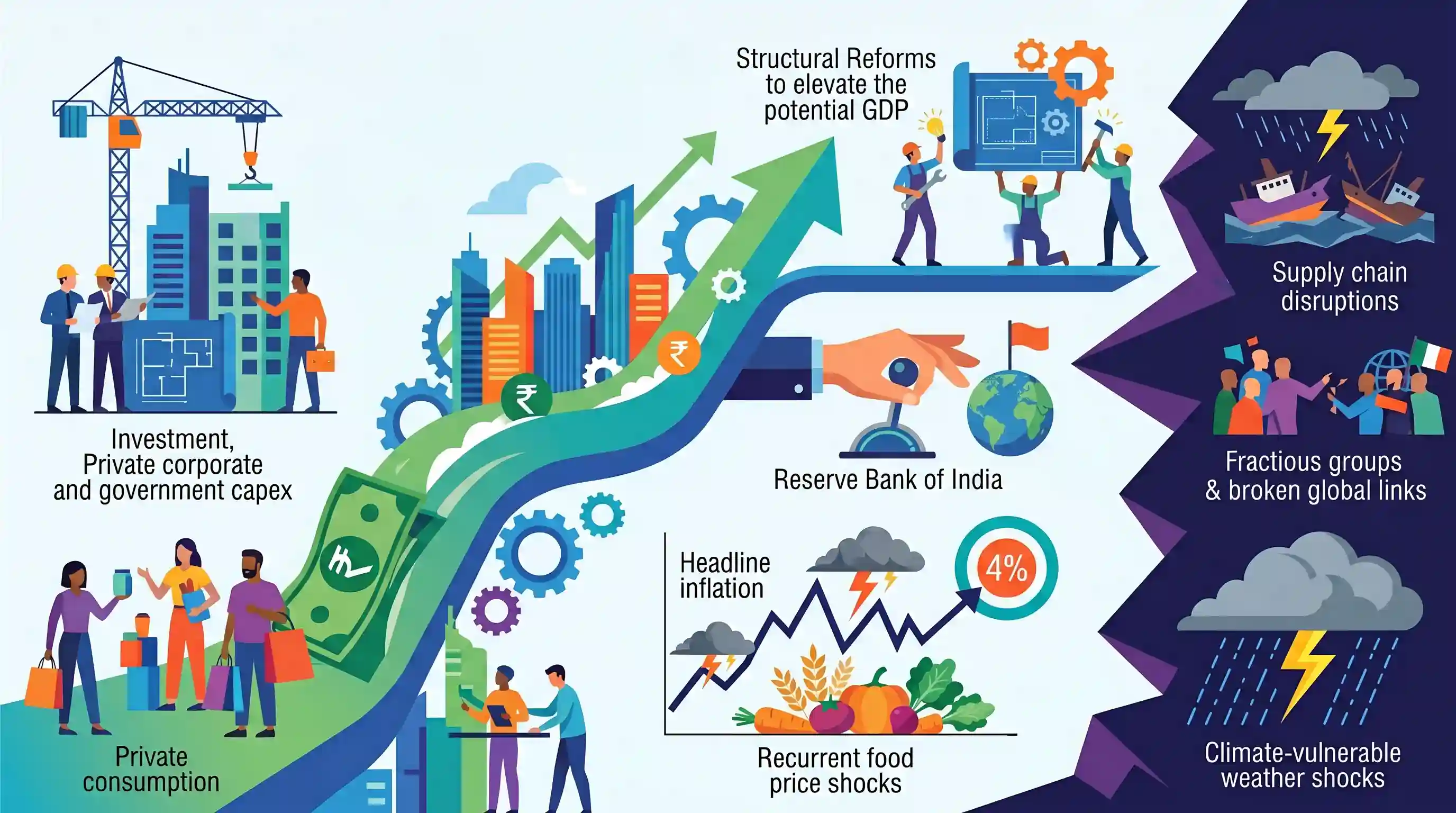
The Reserve Bank of India's (RBI) Annual Report underscores the resilience and robust growth trajectory of the Indian economy, projecting it to remain the fastest-growing major economy through 2025-26. The growth momentum is primarily supported by domestic drivers, notably a revival in private corporate investment, sustained government capex, and a broad-based recovery in private consumption. While headline inflation has moderated significantly, recurrent food price shocks present challenges to aligning it durably with the 4% target. The central bank also highlighted global risks—including geopolitical fragmentation, supply chain disruptions, and climate-vulnerable weather shocks—emphasizing the need for continued structural reforms to elevate the potential GDP growth rate.
Key Points
- The RBI projects India to sustain its position as the fastest-growing major economy globally into 2025-26, driven by a resilient domestic macroeconomic environment.
- Growth momentum is anchored by strengthening private consumption, a revival in the private investment cycle, and sustained capital expenditure by the government.
- While core inflation has eased considerably, recurring supply-side shocks to food prices continue to pose upside risks to the RBI's 4% inflation targeting mandate.
- The central bank highlighted significant global headwinds, including geo-economic fragmentation, supply chain disruptions, geopolitical tensions, and climate-related shocks.
- The report underscores the imperative of continued structural reforms, particularly in physical infrastructure and climate resilience, to boost India's potential GDP.
Important Terms
Reserve Bank of India (RBI)

India's central bank and regulatory body, established under the RBI Act 1934, responsible for monetary stability, currency issuance, and supervising the banking sector.
UPSC context
GS Paper III: Indian Economy. Key institution for monetary policy, financial stability, and banking regulation.
Headline Inflation
The total inflation figure in an economy, including volatile food and energy prices, typically measured through the Consumer Price Index (CPI) in India.
UPSC context
GS Paper III: Economy/Inflation. Tested as the primary anchor for RBI’s monetary policy decisions.
Potential GDP
The maximum sustainable level of output (Real GDP) an economy can produce when all resources like labor and capital are fully and efficiently employed without causing inflation.
UPSC context
GS Paper III: Economic Growth. Crucial benchmark for assessing output gaps and formulating growth-oriented policies.
Flexible Inflation Targeting (FIT)
A monetary policy framework where the central bank targets a specific inflation rate (4% in India, ±2% band) while maintaining economic growth.
UPSC context
GS Paper III: Monetary Policy. Focuses on price stability and the mandate of the Monetary Policy Committee (MPC).
Capital Expenditure (Capex)
Government or corporate spending on the acquisition, upgrade, and maintenance of physical assets like infrastructure, machinery, and technology to boost long-term productive capacity.
UPSC context
GS Paper III: Government Budgeting. Evaluated for its "crowding-in" effect on private investment and infrastructure development.
Structural Reforms
Long-term policy changes aimed at improving economic efficiency, productivity, and competitiveness by addressing fundamental issues in labor, land, taxation, or regulation.
UPSC context
GS Paper III: Economic Growth. Essential for sustaining high potential growth and overcoming supply-side constraints.
Prelims Trap
The RBI targets a 4% core inflation rate to deliberately exclude volatile food and fuel prices.
The RBI legally targets Headline CPI (Combined), which includes volatile food and fuel components. Core inflation is monitored to gauge demand, but is not the statutory target.
Static Concepts Connected
What is the Flexible Inflation Targeting (FIT) Framework in India?
- Statutory basis: Introduced in 2016 through an amendment to the Reserve Bank of India Act, 1934.
- The Target: Targets Headline CPI (Combined) at 4%, with an upper tolerance of 6% and lower tolerance of 2%.
- Implementation: Entrusted to the 6-member Monetary Policy Committee (MPC), which must meet at least four times a year.
How does Potential GDP differ from Actual GDP?
- Potential GDP: The maximum level of real GDP an economy can sustain without triggering inflationary pressure, representing full capacity utilization.
- Output Gap: The difference between actual and potential GDP. A positive gap fuels demand-pull inflation, while a negative gap indicates underutilization.
- Boosting Potential: Requires structural reforms, physical infrastructure development, and technological advancement to shift the production frontier outward.
Cross-Topic Patterns
Climate shocks & Monetary Policy limits
Climate-vulnerable weather disrupts agricultural supply chains. This causes persistent food inflation (supply-side shock) which traditional RBI repo rate hikes (demand-side tools) struggle to control.
Fiscal capex driving 'Crowding In'
Sustained government capital expenditure on infrastructure lowers logistics costs and improves business conditions, which 'crowds in' private corporate investment rather than crowding it out.

Expect a 2026 conceptual question analyzing the limitations of MPC tools (repo rate) against supply-side food inflation driven by climate.
Linked PYQs · 3
Linked PYQs · 3
- 2020MainsGS3
Define potential GDP and explain its determinants. What are the factors that have been inhibiting India from realizing its potential GDP?
- 2019MainsGS3
Do you agree with the view that steady GDP growth and low inflation have left the Indian economy in good shape? Give reasons in support of your arguments.
- 2022PrelimsGS1
In India, which one of the following is responsible for maintaining price stability by controlling inflation?
