RBI assesses macro stability and GDP growth trajectories for India
Source:The Hindu ↗
Why It Matters
The insights provided by an RBI Deputy Governor serve as authoritative data points for UPSC aspirants writing on the state of the Indian economy. The article comprehensively covers key GS Paper 3 themes such as GDP growth trajectories, inflation targeting, banking reforms (NPA reduction), and the shift towards capital expenditure in fiscal policy, making it highly relevant for both Mains answers and Prelims conceptual questions.
Summary
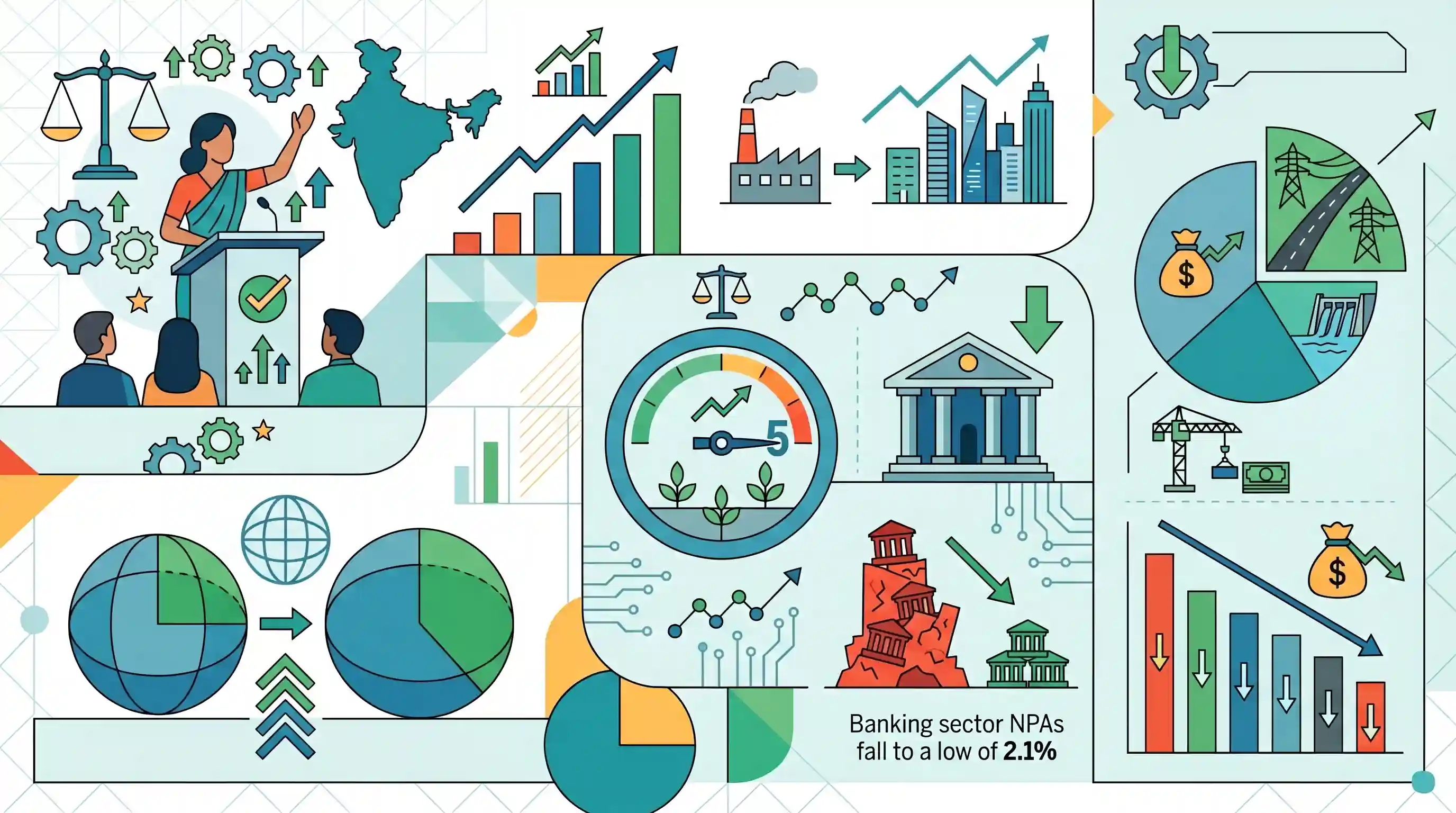
In a lecture at the Centre for Development Studies, RBI Deputy Governor Poonam Gupta highlighted that the Indian economy is currently in its steadiest state ever. She noted a progressive increase in decadal average GDP growth, from 5.7% in the 1980s to 7.7% in the post-COVID-19 era, alongside India's share of global GDP doubling to 3.5%. Macroeconomic stability is evidenced by inflation anchoring near 5% and banking sector non-performing assets (NPAs) falling to a low of 2.1%. Furthermore, fiscal health is improving, with capital expenditure constituting nearly 20% of government spending and fiscal deficits trending downwards.
Key Points
- India's average decadal GDP growth has increased progressively, reaching 7.7% in the post-COVID-19 period.
- The Indian economy's share of world GDP has more than doubled, currently standing at 3.5%.
- Inflation remains relatively stable, hovering around 5% despite various global and domestic shocks.
- The health of the banking sector has improved significantly, with non-performing assets (NPAs) dropping to 2.1%, one of the lowest in emerging Asia.
- The quality of government expenditure has improved, with capital spending now making up nearly 20% of total government expenditure, while fiscal deficits are on a downward trend.
Important Terms
Reserve Bank of India (RBI)

India's central bank and regulatory body responsible for regulating the banking system, controlling monetary policy, and maintaining financial stability and currency value.
UPSC context
GS-III: Indian Economy. Essential for understanding monetary policy, banking regulation, and the central bank's role in inflation control.
Non-Performing Assets (NPAs)
Loans or advances for which the principal or interest payment remained overdue for a period of 90 days, serving as a key indicator of a bank's asset quality.
UPSC context
GS-III: Banking Sector. Tests knowledge of financial health, the "Twin Balance Sheet" problem, and banking reforms.
Macroeconomic Stability
A condition where an economy experiences low and stable inflation, sustainable fiscal deficits, and steady growth, making it resilient to internal and external shocks.
UPSC context
GS-III: Economic Development. Evaluates the overall health of the economy and the impact of fiscal and monetary policies.
Fiscal Deficit
The difference between the government’s total expenditure and its total receipts (excluding borrowings), representing the total amount the government needs to borrow.
UPSC context
GS-III: Government Budgeting. Critical for fiscal policy discussions and the Fiscal Responsibility and Budget Management (FRBM) Act.
Capital Expenditure (Capex)
Government spending on the creation of long-term physical or financial assets, such as roads, bridges, and equipment, which enhances the economy's productive capacity.
UPSC context
GS-III: Investment Models. Assesses the quality of government spending and its role in long-term economic growth.
Centre for Development Studies (CDS)
An autonomous social science research institute in Thiruvananthapuram, Kerala, known for pioneering work in applied economics, human development, and local governance.
UPSC context
GS-III: Institutions. Relevant for understanding the role of specialized research bodies in policy formulation and development studies.
Prelims Trap
"India's GDP growth rate has continuously increased over the past decade."
While decadal averages have improved progressively, year-on-year GDP growth fluctuates heavily (especially with the COVID-19 contraction). 'Continuously' is a classic UPSC trap word.
Static Concepts Connected
What distinguishes Capital Expenditure (Capex) from Revenue Expenditure?
- Asset creation: Capex creates physical or financial assets (e.g., roads, infrastructure, loans given to states), whereas revenue expenditure does not.
- Liability reduction: Capex reduces government liabilities (e.g., repayment of loan principal). Revenue expenditure (e.g., interest payments) does not reduce debt burden.
- Recurring nature: Revenue spending is routine and consumed in the current year (salaries, subsidies, pensions). Capex provides long-term future economic benefits.
How does the RBI's Flexible Inflation Targeting (FIT) framework operate?
- Target range: The RBI is mandated to maintain Consumer Price Index (CPI) inflation at a target of 4%, with a tolerance band of +/- 2%.
- Failure criteria: The framework is deemed to have failed if average inflation remains above 6% or below 2% for three consecutive quarters.
- MPC control: The 6-member Monetary Policy Committee (MPC) is responsible for achieving this target, primarily by adjusting the policy repo rate.
Cross-Topic Patterns
NPAs & Twin Balance Sheet resolution
The drop in NPAs to 2.1% signifies the resolution of the 'Twin Balance Sheet' syndrome (overleveraged corporates, bad-loan-laden banks) of the 2010s, clearing the runway for private corporate investment.
Capex push and 'Crowding In' effect
High public capital expenditure (now 20% of spending) is actively used as a fiscal tool to 'crowd in' private sector investment by building foundational infrastructure and reducing logistics costs.

Expect a 2026 Prelims question testing macro trend-lines: contrasting volatile year-on-year GDP growth with the steadily declining bank NPAs.
Linked PYQs · 5
Linked PYQs · 5
- 2022MainsGS3
Economic growth in the recent past has been led by increase in labour productivity." Explain this statement. Suggest the growth pattern that will lead to creation of more jobs without compromising labour productivity.
- 2019MainsGS3
The public expenditure management is a challenge to the Government of India in the context of budget making during the post-liberalization period. Clarify it.
- 2021MainsGS3
Distinguish between Capital Budget and Revenue Budget. Explain the components of both these Budgets.
- 2022PrelimsGS1
With reference to the Indian economy, consider the following statements: 1. If the inflation is too high, Reserve Bank of India (RBI) is likely to buy government securities. 2. If the rupee is rapidly depreciating, RBI is likely to sell dollars in the market. 3. If interest rates in the USA or European Union were to fall, that is likely to induce RBI to buy dollars. Which of the statements given above are correct?
- 2021PrelimsGS1
With reference to Indian economy, demand-pull inflation can be caused/ increased by which of the following? 1. Expansionary policies 2. Fiscal stimulus 3. Inflation-indexing wages 4. Higher purchasing power 5. Rising interest rates Select the correct answer using the code given below.
