RBI bulletin highlights resilience amid external uncertainties
Source:The Hindu ↗
কেন এটি গুরুত্বপূর্ণ
The RBI Bulletin provides critical assessments of India's macroeconomic health. It showcases the delicate balance between monetary policy intervention (managing a 4.4% headline CPI breach) and supply-side factors (uneven monsoon, food inflation), alongside the role of trade pacts like the India-UK CETA in stabilizing external sectors during global fragmentation.
সারসংক্ষেপ
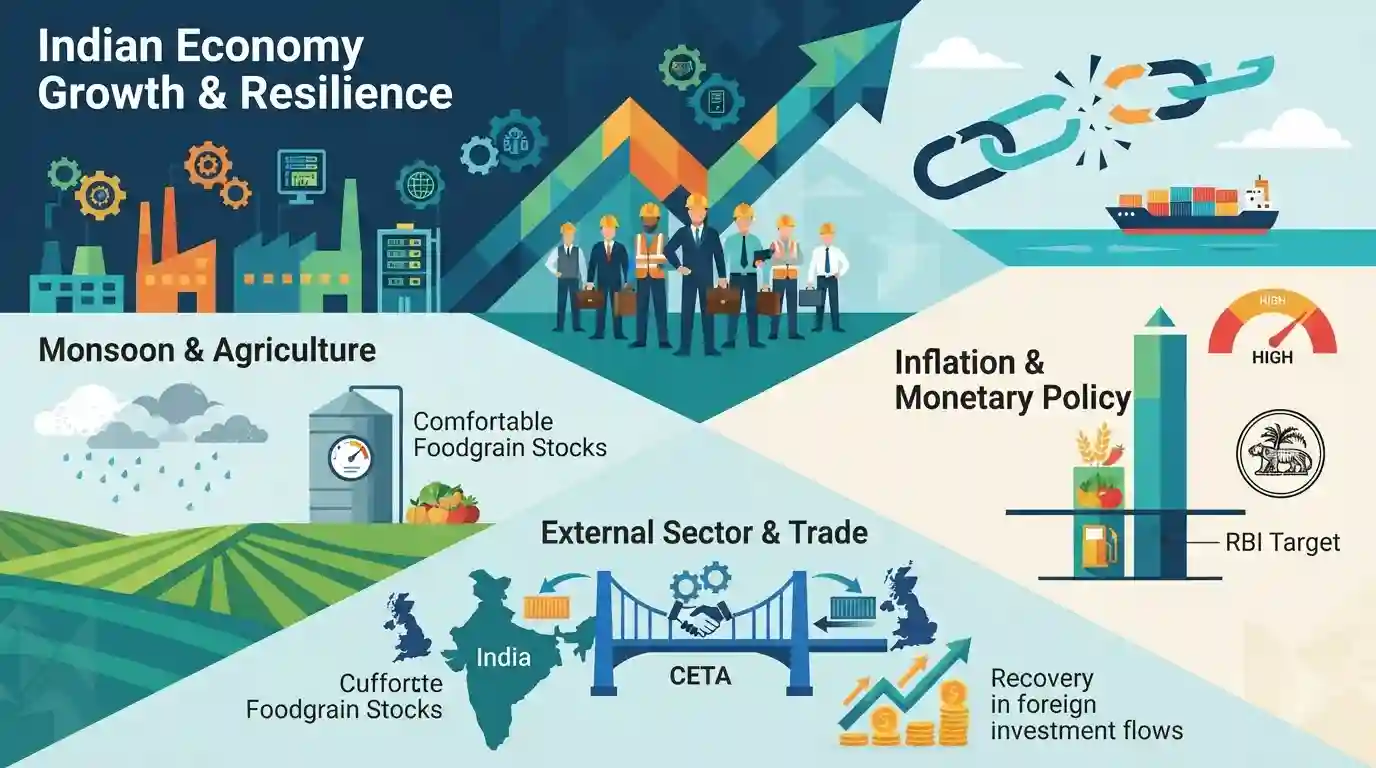
According to the Reserve Bank of India (RBI) July 2026 Bulletin, the Indian economy has successfully navigated global uncertainties and supply chain pressures, sustained by robust aggregate demand and firm industrial and services sectors. Although an uneven southwest monsoon poses agricultural concerns, comfortable foodgrain stocks are expected to cushion food inflation. June 2026 saw headline CPI inflation rise to an 18-month high of 4.4%, crossing the RBI's 4.0% target for the first time since early 2025, driven mainly by food and fuel. On the external front, trade momentum remains solid, supported by the India-UK Comprehensive Economic and Trade Agreement (CETA) and a recovery in foreign investment flows.
মূল বিষয়
- Economic Resilience: India continues to be among the fastest-growing major economies, demonstrating strong industrial and services sector performance and robust domestic demand despite fragmented global trade relations and supply chain shocks.
- Agricultural Outlook and Food Inflation: While an uneven southwest monsoon poses domestic production risks, comfortable foodgrain stocks are anticipated to buffer and mitigate food inflation. Core inflation remained stable at 3.9%.
- Breaching the Inflation Target: Headline Consumer Price Index (CPI) inflation rose to 4.4% in June 2026 (up from 3.9% in May), crossing the RBI's 4.0% medium-term target for the first time since January 2025, driven primarily by volatile food and fuel costs.
- External Trade and Pacts: Export and import momentum in Q1 of 2026-27 is bolstered by the recent operationalisation of the India-UK Comprehensive Economic and Trade Agreement (CETA) and progress in other bilateral agreements, with sound external vulnerability indices.
- Fiscal and Financial Indicators: GST revenue collections registered robust growth in June 2026, signaling healthy consumption, while improved liquidity in the banking system continues to fuel credit growth.
গুরুত্বপূর্ণ শব্দ
India-UK Comprehensive Economic and Trade Agreement

A landmark bilateral trade agreement between India and the UK that entered into force on July 15, 2026, aiming to eliminate major tariffs, boost service exports, and ease professional mobility.
UPSC context
GS Paper III: Bilateral Trade Agreements. Tests understanding of trade liberalization, economic integration, and strategic global partnerships.
CETA
An acronym meaning Comprehensive Economic and Trade Agreement, which in India's current-affairs context refers to the landmark trade pact with the United Kingdom implemented on July 15, 2026.
UPSC context
GS Paper III: External Sector. Tests specific knowledge of modern bilateral FTAs and regional economic cooperation frameworks.
Consumer Price Index
An economic metric that tracks retail inflation by measuring monthly changes in the average prices of a fixed basket of consumer goods and services consumed by households.
UPSC context
GS Paper III: Inflation and Monetary Policy. Tests key concepts of retail price changes, inflation targeting, and macroeconomic indicators.
Goods and Services Tax
A multi-stage, destination-based indirect tax levied on the supply of goods and services in India, designed to create a unified national market.
UPSC context
GS Paper III: Fiscal Policy and Indirect Taxes. Tests understanding of tax structure, cooperative federalism, and resource mobilization.
Reserve Bank of India
India's central bank and regulatory authority, established in 1935, responsible for formulating monetary policy, regulating the banking system, and maintaining financial and price stability.
UPSC context
GS Paper III: Inflation and Monetary Policy. Tests central banking mechanisms, liquidity management, and economic regulation.
প্রিলিমস ফাঁদ
The RBI's Monetary Policy Committee is statutory empowered to set and revise the medium-term CPI inflation target every five years.
Under Section 45ZA of the RBI Act, the Central Government, not the MPC, determines the inflation target in consultation with the RBI. The MPC only determines the policy rate to achieve it.
সংযুক্ত স্থির ধারণা
How do CPI and WPI differ in composition and food weightage?
- Food Weightage: CPI-Combined allocates ~45.86% to food and beverages, whereas WPI's food index weight is much lower at ~24.38%.
- Core Inflation: Excludes volatile food and fuel components to isolate underlying demand-driven price pressures, unlike Headline inflation.
- Services Coverage: CPI includes services like transport and medical care, which are entirely excluded from the Wholesale Price Index.
What differentiates a CEPA from a CECA in trade pacts?
- Scope Breadth: CEPA is broader, comprehensively covering services, investment, IP rights, and regulatory cooperation alongside goods trade.
- CECA Focus: CECA is generally narrower, focusing primarily on eliminating or reducing tariffs on physical goods.
আন্তঃবিষয় প্যাটার্ন
Monsoon volatility + Buffer stock management
Uneven monsoons test the FCI's seasonal stocking norms. Balancing open market interventions to curb food inflation while maintaining strategic reserves is a key GS-3 agricultural policy challenge.
Bilateral trade + Domestic manufacturing
Bilateral pacts like the India-UK CETA demand domestic supply-side structural reforms, linking external trade policy directly with SEZ reforms and state-level ease of doing business.

Multi-statement questions in 2026 will likely test the legal boundary between Central Govt and MPC in inflation-setting, plus CPI-WPI food weight disparities.
সংযুক্ত PYQ · 4
সংযুক্ত PYQ · 4
- 2024MainsGS3
What are the causes of persistent high food inflation in India? Comment on the effectiveness of the monetary policy of the RBI to control this type of inflation.
- 2020PrelimsGS1
Consider the following statements: 1. The weightage of food in Consumer Price Index (CPI) is higher than that in Wholesale Price Index (WPI). 2. The WPI does not capture changes in the prices of services, which CPI does. 3. Reserve Bank of India has now adopted WPI as its key measure of inflation and to decide on changing the key policy rates. Which of the statements given above is/are correct?
- 2017PrelimsGS1
What is/are the most likely advantages of implementing 'Goods and Services Tax (GST)'? 1. It will replace multiple taxes collected by multiple authorities and will thus create a single market in India. 2. It will drastically reduce the 'Current Account Deficit' of India and will enable it to increase its foreign exchange reserves. 3. It will enormously increase the growth and size of economy of India and will enable it to overtake China in the near future. Select the correct answer using the code given below:
- 2020PrelimsGS1
With reference to Foreign Direct Investment in India, which one of the following is considered its major characteristic?
