GDP Growth Rate in Q2 2025-26 and Deflator Trends
Source:The Hindu ↗
Why It Matters
Understanding the distinction between real and nominal GDP, and the concept of the GDP deflator, is fundamental for UPSC aspirants. It illustrates how headline growth numbers can sometimes obscure underlying macroeconomic realities like tepid investment (Capital Formation) and fiscal deficit constraints.
Summary
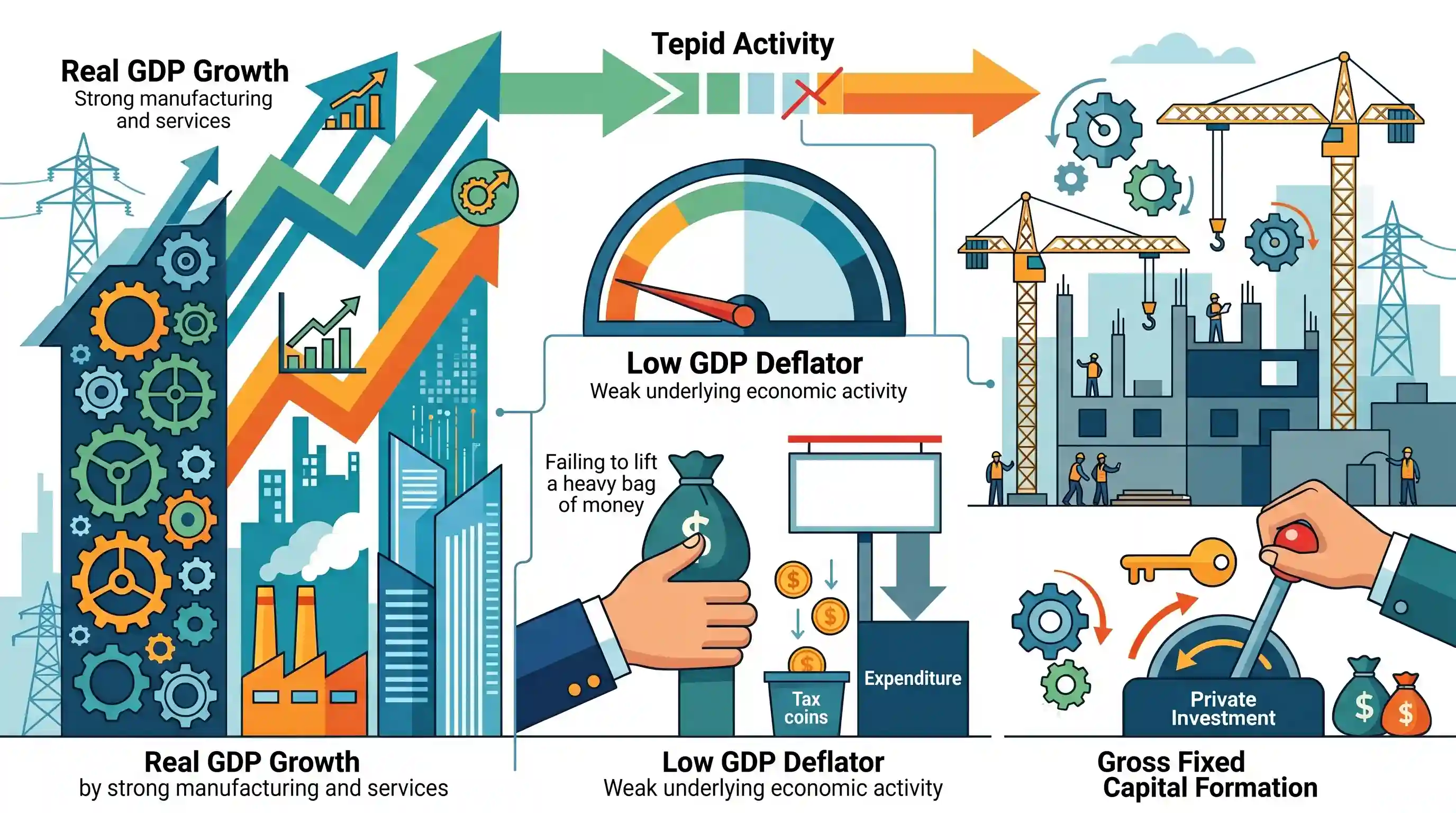
India's real GDP growth accelerated to 8.2% in the second quarter of FY2025-26, supported by strong performances in manufacturing and services. However, this headline figure contrasts with a sluggish nominal GDP growth of just 8.7%, implying a very low GDP deflator of 0.5%. Economists and opposition figures note that such a low deflator points to underlying economic weakness and tepid activity. Furthermore, lower-than-expected nominal GDP poses a challenge for the government in meeting its fiscal deficit target of 4.4% of GDP, as the denominator for the ratio is smaller than budgeted. Concerns were also raised over a slight dip in Gross Fixed Capital Formation, indicating slow private investment.
Key Points
- India's real GDP grew by 8.2% in the second quarter of 2025-26, marking a six-quarter high, driven by a 9.4% expansion in manufacturing and 8.8% in services.
- Gross Value Added (GVA) grew by 8.3% during the same period.
- Despite strong real GDP growth, nominal GDP growth was sluggish at just 8.7%, creating a remarkably low GDP deflator (0.5%).
- A low GDP deflator indicates that the headline growth might be masking underlying tepid economic activity and weak pricing power.
- Sluggish nominal GDP complicates fiscal math; achieving the fiscal deficit target of 4.4% becomes harder when the nominal GDP denominator is lower than projected.
- Gross Fixed Capital Formation (GFCF) as a share of GDP slightly declined to 34%, raising concerns about the pace of private capital investment.
Important Terms
GDP Deflator

A comprehensive inflation measure calculated as the ratio of Nominal GDP to Real GDP. Unlike CPI, it captures price changes across all domestically produced goods and services.
UPSC context
GS III (Economy). Tests understanding of inflation measurement and the distinction between nominal and real economic growth.
Real GDP
The value of all goods and services produced in an economy at constant prices, adjusted for inflation. It reflects the actual volume of economic output.
UPSC context
GS III (Growth). Essential for assessing true economic expansion and comparing productivity across different years without price distortions.
Nominal GDP
The market value of all finished goods and services produced within a country at current prices. It includes the effects of both production changes and inflation.
UPSC context
GS III (Budgeting). Crucial for fiscal metrics like the debt-to-GDP ratio, where current market values serve as the denominator.
Fiscal Deficit
The gap between the government's total expenditure and its total non-debt receipts. It represents the total borrowing required to fund the budget.
UPSC context
GS III (Government Budgeting). A core indicator of fiscal health and macroeconomic stability monitored under the FRBM Act framework.
Gross Fixed Capital Formation (GFCF)
A measure of net investment in fixed assets like machinery, infrastructure, and buildings. It indicates the growth of an economy's productive capacity.
UPSC context
GS III (Investment Models). Tests knowledge of private and public investment trends and their role in long-term development.
Ministry of Statistics and Programme Implementation (MoSPI)
The nodal ministry for official national statistics, including GDP and CPI. It also monitors the implementation of major infrastructure projects and government programmes.
UPSC context
GS III (Economic Planning). Tests knowledge of the institutional framework responsible for India's national accounts and evidence-based policymaking.
Prelims Trap
Higher real GDP growth automatically expands the denominator used to calculate the fiscal deficit-to-GDP ratio.
The fiscal deficit ratio uses *nominal* GDP as its denominator. High real growth paired with a low GDP deflator means sluggish nominal growth, which mathematically worsens the deficit ratio.
Static Concepts Connected
How does the GDP Deflator conceptually differ from the Consumer Price Index (CPI)?
- Basket Coverage: The Deflator covers all domestically produced goods and services (including capital goods), whereas CPI covers only a fixed basket of goods and services consumed by households.
- Imported Goods: Prices of imported consumer goods are included in the CPI, but completely excluded from the GDP Deflator.
- Weighting System: CPI uses static weights based on consumer surveys, while the Deflator uses dynamic weights reflecting current year production patterns.
What is the relationship between Gross Value Added (GVA) and GDP?
- Supply-side Metric: GVA measures the value of goods and services produced from the supply side (value of output minus intermediate consumption).
- GDP Formula: GDP is the demand-side perspective. Mathematically, GDP equals GVA at basic prices plus product taxes minus product subsidies.
- Divergence Driver: When product taxes rise significantly without a corresponding increase in subsidies, GDP growth can outpace GVA growth.
Cross-Topic Patterns
FRBM targets + Denominator effect
Sluggish nominal GDP growth triggers the "denominator effect", complicating the government's FRBM glide path to a sub-4.5% fiscal deficit without resorting to absolute expenditure cuts.
Private Capex + GFCF decline
The paradox of 8%+ headline growth alongside a declining Gross Fixed Capital Formation (GFCF) highlights a persistent reliance on government capex rather than broad-based private investment.

Expect a Prelims question testing the mathematical impact of a low GDP deflator on nominal GDP and the fiscal deficit-to-GDP ratio.
Linked PYQs · 4
Linked PYQs · 4
- 2020MainsGS3
Explain the meaning of investment in an economy in terms of capital formation. Discuss the factors to be considered while designing a concession agreement between a public entity and a private entity.
- 2013MainsGS3
What were the reasons for the introduction of Fiscal Responsibility and Budget Management (FRBM) Act, 2003 ? Discuss critically its salient features and their effectiveness.
- 2020MainsGS3
Define potential GDP and explain its determinants. What are the factors that have been inhibiting India from realizing its potential GDP?
- 2025PrelimsGS1
A country's fiscal deficit stands at ₹50,000 crores. It is receiving ₹10,000 crores through non-debt creating capital receipts. The country's interest liabilities are ₹1,500 crores. What is the gross primary deficit?
