Indian Coast Guard indigenisation and maritime security milestone
Source:The Hindu ↗
Why It Matters
The article provides crucial factual fodder and strategic framing for GS3 Internal Security answers regarding coastal defense, EEZ management, and the indigenization of the armed forces. It also touches on GS2 IR themes through India's use of its maritime agencies to pursue regional doctrines like SAGAR.
Summary
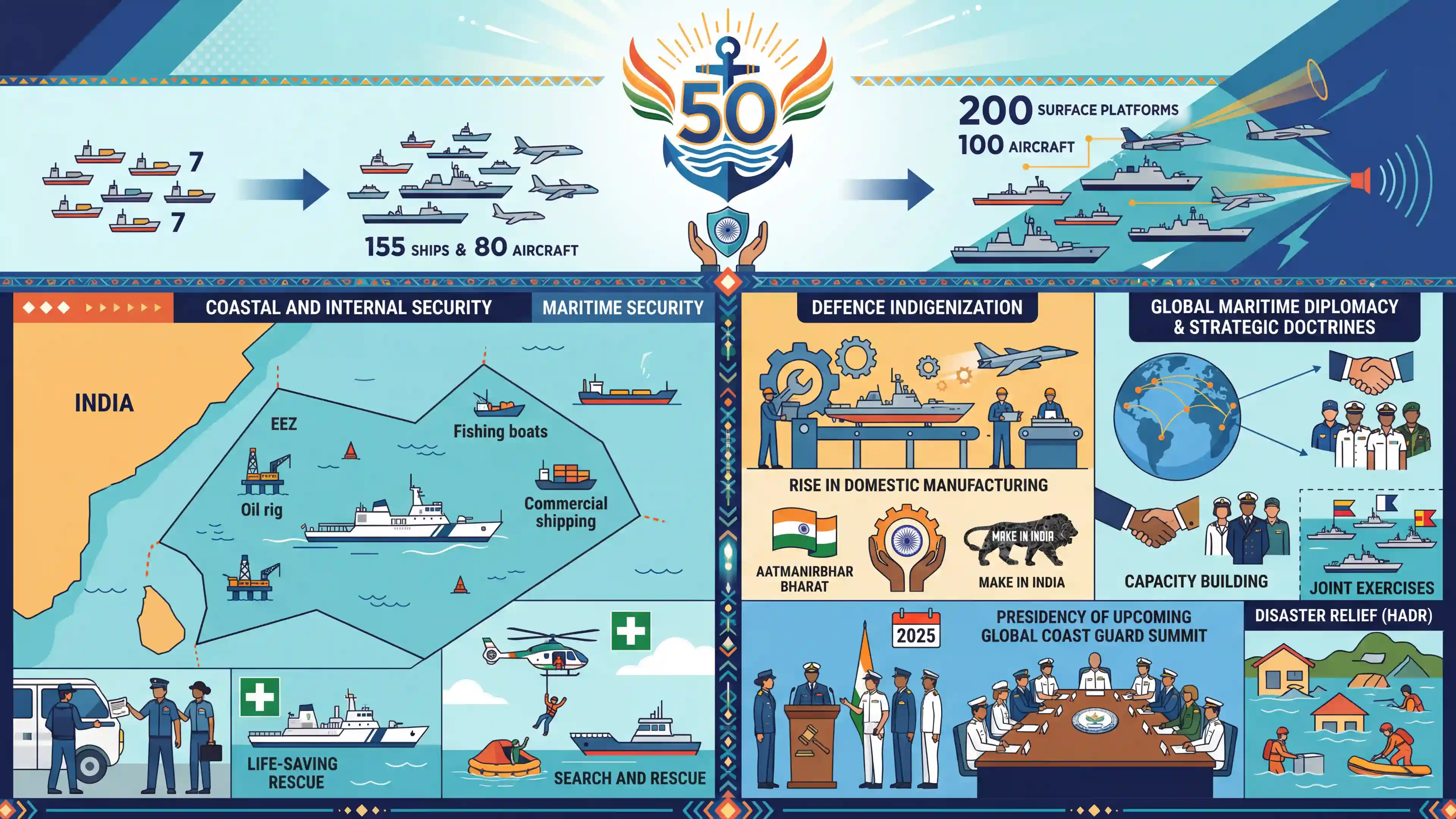
The Indian Coast Guard (ICG) is gearing up to celebrate its 50th Raising Day, highlighting its evolution from a modest fleet of seven platforms in 1977 to a formidable force of 155 ships and 80 aircraft. With an ambitious target of reaching 200 surface platforms and 100 aircraft by 2030, the ICG is heavily prioritizing self-reliance through the 'Aatmanirbhar Bharat' and 'Make in India' initiatives. The force is central to safeguarding India's expansive 20.1 lakh sq. km Exclusive Economic Zone, enforcing maritime law, and executing life-saving rescues. Guided by the strategic doctrines of SAGAR and MAHASAGAR, the ICG is expanding its role in global maritime diplomacy, disaster relief, and capacity building, underscored by its presidency of the upcoming 50th Coast Guard Global Summit in 2025.
Key Points
- The ICG, established in 1977, secures India's 20.1 lakh sq. km Exclusive Economic Zone (EEZ) and 11,098 km coastline.
- Under the 'Aatmanirbhar Bharat' vision, the force is rapidly indigenizing, aiming for 200 surface platforms and 100 aircraft by 2030.
- Operational readiness is reflected in successful joint missions like Operation Sindoor and multiple high-stakes rescues in Lakshadweep and Kerala.
- Anchored in SAGAR and MAHASAGAR doctrines, the ICG actively engages in humanitarian assistance, capacity-building, and disaster relief.
- The ICG will chair the 50th Coast Guard Global Summit in 2025, highlighting India's growing global maritime leadership.
- The force emphasizes gender neutrality, providing equal opportunities for women across seagoing, aviation, and shore roles.
Important Terms
Indian Coast Guard (ICG)

An armed force of the Union, established under the Coast Guard Act, 1978, responsible for maritime law enforcement, coastal security, and search and rescue operations within India's maritime zones.
UPSC context
GS Paper III (Internal Security); tests knowledge of maritime security architecture and border management agencies.
SAGAR (Security and Growth for All in the Region)
India’s strategic vision for the Indian Ocean Region, emphasizing collective maritime security, economic cooperation, and sustainable development while positioning India as a 'net security provider.'
UPSC context
GS Paper II (International Relations); critical for maritime diplomacy and neighborhood-first policy.
MAHASAGAR
An outreach initiative (Mutual and Holistic Advancement for Security and Growth Across Regions) fostering high-level interaction between India and maritime heads of the Indian Ocean Region and Global South.
UPSC context
GS Paper II (International Relations); tests understanding of maritime cooperation and leadership in the Global South.
Exclusive Economic Zone (EEZ)
A sea zone prescribed by UNCLOS extending 200 nautical miles from the coast, where a state has sovereign rights for resource exploration and exploitation.
UPSC context
GS Paper I & III; relevant for maritime boundaries, geography, and resource management.
Aatmanirbhar Bharat (in Defence)
A flagship initiative aimed at making India self-reliant across sectors, particularly focusing on defense indigenization to reduce import dependency and enhance domestic manufacturing.
UPSC context
GS Paper III (Economy/Security); tests concepts of indigenization and strategic autonomy.
Prelims Trap
"The Indian Coast Guard functions as a border guarding force under the Ministry of Home Affairs."
Aspirants often confuse the ICG with Central Armed Police Forces (CAPFs) like the BSF. The ICG is an independent armed force under the Ministry of Defence, not MHA.
Static Concepts Connected
How is India's three-tier coastal security structured?
- State Marine Police: Secures shallow territorial waters up to 12 nautical miles from the coast.
- Indian Coast Guard: Patrols the Exclusive Economic Zone (12 to 200 nautical miles) and acts as the nodal agency for coastal security and marine pollution response.
- Indian Navy: Responsible for overall maritime security, defending the high seas beyond 200 nautical miles, and executing deep-water naval operations.
What are the maritime zones defined under UNCLOS?
- Territorial Sea: Extends up to 12 nautical miles from the baseline; the coastal state exercises full sovereignty over the air space, water, and seabed.
- Contiguous Zone: Extends from 12 to 24 nautical miles; the state can enforce customs, fiscal, immigration, and sanitary laws.
- Exclusive Economic Zone: Extends up to 200 nautical miles; the state has sovereign rights for exploring, exploiting, and managing natural resources.
Cross-Topic Patterns
SAGAR to MAHASAGAR evolution
India's maritime diplomacy is shifting from regional security (SAGAR) to capacity-building across the broader Global South (MAHASAGAR), linking naval platforms with geopolitical soft power.
Coastal security + Defence Indigenization
The ICG's fleet expansion ties directly into GS3 Defence Indigenization, where domestic shipyards are driving the 'Make in India' push to pivot India into a net defense exporter.

Expect a multi-statement prelims question testing the three-tier coastal security architecture, specifically distinguishing ICG mandates.
Linked PYQs · 4
Linked PYQs · 4
- 2025MainsGS3
Why is maritime security vital to protect India's sea trade? Discuss maritime and coastal security challenges and the way forward.
- 2022MainsGS3
What are the maritime security challenges in India ? Discuss the organisational, technical and procedural initiatives taken to improve the maritime security.
- 2024MainsGS2
Critically analyse India's evolving diplomatic, economic and strategic relations with the Central Asian Republics (CARs) highlighting their increasing significance in regional and global geopolitics.
- 2014MainsGS2
With respect to the South China sea, maritime territorial disputes and rising tension affirm the need for safeguarding maritime security to ensure freedom of navigation and over flight throughout the region. In this context, discuss the bilateral issues between India and China.
