Coastal Security Exercise Sagar Kavach and Maritime Preparedness
Source:The Hindu ↗
Why It Matters
Coastal security exercises like Sagar Kavach are critical examples of India's preparedness against sea-borne threats and demonstrate inter-agency coordination, making it highly relevant for the GS3 internal security syllabus.
Summary
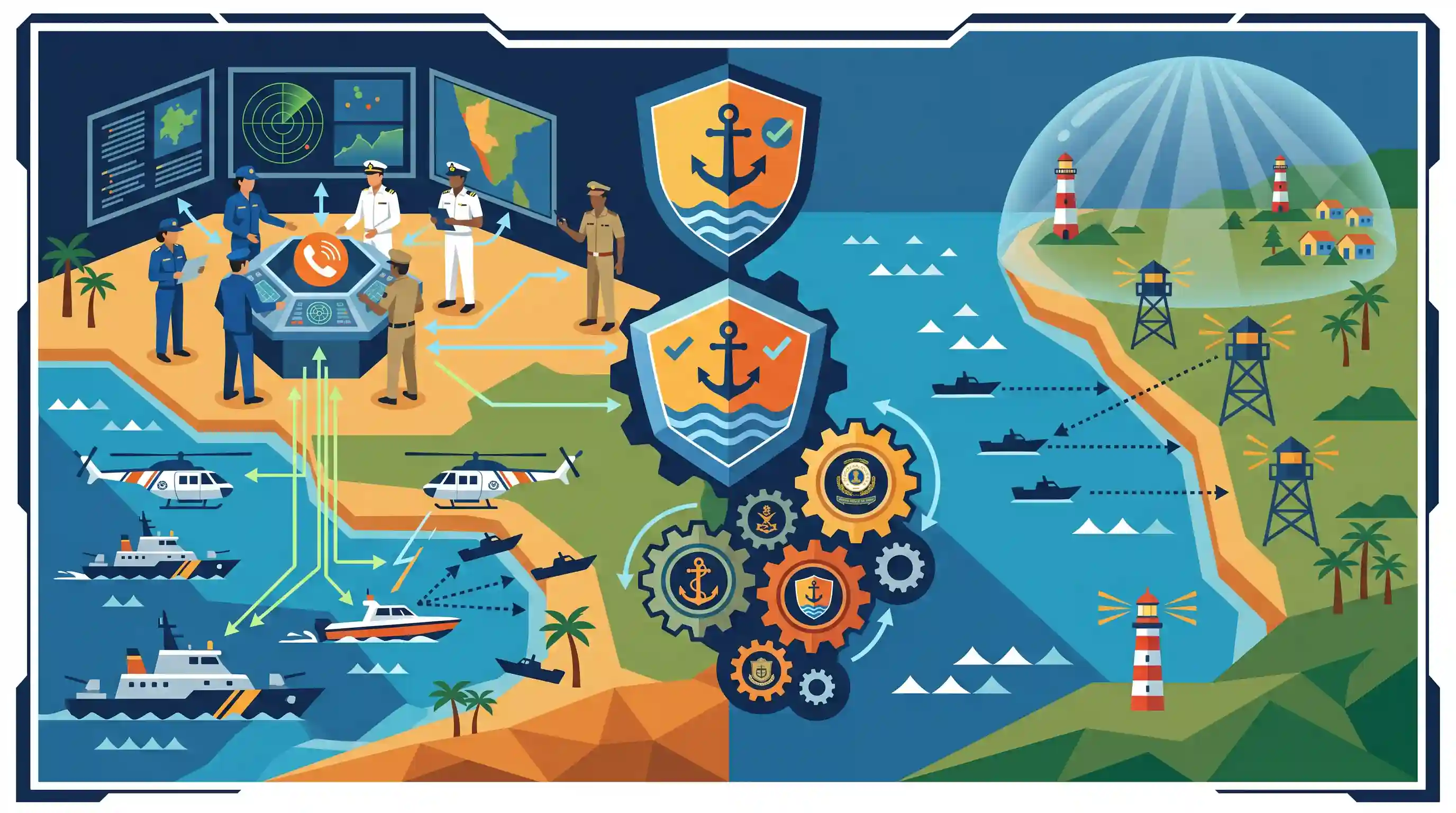
The Indian Coast Guard successfully conducted the two-day 'Sagar Kavach' coastal security exercise across Karnataka and Kerala. Collaborating with multiple stakeholders including the Navy, state police, and various central agencies, the drill simulated real-time infiltration threats from the sea to validate standard operating procedures and boost inter-agency coordination for robust maritime defense.
Key Points
- The two-day coastal security exercise 'Sagar Kavach' was held across the 320 km coastline of Karnataka and the 580 km coastline of Kerala.
- The exercise tested real-time scenarios with a 'Red Force' simulating anti-national infiltrators and a 'Blue Force' acting as defenders.
- Defensive measures utilized included electronic umbrellas, sophisticated anti-drone jammers, and phone tracking to neutralize the simulated threats.
- The drill focused on refining Standard Operating Procedures (SOPs) and enhancing communication and coordination among multiple central and state agencies.
Important Terms
Sagar Kavach

A biannual multi-agency coastal security exercise led by the Indian Coast Guard to simulate real-time maritime threats, infiltration attempts, and validate standard operating procedures across coastal states.
UPSC context
GS3 (Internal Security); tests inter-agency coordination and preparedness against asymmetric maritime threats like terrorism and smuggling.
Indian Coast Guard (ICG)
The primary maritime law enforcement agency responsible for securing India's territorial waters and Exclusive Economic Zone (EEZ), and the lead agency for coastal security during peacetime.
UPSC context
GS3 (Security Forces); focuses on near-shore patrolling, maritime law enforcement, and coordinating the 'hub-and-spoke' coastal security model.
Indian Navy
The designated nodal authority for overall maritime security, responsible for the outermost layer of defense (deep seas and International Maritime Boundary Line) and coastal defense coordination.
UPSC context
GS3 (Security); its Command-in-Chiefs act as Commanders-in-Chief Coastal Defence, overseeing the three-tier maritime security grid.
Coastal Security Police
A specialized wing of state police forces responsible for the innermost ring of coastal security, patrolling shallow waters (up to 12 nautical miles) and preventing local maritime crimes.
UPSC context
GS3 (Border Management); established under the Coastal Security Scheme (2005) to strengthen ground-level surveillance and community policing.
Central Industrial Security Force (CISF)
A Central Armed Police Force that provides security to vital installations, including nuclear plants and airports, and recently became the unified security regulator for 250+ seaports.
UPSC context
GS3 (Internal Security); vital for protecting coastal infrastructure and standardizing security protocols across major and minor ports.
Fisheries Department
The department responsible for managing marine resources; it collaborates with security agencies to integrate the fishing community as the 'eyes and ears' of coastal surveillance.
UPSC context
GS3 (Internal Security/Security Management); crucial for the 'Community Interaction Programmes' that turn local fishermen into a vital intelligence layer.
Customs Department
A central agency under the Ministry of Finance responsible for preventing smuggling and the illegal movement of contraband like narcotics or arms through maritime routes.
UPSC context
GS3 (Internal Security); coordinates with the ICG for anti-smuggling operations and sea-front patrolling to safeguard economic borders.
Prelims Trap
"State Marine Police are designated as the primary agency responsible for patrolling India's Exclusive Economic Zone (EEZ)."
India uses a 3-tier coastal grid. State Marine Police only handle shallow coastal waters (up to 12 NM). The Coast Guard and Navy manage the EEZ.
Static Concepts Connected
How is India's 3-tier coastal security architecture structured post-26/11?
- Inner Tier: State Marine Police patrol shallow coastal areas and territorial waters (generally up to 12 nautical miles) and interact directly with fishing communities.
- Middle Tier: The Indian Coast Guard (ICG) is tasked with patrolling the territorial waters and the wider Exclusive Economic Zone (EEZ).
- Outer Tier: The Indian Navy secures the maritime boundaries beyond the EEZ and maintains overall command and control of the coastal security architecture.
What is the Red Force / Blue Force methodology in security exercises?
- Red Force (Aggressors): A designated team that simulates enemy combatants, infiltrators, or terrorists. In Sagar Kavach, they simulate anti-national elements trying to breach coastal defenses.
- Blue Force (Defenders): The friendly defending forces (Coast Guard, Navy, Police) who must detect, intercept, and neutralize the simulated threat to validate Standard Operating Procedures (SOPs).
Cross-Topic Patterns
Coastal Security & Cooperative Federalism
Coastal security relies on seamless intelligence sharing between Central agencies (Navy, ICG, Customs) and State bodies (Marine Police). Analyzing friction in this multi-agency framework is a recurring GS3 Mains theme.
Asymmetric Threats & Border Tech
The use of electronic umbrellas and anti-drone jammers in maritime drills mirrors the tech-focused Comprehensive Integrated Border Management System (CIBMS) currently being deployed along volatile land borders.

Expect a Prelims question matching India's 3-tier coastal security agencies (Navy/ICG/State Police) with their exact nautical jurisdictions.
Linked PYQs · 2
Linked PYQs · 2
- 2025MainsGS3
Why is maritime security vital to protect India's sea trade? Discuss maritime and coastal security challenges and the way forward.
- 2022MainsGS3
What are the maritime security challenges in India ? Discuss the organisational, technical and procedural initiatives taken to improve the maritime security.
