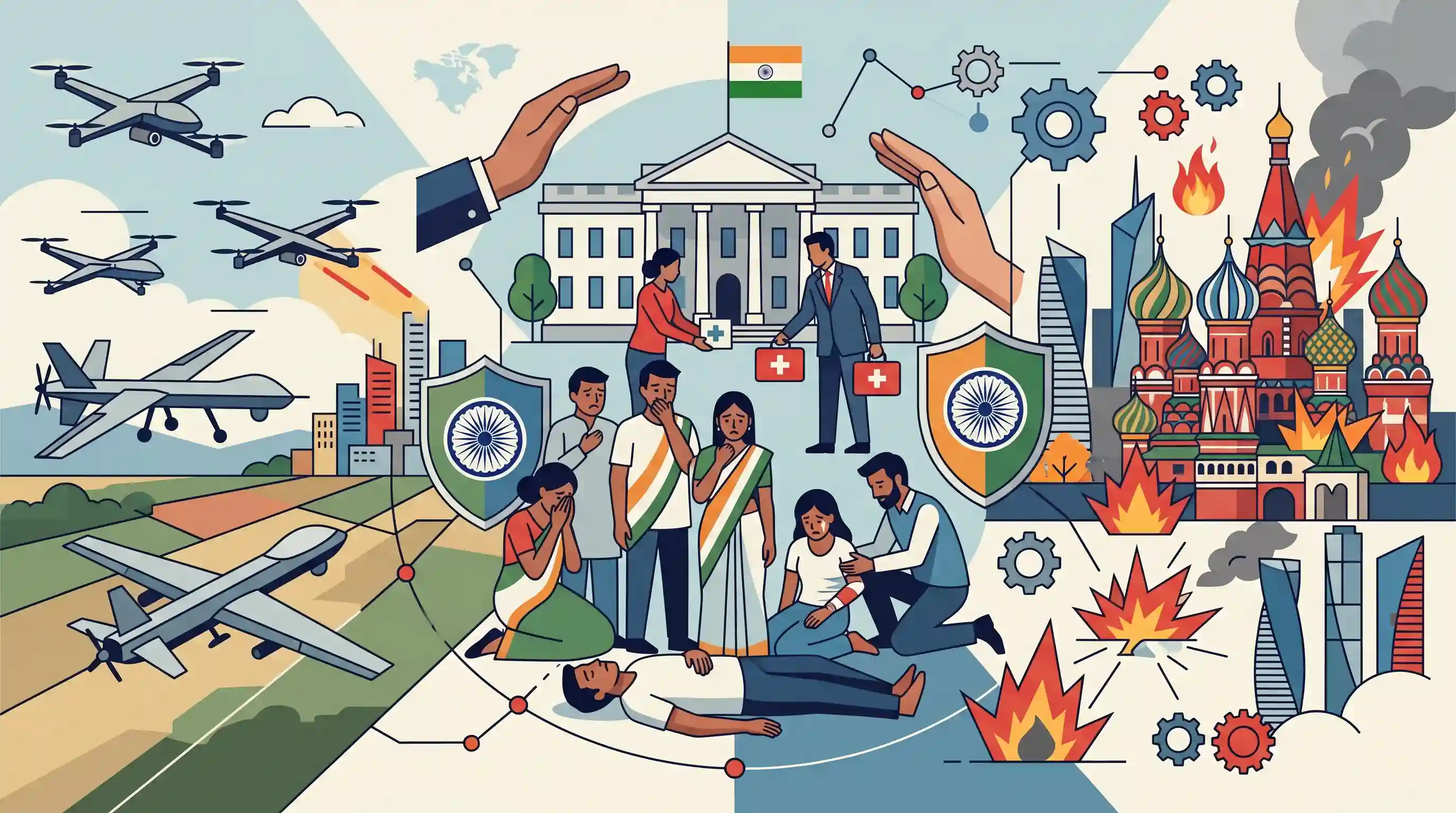
Indian National Killed in Ukrainian Drone Attack on Moscow
Source:Indian Express ↗
Why It Matters
The incident illustrates the direct human cost of international conflicts on the Indian diaspora and raises crucial questions regarding consular protection and the safety of citizens abroad. Furthermore, the extensive use of drones in the Russia-Ukraine war serves as a case study for the evolving nature of modern warfare, which is highly relevant to India's border and internal security preparedness.
Summary
An Indian citizen was killed and three others were injured during a massive Ukrainian drone strike on Moscow. The attack, one of the largest on the Russian capital, highlights the escalating nature of the Russia-Ukraine war and the increasing use of drone technology in modern warfare. The Indian Embassy is coordinating relief efforts, bringing attention to the vulnerability of Indian nationals living in conflict zones.
Key Points
- An Indian national was killed and three others injured in a massive Ukrainian drone strike on Moscow, Russia.
- The attack marks one of the largest Ukrainian drone strikes on the Russian capital since the war began, launched in retaliation for Russian strikes.
- The Indian Embassy in Russia is actively coordinating with local authorities to provide assistance to the injured and repatriate the deceased.
- The incident underscores the safety risks faced by Indian nationals and migrant workers residing in global conflict zones.
- The heavy deployment of unmanned aerial vehicles (UAVs) in the conflict highlights their growing prominence in modern asymmetric warfare.
Important Terms
Artificial Intelligence

The simulation of human intelligence processes by machines, especially computer systems, including learning, reasoning, and self-correction.
UPSC context
GS Paper 3: Science and Technology. Important for understanding the impact of AI on employment, ethics, and governance.
Blockchain Technology
A decentralized, distributed ledger technology that records transactions across multiple computers so that the record cannot be altered retroactively.
UPSC context
GS Paper 3: Science and Technology. Relevant to digital currency, secure data management, and transparency in governance.
Sustainable Development
Development that meets the needs of the present without compromising the ability of future generations to meet their own needs.
UPSC context
GS Paper 3: Environment and Ecology. A core theme in the UPSC syllabus regarding conservation and resource management.
Fiscal Policy
The use of government revenue collection and expenditure to monitor and influence a nation's economy.
UPSC context
GS Paper 3: Indian Economy. Essential for understanding the Union Budget, deficit financing, and economic stability.
Climate Change
Long-term shifts in temperatures and weather patterns, primarily caused by human activities such as burning fossil fuels.
UPSC context
GS Paper 3: Environment. A major global issue frequently asked in the context of international treaties and environmental impact.
Digital India
A flagship program of the Government of India aimed at transforming India into a digitally empowered society and knowledge economy.
UPSC context
GS Paper 2: Governance. Crucial for understanding e-governance, digital literacy, and public service delivery.
Atmanirbhar Bharat
A mission launched by the Government of India to make the country self-reliant through increased domestic production and reduced imports.
UPSC context
GS Paper 3: Economy. Significant for industrial policy, manufacturing (Make in India), and economic resilience.
Cybersecurity
The practice of defending computers, servers, mobile devices, electronic systems, networks, and data from malicious attacks.
UPSC context
GS Paper 3: Internal Security. Vital for understanding national security threats, data protection, and cyber warfare.
Prelims Trap
"The Indian Community Welfare Fund (ICWF) is wholly funded by the Consolidated Fund of India."
ICWF is primarily funded by levying a nominal service charge on consular services (passports, visas) provided by Indian Missions abroad, not the CFI.
Static Concepts Connected
What is the Indian Community Welfare Fund (ICWF)?
- Core Objective: Established in 2009 to assist distressed overseas Indians with emergency boarding, lodging, medical care, and airlifting mortal remains.
- Funding Mechanism: Financed not by direct budget allocations, but by a nominal service charge levied on consular services at Indian Missions.
- 2017 Expansion: Revised in 2017 to expand scope, including community welfare activities, legal assistance, and support for foreign nationals married to Indians.
How do loitering munitions differ from conventional cruise missiles?
- Definition: Kamikaze drones that passively wait in the air (loiter) to identify targets before attacking, acting as both a sensor and a weapon.
- Target Flexibility: Unlike older cruise missiles, loitering munitions allow operators to abort the strike, change targets mid-flight, or return to base if no target is found.
- Asymmetric Advantage: They are significantly cheaper to produce, have smaller radar cross-sections, and fly at low altitudes, making traditional air-defence systems less effective.
Cross-Topic Patterns
Diaspora vulnerabilities vs. remittance dependency
The economic benefit of India's vast diaspora (highest global remittances) is increasingly counterbalanced by the diplomatic and logistical costs of emergency wartime evacuations (e.g., Operations Ganga, Ajay, Kaveri).
Asymmetric drone warfare and border security
The successful use of low-cost UAVs to bypass advanced Russian air-defences directly informs India's internal security challenges regarding cross-border drone-based arms and drug smuggling in Punjab and J&K.

Expect a Prelims question contrasting cruise missiles, ballistic missiles, and loitering munitions in the context of recent global conflicts.
Linked PYQs · 2
Linked PYQs · 2
- 2023MainsGS3
The use of unmanned aerial vehicles (UAVs) by our adversaries across the borders to ferry arms/ammunitions, drugs, etc., is a serious threat to the internal security. Comment on the measures being taken to tackle this threat.
- 2023MainsGS2
Indian diaspora has scaled new heights in the West. Describe its economic and political benefits for India.
