RBI Seeks Review of Supreme Court Yes Bank AT 1 Bonds Order
Source:The Hindu ↗
Why It Matters
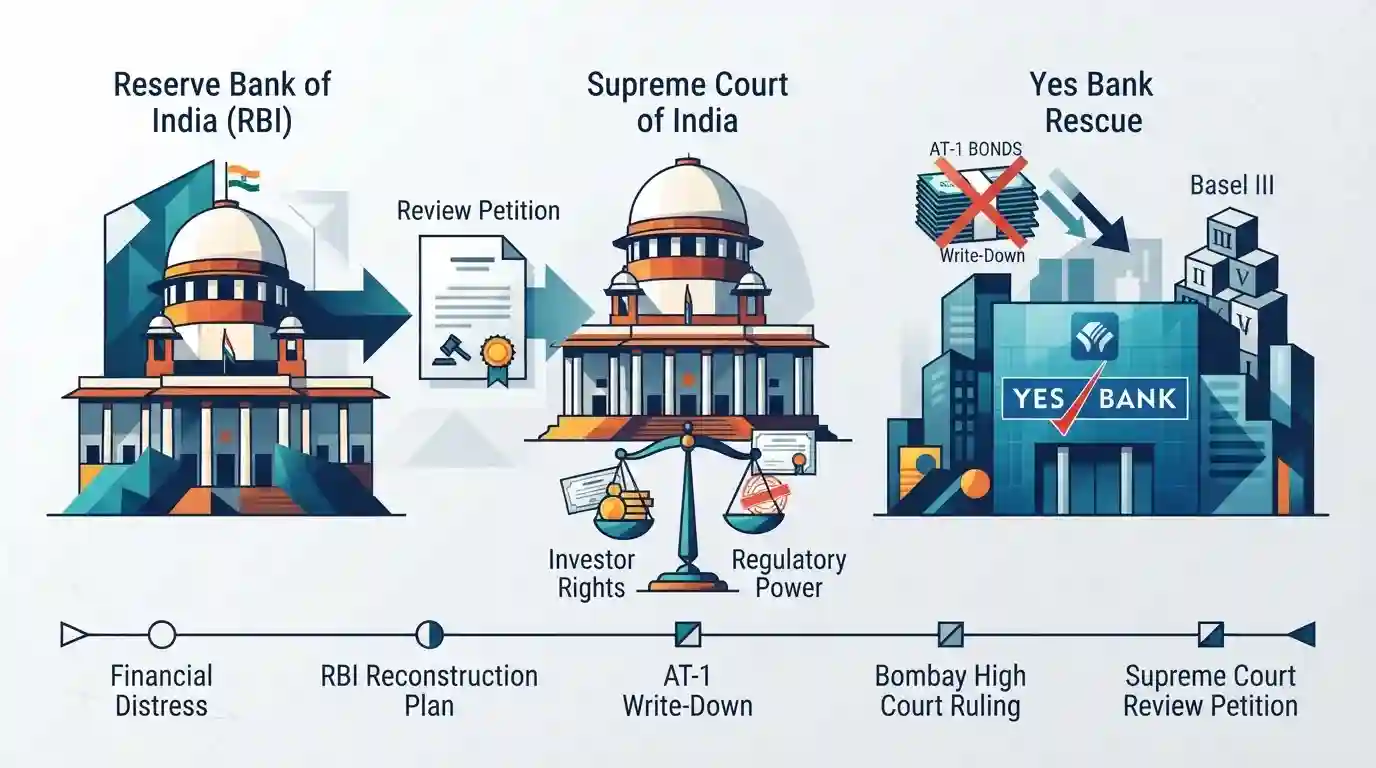
This case directly impacts India's financial stability framework, the sanctity of Basel III capital instruments (AT-1 bonds), and the scope of regulatory powers vested in the central bank during banking crises.
Summary
The Reserve Bank of India has filed a review petition in the Supreme Court regarding its verdict on Yes Bank's Additional Tier-1 (AT-1) bonds. The core legal and economic issue involves the write-down of perpetual bonds under Basel III guidelines during Yes Bank's rescue, balancing central bank regulatory powers with investor rights.
Key Points
- The Reserve Bank of India (RBI) has sought a review of the Supreme Court's order concerning Yes Bank's Additional Tier-1 (AT-1) bonds.
- AT-1 bonds are high-yield, perpetual debt instruments regulated under Basel III capital norms, carrying unique write-down features during distress.
- The case highlights judicial scrutiny versus regulatory discretion of central banks in handling financial restructuring and banking crises.
- The outcome will impact investor confidence in hybrid capital instruments and the regulatory framework for bank recapitalization in India.
Important Terms
Basel III norms

International regulatory framework for banks improving capital adequacy, stress testing, and market liquidity risk, including provisions for loss-absorbing instruments like Additional Tier-1 bonds.
UPSC context
UPSC Paper III (Indian Economy & Banking Regulation): Tests understanding of global banking standards, capital requirements, and financial stability mechanisms.
Additional Tier 1 bonds
High-risk, perpetual bonds issued by banks to meet capital requirements under Basel III, featuring loss-absorption mechanisms that can be written down during financial distress.
UPSC context
UPSC Paper III (Banking & Financial Sector): Evaluates awareness of financial instruments, investor rights, and regulatory powers in bank rescues.
Reserve Bank of India
India's central banking institution responsible for monetary policy, currency issuance, regulation of the banking system, and safeguarding financial stability.
UPSC context
UPSC Paper III (Monetary Policy & Central Banking): Tests knowledge of central bank autonomy, regulatory jurisdiction, and crisis management.
Prelims Trap
AT-1 bonds are fixed-maturity debt instruments that rank on par with senior secured depositors during bank resolution and restructuring.
Aspirants often assume AT-1 bonds carry a fixed maturity date and are protected like senior debt during bank liquidation, ignoring their loss-absorption perpetual nature.
Static Concepts Connected
What are the key features and regulatory framework of Additional Tier-1 (AT-1) bonds in India?
- Perpetual Structure: Perpetual nature with no fixed maturity date, though issuers typically retain call options subject to RBI approval.
- Loss Absorption: Designed under Basel III capital regulations to absorb losses when a bank's capital adequacy falls below specific thresholds.
- Write-down Clause: Can be permanently written down or converted to common equity shares during a pre-specified trigger event or point of non-viability (PONV).
- Investor Restrictions: SEBI mandates high minimum ticket sizes and restricts issuances primarily to Qualified Institutional Buyers (QIBs) to protect retail investors.
Cross-Topic Patterns
Judicial Review vs. Central Bank Regulatory Autonomy
AT-1 bond write-downs test the judiciary's power of review over specialized financial regulators like RBI, mirroring debates in administrative law and separation of powers.
Basel III Norms & Fiscal Risk Management
Basel III capital adequacy norms dictate how Indian banks absorb shocks, directly impacting sovereign ratings, fiscal deficit risks during bailouts, and corporate bond market depth.

AT-1 bonds + Basel III write-down triggers will be framed as a statement-based question testing Tier-1 capital mechanics & RBI powers.
Linked PYQs · 2
Linked PYQs · 2
- 2024PrelimsGS1
With reference to the rule/rules imposed by the Reserve Bank of India while treating foreign banks, consider the following statements: 1. There is no minimum capital requirement for wholly owned banking subsidiaries in India. 2. For wholly owned banking subsidiaries in India, at least 50% of the board members should be Indian nationals. Which of the statements given above is/are correct?
- 2023PrelimsGS1
Which one of the following activities of the Reserve Bank of India is considered to be part of 'sterilization'?
