Crude Oil Price Surge and Impact on Indian Government Bonds
Source:The Hindu ↗
Why It Matters
This article provides a textbook real-world example of how global geopolitical events (oil shocks) transmit to domestic macroeconomic indicators (inflation, interest rates, bond yields). It is highly relevant for Prelims conceptual questions on the inverse relationship between bond prices and yields, and Mains questions on India's energy security vulnerabilities.
Summary
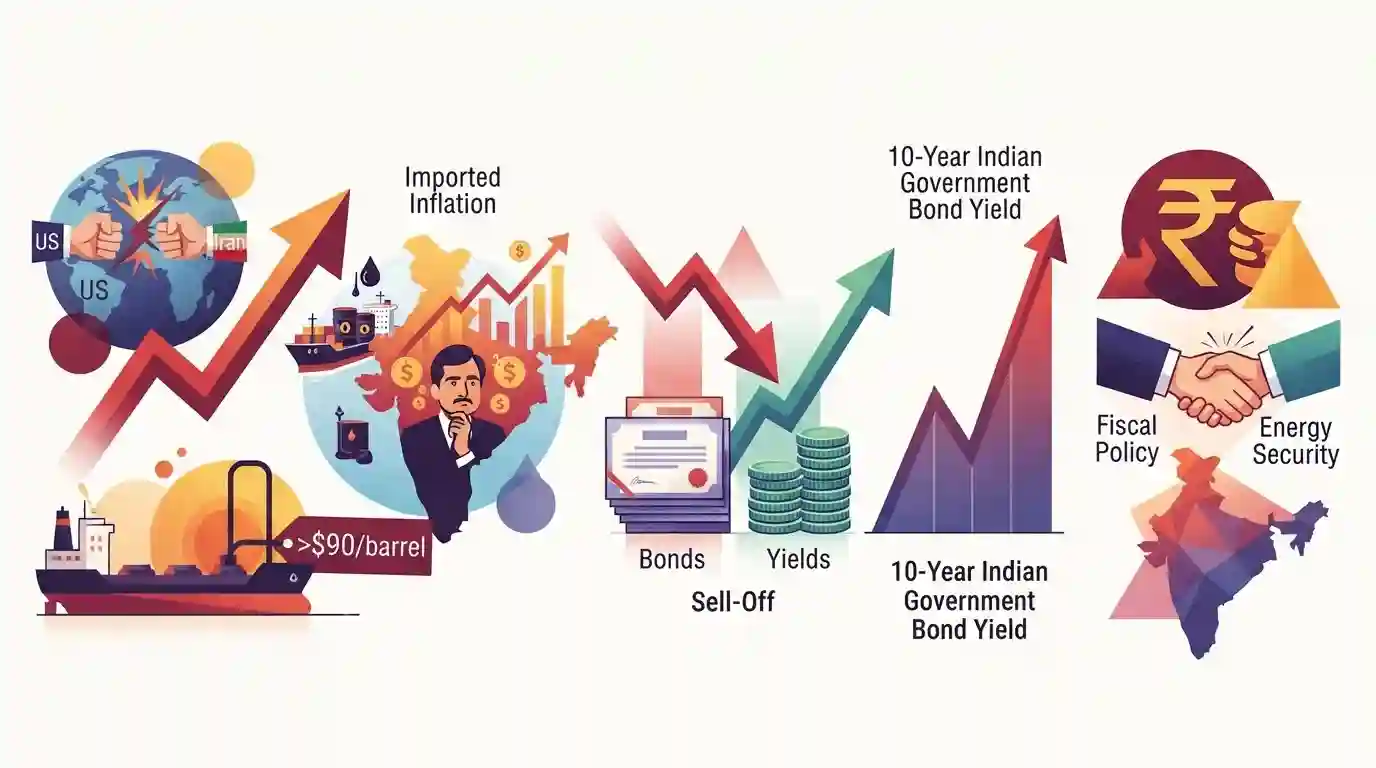
The article analyzes the impact of surging crude oil prices—triggered by geopolitical tensions between the US and Iran—on India's macroeconomic stability, specifically focusing on the domestic bond market. With crude oil crossing $90 a barrel, concerns over imported inflation have heightened, given that India imports over 80% of its oil requirements. Anticipating that central banks may keep interest rates high to combat this inflation, investors have engaged in a bond sell-off. This dynamic illustrates the fundamental inverse relationship between bond prices and yields: as bond prices fall due to selling pressure, their yields rise. Consequently, the yield on India's 10-year benchmark bond has increased. The situation highlights India's vulnerability to global energy shocks and the direct transmission of geopolitical risks to domestic financial markets and fiscal health.
Key Points
- Crude oil prices surged past $90 per barrel due to escalating geopolitical hostilities between the US and Iran in West Asia.
- The oil price shock negatively impacted Indian government bonds, leading to a sell-off that caused bond prices to fall and yields to rise (with the 10-year benchmark yield settling at 6.7938%).
- The event demonstrates the inverse relationship between bond prices and yields: anticipation of higher inflation leads investors to expect higher interest rates, prompting them to sell existing bonds.
- India's heavy reliance on imported crude oil (over 80% of requirements) makes its macroeconomic stability, inflation targets, and fiscal balance highly vulnerable to global energy market shocks.
Important Terms
Reserve Bank of India (RBI)

India's central banking institution established under the RBI Act, 1934, responsible for formulating monetary policy, regulating the banking system, managing foreign exchange, and maintaining price and financial stability.
UPSC context
GS Paper III (Indian Economy); tests core concepts of monetary policy, inflation management, and central banking functions.
Bond Yield
The annual rate of return an investor realizes on a debt security, which fluctuates based on coupon payments and market price, moving inversely to the bond's price.
UPSC context
GS Paper III (Financial Markets); tests understanding of government debt dynamics, borrowing costs, and financial transmission.
Imported Inflation
An increase in domestic price levels caused by rising costs of imported raw materials, such as crude oil, or due to depreciation of the domestic currency.
UPSC context
GS Paper III (Inflation); evaluates concepts of inflation types, international trade shocks, and external vulnerabilities.
Current Account Deficit (CAD)
A measurement of a country's trade where the value of imported goods, services, and transfers exceeds the value of its exports, indicating dependence on external borrowing.
UPSC context
GS Paper III (External Sector); tests balance of payments, trade imbalances, and currency stability.
Government Securities (G-Secs)
Debt instruments issued by central or state governments to borrow funds, managed and regulated by the RBI, and serving as low-risk benchmark assets.
UPSC context
GS Paper III (Government Budgeting); tests mechanisms of fiscal borrowing, open market operations, and liquidity management.
Prelims Trap
An increase in sovereign bond yields indicates rising market demand and an appreciation in the market price of those bonds.
Yields and prices share an inverse relationship; yields rise when bonds are sold off (depreciating their price) due to inflation concerns.
Static Concepts Connected
What is the economic mechanism behind the inverse relationship between bond prices and yields?
- Mathematical Inverse: Yield is calculated as coupon payment divided by market price; as price drops, nominal yield mathematically rises.
- Inflation Influence: Anticipated inflation drives interest rates up, making older fixed-rate bonds less attractive, triggering sell-offs that lower their prices.
What is India's Strategic Petroleum Reserve (SPR) framework?
- Phase I Reserves: Totaling 5.33 MMT across three underground rock cavern locations: Visakhapatnam, Mangaluru, and Padur.
- Institutional Custodian: Managed by Indian Strategic Petroleum Reserves Limited (ISPRL), a Special Purpose Vehicle under the Ministry of Petroleum.
- Strategic Coverage: Provides roughly 9.5 days of net oil import coverage, distinct from oil marketing companies' commercial storage.
Cross-Topic Patterns
Energy imports and Twin Deficit dynamics
Crude spikes directly inflate India's merchandise import bill, widening the CAD, while rising bond yields increase public debt servicing costs, worsening the fiscal deficit.
West Asian chokepoints and energy security
Over 40% of India's crude transits the Strait of Hormuz, linking West Asian geopolitical conflicts directly to domestic inflation and monetary policy maneuvers.

UPSC 2026 is highly likely to test the macro transmission of crude shocks: how CAD expansion, currency depreciation, and bond yields interlink.
Linked PYQs · 4
Linked PYQs · 4
- 2021PrelimsGS1
Indian Government Bond Yields are influenced by which of the following? 1. Actions of the United States Federal Reserve 2. Actions of the Reserve Bank of India 3. Inflation and short-term interest rates Select the correct answer using the code given below.
- 2022PrelimsGS1
With reference to the Indian economy, consider the following statements: 1. If the inflation is too high, Reserve Bank of India (RBI) is likely to buy government securities. 2. If the rupee is rapidly depreciating, RBI is likely to sell dollars in the market. 3. If interest rates in the USA or European Union were to fall, that is likely to induce RBI to buy dollars. Which of the statements given above are correct?
- 2017MainsGS2
The question of India's Energy Security constitutes the most important part of India's economic progress. Analyze India's energy policy cooperation with West Asian countries.
- 2025MainsGS2
"Energy security constitutes the dominant kingpin of India's foreign policy, and is linked with India's overarching influence in Middle Eastern countries.” How would you integrate energy security with India's foreign policy trajectories in the coming years?
