Retail loan write-offs and banking sector asset quality in India
Source:Indian Express ↗
Why It Matters
Understanding the shift in NPAs from the corporate sector to retail loans is crucial for GS3 (Indian Economy), specifically regarding banking sector health, financial inclusion, and RBI's regulatory role in managing macroprudential risks.
Summary
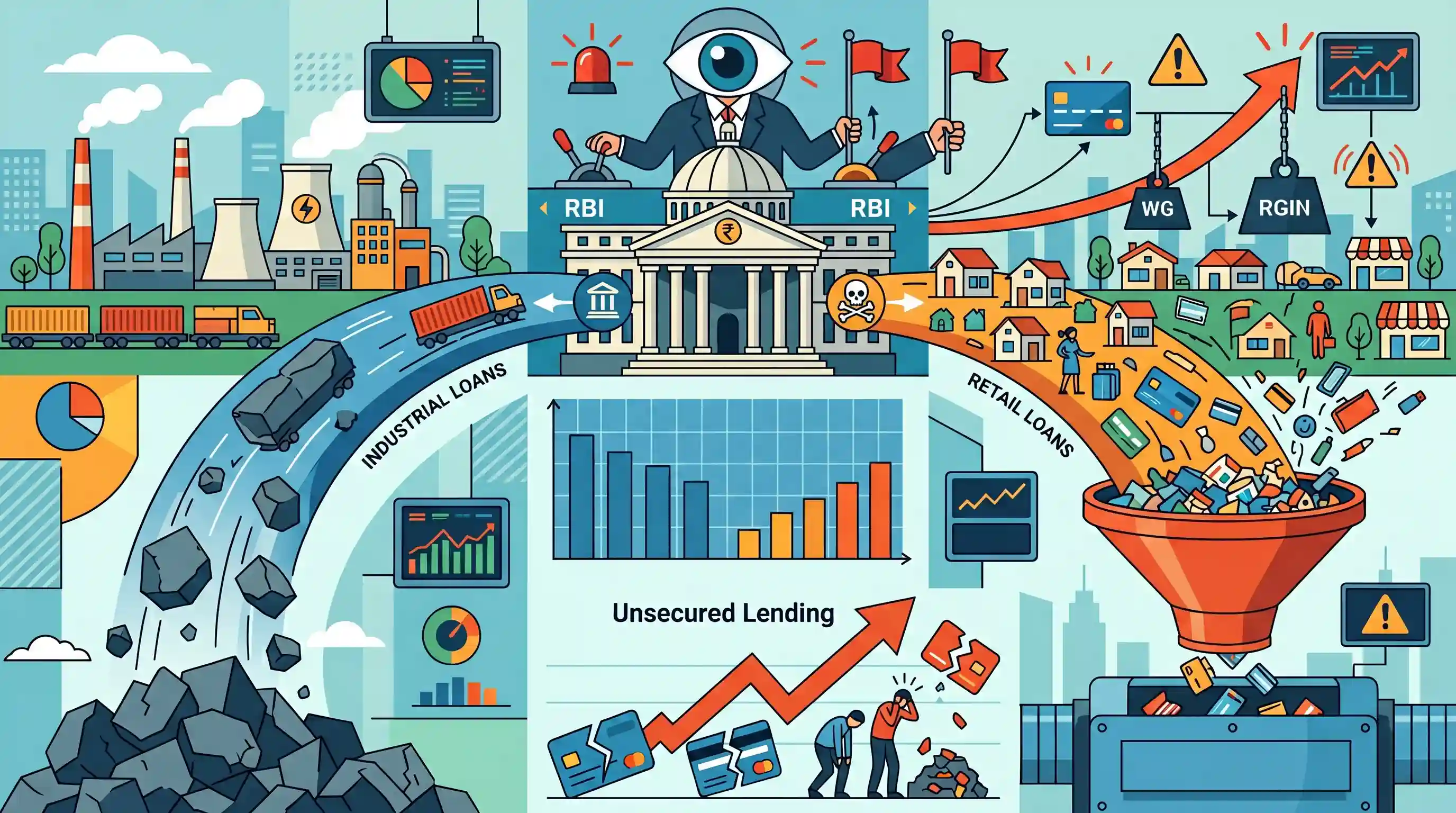
According to Finance Ministry data, retail loans emerged as the top category for loan write-offs by Indian banks in the financial year 2024-25, surpassing industrial loans for the first time. The surge in write-offs is largely attributed to aggressive growth and subsequent defaults in unsecured retail credit, including personal loans and credit card debt. The Reserve Bank of India (RBI) had previously flagged systemic risks associated with unsecured consumer lending and tightened norms by increasing risk weights. This development indicates a significant structural shift in India's banking sector asset quality, moving from large corporate defaults to more granular, household-level non-performing assets (NPAs).
Key Points
- For the first time in FY25, retail loans accounted for the largest share of loan write-offs by Indian banks, overtaking industrial and corporate loans.
- The spike in write-offs is primarily driven by defaults in unsecured lending segments, such as personal loans and credit card outstanding debt.
- The trend validates the Reserve Bank of India's (RBI) recent concerns and macroprudential measures, such as raising risk weights on unsecured consumer credit.
- The data highlights rising financial stress in household balance sheets and marks a structural shift in the origin of Non-Performing Assets (NPAs) in the banking sector.
Important Terms
Loan Write-offs

An accounting practice where a bank removes a defaulted loan from its balance sheet to reduce taxable income and improve financial ratios, while the borrower remains legally liable for repayment.
UPSC context
GS Paper 3/Prelims: Tests conceptual clarity between accounting 'write-offs' and total debt forgiveness 'waivers' and their impact on banking health.
Non-Performing Assets (NPAs)
Loans or advances where the principal or interest payment remains overdue for 90 days or more, ceasing to generate income for the lending institution.
UPSC context
GS Paper 3: A core topic regarding banking stability, asset quality reviews (AQR), and the 'Twin Balance Sheet' problem.
Unsecured Lending
Loans provided without any collateral, issued based solely on the borrower’s creditworthiness (e.g., credit cards, personal loans), carrying higher risk for the lender.
UPSC context
GS Paper 3/Mains: Focuses on the rise of household debt and systemic risks posed by 'granular' defaults versus corporate defaults.
Risk Weights
Percentage factors assigned by regulators to various asset classes based on their riskiness; they determine the minimum capital a bank must reserve against those assets.
UPSC context
GS Paper 3/Prelims: Tests knowledge of macro-prudential tools and Basel-III norms used by the RBI to curb excessive credit growth.
Retail Loans
Loans provided to individual consumers for personal use, such as home, auto, or personal loans, rather than to corporations or businesses.
UPSC context
GS Paper 3: Examines the shifting composition of bank credit and its implications for financial inclusion and consumption-led growth.
Reserve Bank of India (RBI)
India's central bank and regulatory body responsible for supervising the banking system, managing monetary policy, and maintaining financial stability.
UPSC context
GS Paper 3: Essential for understanding regulatory shifts, such as tightening norms for consumer credit to prevent systemic crises.
Prelims Trap
"A loan write-off by a bank extinguishes the borrower's legal obligation to repay."
A write-off is an accounting exercise to clean balance sheets and claim tax benefits. The bank continues recovery efforts, and the borrower remains legally liable, unlike a formal loan waiver.
Static Concepts Connected
How do "risk weights" affect a bank's lending capacity?
- Capital buffer: Higher risk weights compel banks to set aside a larger proportion of their core capital against potential defaults in a specific loan category.
- Credit curb: By increasing the capital requirement, lending in that segment becomes costlier for the bank, intentionally cooling down credit growth in overheated sectors.
- Macroprudential tool: The RBI uses this as a macroprudential tool under Basel norms to prevent systemic risks without altering benchmark policy rates.
What distinguishes unsecured lending from secured lending?
- Collateral backing: Secured loans (like housing or auto) are backed by tangible assets. Unsecured loans (credit cards, personal loans) rely solely on the borrower's credit history.
- Risk premium: Because banks cannot seize assets to recover unsecured defaults, these loans inherently carry significantly higher interest rates to compensate for the elevated risk.
Cross-Topic Patterns
Falling savings + rising retail NPAs
The spike in unsecured retail defaults directly correlates with India's declining net household financial savings, threatening the private consumption pillar that drives nearly 60% of GDP growth.
Corporate deleveraging vs. Household stress
While large corporates have deleveraged over the last decade (easing the Twin Balance Sheet crisis), the debt burden and default risks have structurally shifted to retail consumers and households.

Expect a multi-statement Prelims question testing the difference between loan write-offs and waivers, alongside RBI's use of risk weights.
Linked PYQs · 4
Linked PYQs · 4
- 2020PrelimsGS1
In the context of the Indian economy, non-financial debt includes which of the following? 1. Housing loans owed by households 2. Amounts outstanding on credit cards 3. Treasury bills Select the correct answer using the code given below:
- 2019PrelimsGS1
Which of the following is not included in the assets of a commercial bank in India?
- 2024PrelimsGS1
Consider the following statements : Statement-I : Syndicated lending spreads the risk of borrower default across multiple lenders. Statement-II : The syndicated loan can be a fixed amount/lump sum of funds, but cannot be a credit line. Which one of the following is correct in respect of the above statements?
- 2022MainsGS3
Is inclusive growth possible under market economy ? State the significance of financial inclusion in achieving economic growth in India.
