Commercial Space Missions Advance Human Spaceflight Training
Source:The Hindu ↗
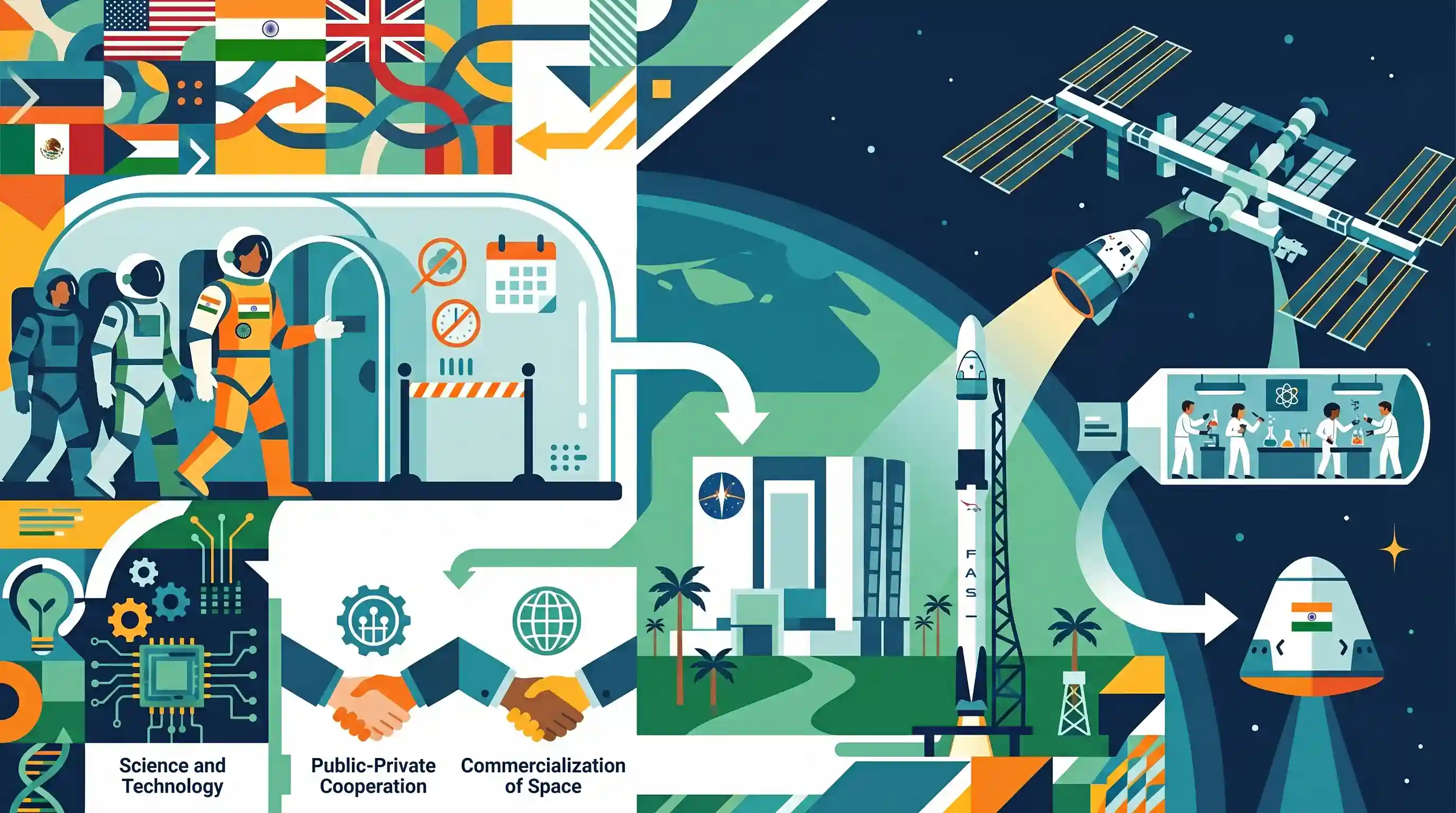
Why It Matters
The participation of an ISRO astronaut in a private ISS mission signifies a strategic shift in international space partnerships. It provides crucial operational experience for India's upcoming indigenous manned mission, Gaganyaan, which represents a major technological leap for the nation.
Summary
Indian astronaut Group Captain Shubhanshu Shukla and his fellow crew members have entered quarantine ahead of the Axiom-4 (Ax-4) commercial mission to the International Space Station (ISS). Slated for launch in early June 2025 aboard a SpaceX Dragon spacecraft from NASA's Kennedy Space Center, the mission highlights growing international and public-private cooperation in space exploration. For India, it is a critical milestone that will provide hands-on spaceflight experience for its astronauts in preparation for ISRO's indigenous Gaganyaan program.
Key Points
- Indian astronaut Group Captain Shubhanshu Shukla is entering pre-flight quarantine as a crew member of the Axiom-4 (Ax-4) mission.
- The commercial spaceflight mission is scheduled to launch to the International Space Station (ISS) on June 8/9, 2025, from NASA’s Kennedy Space Center in Florida.
- The crew will be carried aboard a Dragon spacecraft, propelled by a SpaceX Falcon 9 rocket.
- This mission serves as critical real-world spaceflight and microgravity research experience for ISRO ahead of India's indigenous Gaganyaan human spaceflight mission.
Important Terms
Axiom-4 (Ax-4) Mission

The fourth commercial human spaceflight mission to the International Space Station (ISS), organized by Axiom Space. It features Indian astronaut Shubhanshu Shukla as mission pilot, facilitating India’s first ISS-linked crewed experience.
UPSC context
GS-III (Space S&T). Tests awareness of international collaborations and private-sector roles in bridging India’s human spaceflight capability gaps.
Gaganyaan Program
India’s flagship human spaceflight program designed to demonstrate indigenous capability by launching a 3-member crew to Low Earth Orbit (LEO) and returning them safely to Earth.
UPSC context
GS-III (Space S&T). A primary topic for indigenous technological milestones and India's strategic autonomy in space exploration.
ISRO (Indian Space Research Organisation)
India's national space agency under the Department of Space, mandated with space research, planetary exploration, and developing launch vehicles like LVM3 and SSLV.
UPSC context
GS-III (S&T). Central institutional body for space policy, self-reliance, and socio-economic applications of space technology.
Axiom Space Inc.
A U.S. private aerospace company providing commercial spaceflight services and building the first commercial space station; it serves as the mission integrator for Ax-4.
UPSC context
GS-III (S&T). Relevant for understanding the 'New Space' economy and the increasing commercialization of Low Earth Orbit.
National Aeronautics and Space Administration (NASA)
The United States' federal space agency and the primary host of the ISS; it collaborates with ISRO on astronaut training and joint missions like NISAR.
UPSC context
GS-III (Space S&T). Key for international cooperation questions and bilateral science-tech partnerships (e.g., iCET).
SpaceX
A private American aerospace firm providing the Falcon 9 launch vehicle and Dragon spacecraft for the Ax-4 mission, specializing in reusable rocket technology.
UPSC context
GS-III (S&T). Important for discussing launch cost-efficiency, reusable technology, and global private sector dominance in space logistics.
Prelims Trap
Group Captain Shubhanshu Shukla is the first Indian citizen to travel to space.
Aspirants confuse "first Indian on the ISS" with "first Indian in space". Rakesh Sharma went to space in 1984 (Salyut-7), making Shukla the second Indian in space, but the first on the ISS.
Static Concepts Connected
What are the core architectural components of ISRO's Gaganyaan Mission?
- Launch Vehicle: Utilizes the Human-Rated LVM3 (HLVM3), consisting of a solid stage, liquid core, and a cryogenic upper stage to ensure crew safety.
- Orbital Module: Comprises the pressurized, habitable Crew Module (CM) and the unpressurized Service Module (SM) which provides propulsion and power.
- Target Orbit: Designed to place a crew of 3 members into a Low Earth Orbit (LEO) of roughly 400 km for a 3-day mission.
How does prolonged exposure to microgravity affect the human body?
- Musculoskeletal impacts: Causes accelerated loss of bone density (spaceflight osteopenia) and severe muscle atrophy, necessitating strict daily resistance exercise.
- Cardiovascular shifts: Gravity no longer pulls bodily fluids downward, resulting in an upward fluid shift that causes facial puffiness and reduced overall blood volume.
- Sensorimotor disruption: Disruption of the inner-ear vestibular system leads to space motion sickness, spatial disorientation, and altered hand-eye coordination.
Cross-Topic Patterns
Artemis Accords and Space Diplomacy
This ISRO-NASA-Axiom collaboration stems directly from India signing the Artemis Accords in 2023, signaling a strategic alignment with US-led space architecture and cooperative norms.
Space Sector Privatization
Axiom-4 relies on SpaceX commercial launch capabilities, mirroring India's own macroeconomic push to commercialize Low Earth Orbit activities through IN-SPACe and NSIL.

A 2026 multi-statement question will likely blend Gaganyaan's technical specs (HLVM3/LEO) with India's role in the Artemis Accords.
Linked PYQs · 2
Linked PYQs · 2
- 2025PrelimsGS1
Consider the following space missions : I. Axiom-4 II. SpaDeX III. Gaganyaan How many of the space missions given above encourage and support micro-gravity research?
- 2017MainsGS3
India has achieved remarkable successes in unmanned space missions including the Chandrayaan and Mars Orbitter Mission, but has not ventured into manned space missions. What are the main obstacles to launching a manned space mission, both in terms of technology and logistics? Examine critically.
