Shubhanshu Shukla ISS Space Mission and Indian Human Spaceflight
Source:The Hindu ↗
Why It Matters
India's participation in the ISS via a commercial mission highlights its transition from purely unmanned missions to preparing for human spaceflight (Gaganyaan). The microgravity experiments will generate proprietary scientific data crucial for long-duration space missions.
Summary
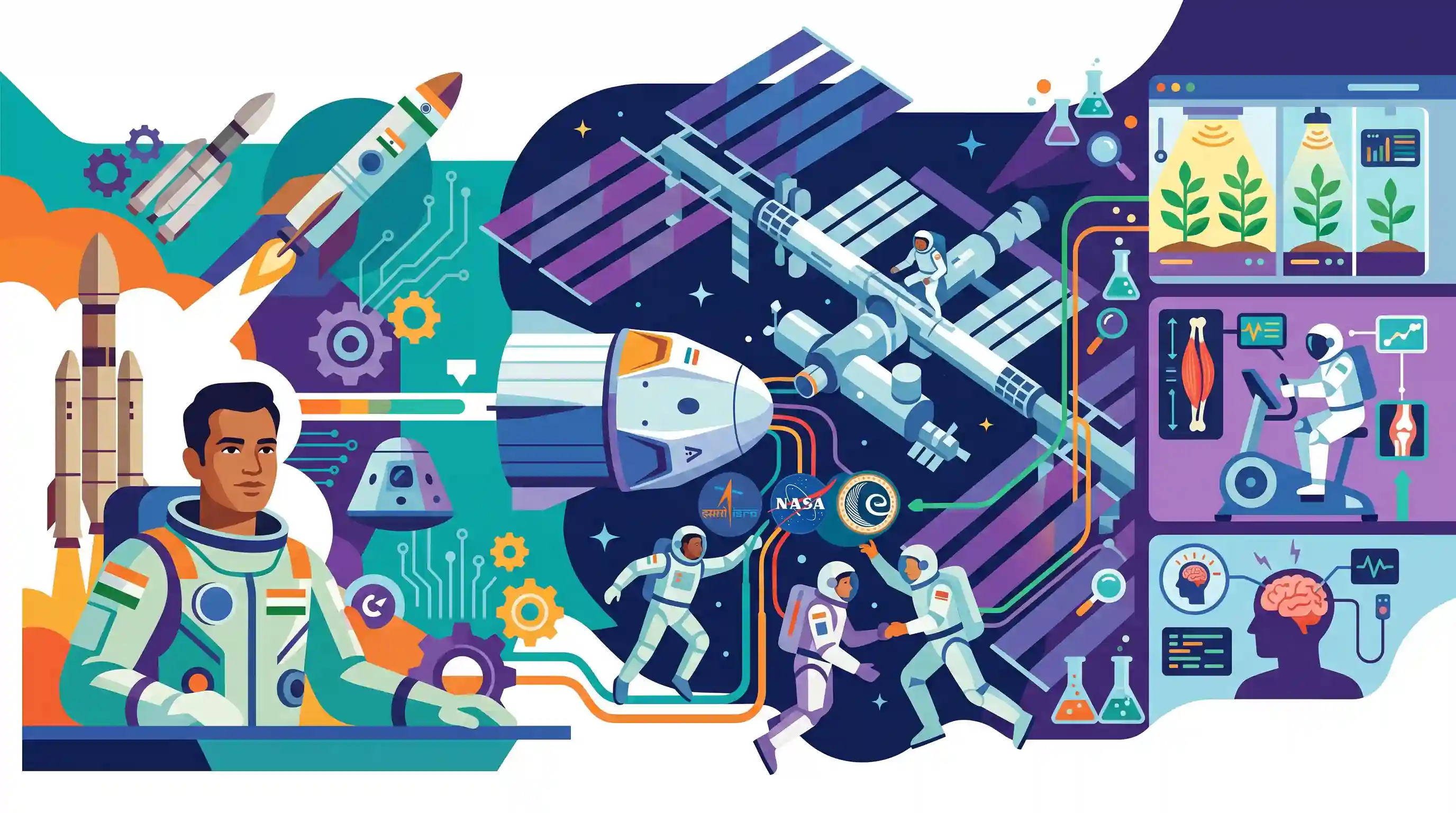
Group Captain Shubhanshu Shukla, one of India's four Gaganyaan astronaut-designates, will pilot the upcoming Axiom-4 (Ax-4) mission to the International Space Station (ISS). Slated for May 2025, Ax-4 is a commercial spaceflight that will feature collaborative microgravity research by ISRO, NASA, and ESA. The mission will conduct around 60 experiments, with ISRO focusing on the biological impacts of spaceflight on crops, muscles, and cognitive health. The flight will make Shukla the first Indian in space in four decades and serves as a vital precursor to India's independent human spaceflight capabilities.
Key Points
- Indian astronaut Group Captain Shubhanshu Shukla has been selected to pilot the private Axiom-4 (Ax-4) mission to the International Space Station (ISS), becoming the first Indian in space in 40 years.
- Scheduled for launch no earlier than May 2025 from NASA's Kennedy Space Center, the 14-day mission will include crew members from the US, Poland (ESA), and Hungary.
- The Ax-4 crew will conduct roughly 60 scientific studies on the ISS.
- ISRO-led microgravity research will include studying the physical and cognitive effects of computer screens, spaceflight impacts on plant seeds, microalgae, and skeletal muscle dysfunction.
- This mission serves as a critical preparatory step for India's indigenous human spaceflight programme, Gaganyaan.
Important Terms
Gaganyaan mission

ISRO’s flagship program to demonstrate indigenous human spaceflight capability by sending a crew to a 400 km orbit for three days and returning them safely.
UPSC context
GS-3: Science & Tech; tests knowledge of India's indigenization efforts and its emergence as a global space power.
Axiom-4 (Ax-4) mission
A collaborative private astronaut mission to the International Space Station (ISS), featuring ISRO’s Group Captain Shubhanshu Shukla as pilot to conduct extensive microgravity research.
UPSC context
GS-3: Achievements of Indians in S&T; highlights the strategic India-US space partnership under the iCET framework.
ISRO
India's national space agency focused on satellite technology, planetary exploration, and human spaceflight missions like Gaganyaan and the upcoming Bhartiya Antariksh Station.
UPSC context
GS-3: S&T; fundamental to questions on India's institutional framework for technology and international space cooperation.
Axiom Space
A private U.S. aerospace company that organizes commercial missions to the ISS and is building the first commercial space station for future research.
UPSC context
GS-3: Space Privatization; relevant to the evolving global space economy and the role of private players in orbit.
Microgravity Research
Scientific experiments conducted in a weightless environment (like the ISS) to study biological and physical processes unaffected by Earth's gravity.
UPSC context
GS-3: S&T Applications; tests understanding of how space missions contribute to breakthroughs in medicine, agriculture, and materials science.
International Space Station (ISS)
A modular space research facility in orbit around Earth, serving as a collaborative international platform for long-duration human presence and scientific discovery.
UPSC context
GS-3: International Relations/S&T; central to discussions on global technological cooperation and orbital research operations.
Bhartiya Antariksha Station (BAS)
India's planned indigenous space station, targeted for 2035, intended to support permanent human presence and advanced scientific research in Low Earth Orbit.
UPSC context
GS-3: Space Technology; key component of India’s long-term "Space Vision 2047" roadmap for strategic autonomy in space.
Low Earth Orbit (LEO)
An orbit altitude between 160 km and 2,000 km where the ISS, Gaganyaan, and many Earth observation satellites operate.
UPSC context
GS-3: Space Technology basics; essential for understanding the physical environment of current and future manned space missions.
Prelims Trap
"Ax-4 is a joint government mission by NASA and ISRO, marking the first crewed flight of the Gaganyaan spacecraft."
Ax-4 is a commercial spaceflight operated by private firm Axiom Space, not Gaganyaan. It is a capacity-building precursor for India's indigenous program.
Static Concepts Connected
How does a microgravity environment affect the human body?
- Musculoskeletal atrophy: Loss of bone density (osteopenia) and skeletal muscle dysfunction occurs rapidly due to the absence of gravity-induced physical loading.
- Fluid shifts: Bodily fluids migrate upward, causing facial puffiness, decreased blood plasma volume, and potential cardiovascular stress.
- Vision and neurology: Spaceflight-Associated Neuro-ocular Syndrome (SANS) affects astronauts' eyesight due to altered intracranial pressure in prolonged weightlessness.
What are the key characteristics of Low Earth Orbit (LEO) used by the ISS?
- Altitude range: Located between roughly 160 km and 2,000 km above Earth, offering a relatively accessible environment for crewed missions and Earth observation.
- Orbital drag: Objects in LEO experience slight atmospheric drag, requiring space stations like the ISS to perform periodic re-boost maneuvers to maintain altitude.
- Commercial transition: LEO is transitioning from government-only stations to a commercial hub, paving the way for private space habitats and commercial research.
Cross-Topic Patterns
Space privatization and IN-SPACe
Axiom-4 demonstrates the global pivot to LEO commercialization, mirroring India's domestic space sector reforms driven by IN-SPACe and NSIL to boost private enterprise involvement.
Space biology and micro-agriculture
Studying crop seeds and microalgae in space connects space technology with agricultural biotechnology, testing stress responses in extreme environments to secure future food systems.

Expect a 2026 Prelims question testing the distinction between India's indigenous Gaganyaan architecture and commercial LEO missions like Ax-4.
Linked PYQs · 3
Linked PYQs · 3
- 2025PrelimsGS1
Consider the following space missions : I. Axiom-4 II. SpaDeX III. Gaganyaan How many of the space missions given above encourage and support micro-gravity research?
- 2016MainsGS3
Discuss India's achievements in the field of Space Science and Technology. How the application of this technology has helped India in its socio-economic development?
- 2017MainsGS3
India has achieved remarkable successes in unmanned space missions including the Chandrayaan and Mars Orbitter Mission, but has not ventured into manned space missions. What are the main obstacles to launching a manned space mission, both in terms of technology and logistics? Examine critically.
