Astronomy Community Unveils Vision Roadmap for Solar Physics
Source:The Hindu ↗
Why It Matters
With increasing global reliance on satellite networks, GPS, and delicate power grids, space weather has emerged as a significant threat to global infrastructure and security. Understanding India's roadmap and missions (like Aditya-L1) is crucial for addressing questions on indigenous space technology, disaster preparedness, and the socio-economic applications of space science.
Summary
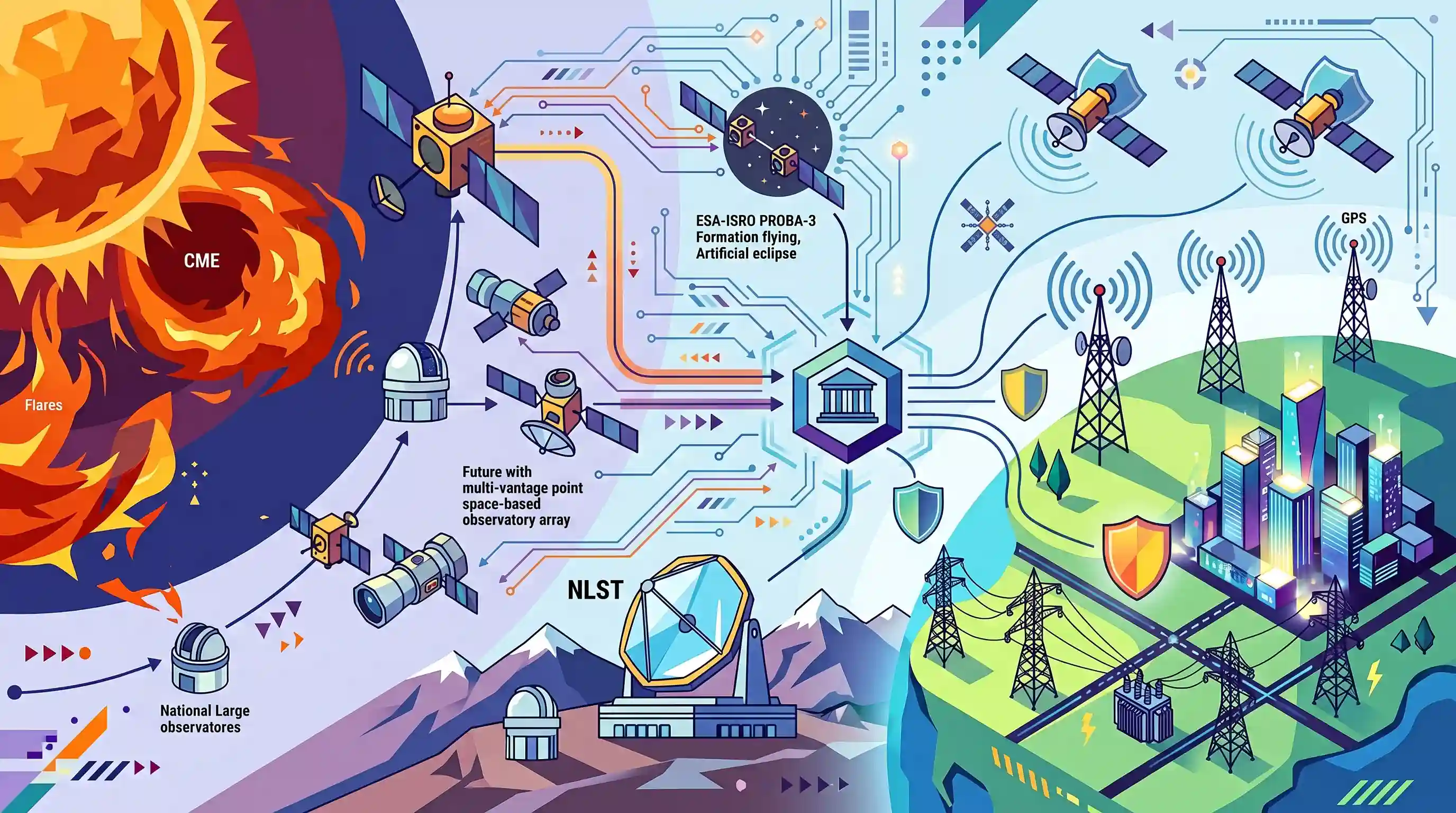
The Indian astronomy community has outlined a comprehensive strategic vision emphasizing solar physics and space weather research to safeguard modern infrastructure from extreme solar events. Building on the milestone success of the Aditya-L1 mission, the roadmap highlights the critical need for continuous, multi-vantage point monitoring of the Sun to predict Coronal Mass Ejections (CMEs) and solar flares. It advocates for new ground-based facilities, such as the National Large Solar Telescope (NLST) in Ladakh, alongside future space-based observatories and international collaborations (like the ESA-ISRO PROBA-3). This holistic approach aims to protect satellites, telecommunications, GPS networks, and power grids from debilitating space weather disruptions.
Key Points
- The Indian astronomy community's vision document emphasizes solar physics and space weather research to protect critical global infrastructure from solar storms.
- Advocates for building on the success of India's Aditya-L1 mission by deploying multi-vantage point space observatories to improve the predictive forecasting of Coronal Mass Ejections (CMEs) and solar flares.
- Highlights the importance of developing advanced ground-based infrastructure, specifically the proposed National Large Solar Telescope (NLST) at Pangong Tso, Ladakh.
- Stresses international cooperation, mirroring collaborative efforts like the ESA-ISRO PROBA-3 mission, to achieve comprehensive, continuous monitoring of the Sun's corona.
Important Terms
Aditya-L1 Mission

India's first dedicated space-based solar observatory, positioned at the Lagrange Point 1 (L1) to continuously monitor the Sun's atmosphere, solar winds, and magnetic storms without interruptions like eclipses.
UPSC context
GS Paper 3: Space Technology; crucial for understanding solar-terrestrial relations and indigenous scientific achievements.
PROBA-3 Mission
An ESA-led technology demonstration mission launched by ISRO in December 2024, using two satellites in high-precision formation flying to create an artificial solar eclipse and study the Sun's inner corona.
UPSC context
GS Paper 3: International collaboration in space and advancements in satellite formation flying technology.
National Large Solar Telescope (NLST)
A proposed 2-meter aperture ground-based solar telescope in Merak, Ladakh, designed to study the Sun's microscopic structure and magnetic fields, serving as a ground-based complement to the Aditya-L1 mission.
UPSC context
GS Paper 3: Science and Technology; development of domestic research infrastructure and observational astronomy.
Space Weather
Environmental conditions in near-Earth space, driven by solar activity like flares and Coronal Mass Ejections (CMEs), which can disrupt satellites, GPS, telecommunications, and power grids.
UPSC context
GS Paper 3: Disaster Management and S&T; GS Paper 1: Geography (Solar phenomena).
Indian Institute of Astrophysics (IIA)
An autonomous research institute under India's Department of Science and Technology, serving as the nodal agency for the NLST and a key contributor to solar physics research.
UPSC context
GS Paper 3: Scientific institutions and their role in national technology roadmaps.
Astronomical Society of India (ASI)
The primary professional body of astronomers in India, responsible for the 'Vision Document' that outlines the strategic roadmap for Indian astronomy and solar research for the next decade.
UPSC context
GS Paper 3: Institutional framework for scientific development and consensus-building in research.
Prelims Trap
"PROBA-3 is a joint solar observatory developed collaboratively by ISRO and ESA."
PROBA-3 is strictly an ESA mission. ISRO’s involvement is limited to providing the PSLV launch services, unlike NISAR which is a genuinely co-developed scientific payload.
Static Concepts Connected
What are Lagrange Points and why is L1 preferred for solar space missions?
- Gravitational equilibrium: Positions where the gravitational pull of two large masses (Earth and Sun) precisely equals the centripetal force required for a small object to move with them.
- Continuous observation: A satellite in a halo orbit around L1 (1.5 million km from Earth) has an uninterrupted, continuous view of the Sun without eclipses or planetary occultation.
Why is Ladakh chosen for ground-based astronomical observatories like NLST?
- Rain-shadow climate: Being a cold desert in the Himalayas' rain-shadow, Ladakh has extremely low atmospheric water vapor and boasts a remarkably high number of clear, cloudless nights annually.
- High-altitude thin air: The thin atmosphere at high elevations (like Pangong Tso or Hanle) significantly minimizes atmospheric turbulence, reducing optical distortion for sensitive telescopes.
Cross-Topic Patterns
Space Weather as a Terrestrial Disaster
Links GS3 Space Tech to Disaster Management. Solar flares and CMEs threaten terrestrial power grids, submarine cables, and GPS, expanding the definition of 'disaster' beyond earthly natural hazards.
Ladakh's Cold Desert Sci-Tech Ecosystem
Connects GS1 Geography to GS3 Science. The proposed NLST joins the Hanle Dark Sky Reserve and Himalayan Chandra Telescope, cementing Ladakh's cold desert topography as India's premier astro-hub.

Expect a Prelims question distinguishing CMEs from solar flares, mapped against the specific orbital advantages of Aditya-L1 and PROBA-3.
Linked PYQs · 3
Linked PYQs · 3
- 2022PrelimsGS1
If a major solar storm (solar flare) reaches the Earth, which of the following are the possible effects on the Earth? 1. GPS and navigation systems could fail. 2. Tsunamis could occur at equatorial regions. 3. Power grids could be damaged. 4. Intense auroras could occur over much of the Earth. 5. Forest fires could take place over much of the planet. 6. Orbits of the satellites could be disturbed. 7. Shortwave radio communication of the aircraft flying over polar regions could be interrupted. Select the correct answer using the code given below:
- 2025PrelimsGS1
Consider the following statements : Statement I: Scientific studies suggest that a shift is taking place in the Earth's rotation and axis. Statement II: Solar flares and associated coronal mass ejections bombarded the Earth's outermost atmosphere with tremendous amount of energy. Statement III : As the Earth's polar ice melts, the water tends to move towards the equator. Which one of the following is correct in respect of the above statements?
- 2016MainsGS3
Discuss India's achievements in the field of Space Science and Technology. How the application of this technology has helped India in its socio-economic development?
