Desert Cyclone II Military Exercise and India UAE Defence Ties
Source:The Hindu ↗
Why It Matters
Joint military exercises are frequently assessed in Prelims (matching exercise to country). For Mains, the focus on UAS and counter-UAS techniques highlights the evolving nature of modern warfare and border security challenges. Additionally, it underscores India's active military diplomacy in the Gulf region.
Summary
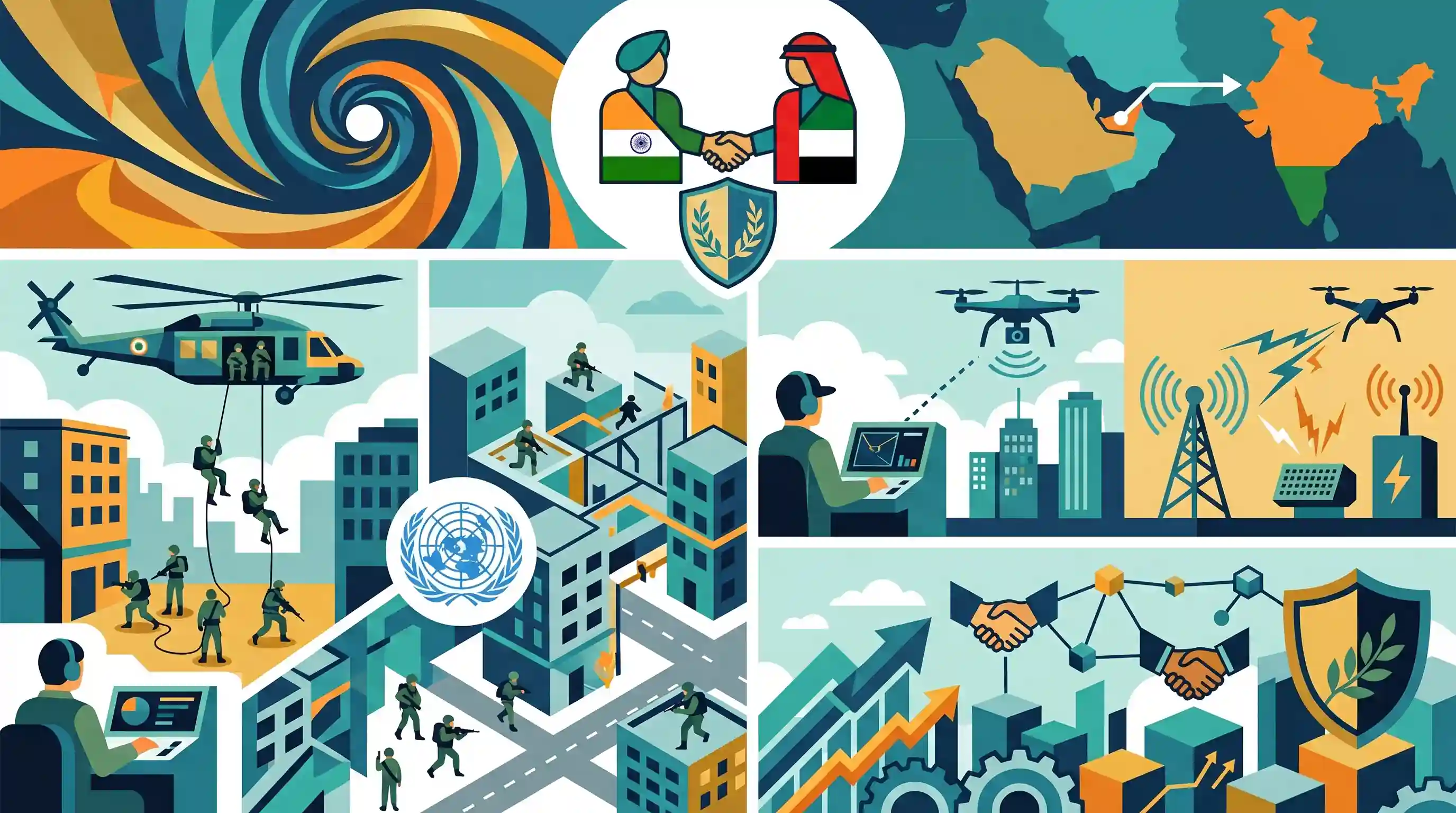
The Indian Army has dispatched a contingent to the UAE to participate in 'Desert Cyclone-II', a joint military exercise taking place in Abu Dhabi. Focusing on sub-conventional operations in urban environments under a UN mandate, the exercise will train forces in heliborne operations, Unmanned Aerial Systems (UAS), and counter-UAS tactics. This exercise is a significant step in strengthening defense cooperation and the strategic partnership between India and the UAE.
Key Points
- A 45-member Indian Army contingent is travelling to Abu Dhabi, UAE, to participate in the second edition of the joint military exercise 'Desert Cyclone-II'.
- The primary aim of the exercise is to enhance interoperability between the two armies in conducting sub-conventional operations in an urban environment under a United Nations mandate.
- Tactical focuses of the exercise include heliborne operations, the deployment of Unmanned Aerial Systems (UAS), and counter-UAS techniques for modern combat scenarios.
- The joint exercise reflects the deepening strategic partnership and military diplomacy between India and the UAE, aiming to foster regional peace and stability.
Important Terms
Desert Cyclone-II

The second edition of the bilateral joint military exercise between the Indian Army and the UAE Land Forces, focusing on urban warfare and sub-conventional operations.
UPSC context
GS Paper II: Bilateral Relations. Tests knowledge of India's strategic partnerships and military diplomacy in West Asia.
UN Mandate
Legal authorization from the UN Security Council for military actions, ensuring operations align with international law, peacekeeping standards, and civilian protection.
UPSC context
GS Paper II/III: International Institutions & Security. Tests understanding of international legal frameworks for peacekeeping and global security.
Mechanised Infantry Regiment
An elite infantry arm of the Indian Army, raised in 1979, specializing in rapid mobility and armored support across diverse terrains including urban environments.
UPSC context
GS Paper III: Internal Security/Defense. Tests awareness of Indian Army organizational structure and specialized combat capabilities.
Sub-conventional Operations
Military operations below the level of conventional war, such as counter-insurgency, counter-terrorism, and stability operations, often conducted in urban settings.
UPSC context
GS Paper III: Internal Security. Tests understanding of modern asymmetric warfare challenges and Indian military's response strategies.
Interoperability
The ability of different military forces to work together effectively using shared tactics, communication systems, and standardized procedures.
UPSC context
GS Paper III: Defense & Security. Tests knowledge of the core objective behind international joint military exercises.
UAS/Counter-UAS
Unmanned Aerial Systems (drones) and the defensive technologies used to detect, track, and neutralize them in modern combat scenarios.
UPSC context
GS Paper III: Science & Technology and Security. Tests awareness of emerging technological threats and defense innovations.
Prelims Trap
"Exercise Desert Cyclone is a joint military exercise between India and Egypt."
'Cyclone' is an Army exercise with Egypt, while 'Desert Cyclone' is with the UAE. Aspirants also confuse this with 'Desert Knight' (Air Force).
Static Concepts Connected
What distinguishes sub-conventional warfare from conventional warfare?
- Threshold: It remains below the threshold of conventional state-on-state war but exists above the level of peaceful coexistence.
- Actors: It typically involves non-state actors, insurgencies, or state-sponsored proxy wars rather than traditional uniformed militaries facing off.
- Environment: It is frequently fought in urban settings (Fighting in Built-Up Areas) requiring specialized counter-terrorism and counter-UAS tactics.
What characterizes India's Comprehensive Strategic Partnership (CSP) with the UAE?
- Core Scope: An elevated bilateral framework spanning beyond traditional energy and diaspora ties to cover defense, space, trade, and strategic convergence (signed in 2017).
- Institutional Mechanisms: Operates via high-level institutional dialogues, such as the recently upgraded Secretary-level Joint Defence Cooperation Committee (JDCC).
Cross-Topic Patterns
Gulf diplomacy + Defense indigenization
Integrating indigenous systems like the 'SAKSHAM' AI anti-drone grid in bilateral drills highlights India's broader push to showcase and export defense manufacturing capabilities to Gulf partners.
UN Mandates + Urban Warfare
Modern UN peacekeeping mandates increasingly require expertise in Fighting in Built-Up Areas (FIBUA), reflecting a global strategic shift from rural insurgencies to urban asymmetric threats.

2026 Prelims will likely feature a match-the-pair question on Middle East exercises like Cyclone, Desert Cyclone, and Sada Tanseeq.
Linked PYQs · 1
Linked PYQs · 1
- 2023MainsGS3
The use of unmanned aerial vehicles (UAVs) by our adversaries across the borders to ferry arms/ammunitions, drugs, etc., is a serious threat to the internal security. Comment on the measures being taken to tackle this threat.
