CBSE Three-Language Formula and Educational Policy Dilemma
Source:The Hindu ↗
Why It Matters
Language policy in Indian education is a complex socio-political issue. This article highlights the practical, administrative, and developmental challenges of implementing the Three-Language Formula, balancing the preservation of indigenous languages with the economic and global necessity of English and foreign languages. This is crucial for Mains questions on educational reforms, NEP 2020, and human resource development.
Summary
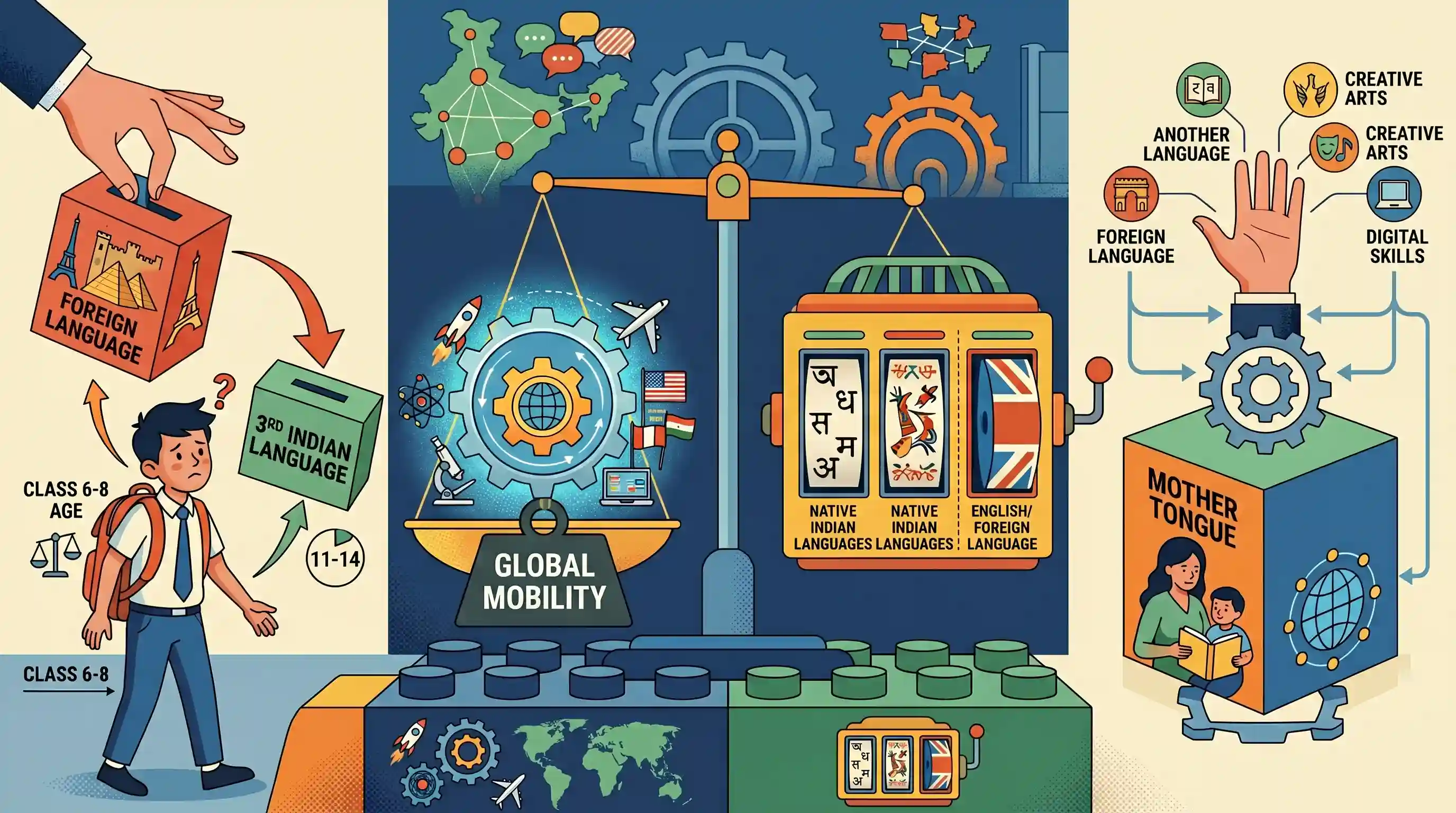
The editorial discusses the implementation of the Three-Language Formula by the Central Board of Secondary Education (CBSE) under the National Education Policy (NEP) 2020. It critiques the policy's inherent contradiction: while NEP 2020 acknowledges the global significance of English for STEM and global mobility, its language formula requires two native Indian languages, placing English on par with foreign languages. This led to a controversy when CBSE ordered middle-school students to drop foreign languages or adopt a third Indian language. Although CBSE temporarily relaxed this for senior classes, it intends to proceed with the policy from Class 6. The article suggests a pragmatic model—focusing on the mother tongue and English, while allowing students to choose a third language based on interest and school resources.
Key Points
- The article critiques CBSE's implementation of the National Education Policy (NEP) 2020's Three-Language Formula, highlighting an internal contradiction in the policy regarding English and foreign languages.
- While NEP 2020 recognizes the critical importance of English in STEM and legal education (promoting bilingual textbooks with the mother tongue), its Three-Language Formula mandates that two of the three languages must be native 'Bharatiya' languages, effectively treating English as a foreign language.
- CBSE's initial directive forced middle school students (Classes 7-9) who were studying English and a foreign language (like French or Spanish) to drop the foreign language or study a third Indian language, risking their academic performance and rendering school foreign-language resources redundant.
- Following public backlash, CBSE offered a temporary relaxation by exempting the third language from Class 10 testing for existing senior batches, but it plans to proceed with the dual-native language requirement starting from Class 6.
- The editorial argues that rigid language mandates hinder global mobility and employability (which NEP itself aims to promote through languages like German or Japanese). It advocates for a pragmatic approach: teaching the mother tongue and English, while offering a third language of choice based on student preference and resource availability.
Important Terms
National Education Policy (NEP) 2020

A comprehensive policy framework launched in 2020 to overhaul India's education system, aiming to make it holistic, multidisciplinary, and aligned with global standards from primary to higher education.
UPSC context
GS Paper II: Government policies and interventions; issues relating to development and management of Social Sector/Services relating to Education.
Three-Language Formula
A language education policy first proposed in 1968 and retained in NEP 2020, mandating that school students learn three languages, with at least two being native Indian languages.
UPSC context
GS Paper II: Federalism and linguistic diversity; GS Paper I: Issues of regionalism and national integration.
Central Board of Secondary Education (CBSE)
A national-level board of education in India for public and private schools, controlled and managed by the Central Government, responsible for secondary and senior secondary school examinations.
UPSC context
GS Paper II: Statutory, regulatory and various quasi-judicial bodies; policy implementation and governance in education.
Prelims Trap
Article 350A, safeguarding instruction in the mother tongue at the primary stage, was part of the original 1950 Constitution.
It was actually inserted by the 7th Constitutional Amendment Act of 1956, following the recommendations of the States Reorganisation Commission.
Static Concepts Connected
What are the primary constitutional provisions safeguarding linguistic rights in India?
- Article 350A: Mandates states to provide adequate facilities for mother-tongue instruction at the primary level to linguistic minority children (added by 7th CAA, 1956).
- Article 350B: Provides for a Special Officer for Linguistic Minorities appointed by the President to investigate and report on constitutional safeguards.
- Article 29(1): Grants any section of citizens residing in India the right to conserve their distinct language, script, or culture.
What is the origin and structure of the Three-Language Formula?
- Origin: First recommended by the Kothari Commission (1964-66) and formally incorporated into the National Policy on Education, 1968, to foster national integration.
- Classic Structure: In Hindi-speaking states, it includes Hindi, English, and a modern Indian language; in non-Hindi-speaking states, it includes the regional language, Hindi, and English.
- NEP 2020 / NCF-SE 2023: Mandates three languages, with at least two being native Indian ('Bhartiya') languages, which structurally restricts pairing English with a foreign language.
Cross-Topic Patterns
Linguistic Federalism vs Central Mandates
Frictions between regional language policies (e.g., Tamil Nadu's two-language model) and central mandates (NEP) highlight ongoing federal tensions under the Concurrent List.
Language Education and Global Economic Mobility
Restricting early foreign-language access in schools directly conflicts with India's economic diplomacy and bilateral mobility partnerships with non-English corridors like Japan and Germany.

Constitutional status of English, Article 350A's origin, and Eighth Schedule amendments will likely form a high-yield Prelims 2026 question.
Linked PYQs · 2
Linked PYQs · 2
- 2020MainsGS2
National Education Policy 2020 is in conformity with the Sustainable Development Goal-4 (2030). It intends to restructure and reorient education system in India. Critically examine the statement.
- 2018PrelimsGS1
Regarding Wood's Dispatch, which of the following statements are true? 1. Grants-in-Aid system was introduced. 2. Establishment of universities was recommended. 3. English as a medium of instruction at all levels of education was recommended. Select the correct answer using the code given below:
